You can buy disused warehouses at 20–40% basis discounts versus stabilized comps, but you’ll only earn that upside if you price risks early. Verify zoning and change-of-use timelines, run Phase I (and Phase II if triggered), and flag asbestos. Confirm utilities (three-phase power, water, sewer, fiber) and inspect the roof, slab, loading, and truck court against tenant specs. Budget refurb at $40–$110/SF or redevelopment at $140–$260/SF plus contingencies. Next, you’ll see how to match upgrades to today’s highest-rent tenants.
Key Takeaways
- Run rigorous due diligence: zoning, utilities, access, roof/slab, and title; price upgrades and conditional-use timelines before closing.
- Manage environmental risk early: Phase I/II triggers, asbestos testing, cleanup scope, and escrow needs can change pricing and schedules.
- Find mispricing by comparing asking price to replacement cost and stabilized comps; discounts of 20–40% may exist after capex.
- Capture upside by converting to higher-rent uses like last-mile, studios, self-storage, labs, or food production, often earning 30–100% premiums.
- Underwrite tenant demand and location: clear heights, docks, power, highway access, labor shed, and nuisance neighbors drive lease-up speed and exit value.
Disused Warehouse Investing: Quick Viability Checklist

Before you spend money on surveys or architects, run a quick viability check that screens out warehouses with deal-breaking constraints. Verify zoning and permitted use; confirm any conditional-use timeline. Pull flood, wildfire, and contamination maps; if Phase I red flags appear, price Phase II.
Check utilities: three-phase power, water pressure, sewer capacity, and fiber; quantify upgrade costs per linear foot. Measure clear height, column spacing, floor load rating, dock count, and truck court depth against your target tenant specs.
Review title for easements, access rights, and encroachments. Assess roof age, drainage, and envelope integrity with photos and repair quotes. Flag Historical significance early; landmark status can restrict alterations and create Preservation challenges that add months and compliance costs.
Confirm insurance availability and premiums.
Why Disused Warehouses Can Outperform Priced-In Assets
You can outperform priced-in assets because disused warehouses often trade on headline vacancy, not on replacement cost, zoning flexibility, or the value of existing slab, clear heights, and power capacity.
When you quantify capex-to-stabilized NOI and compare it to local comp rents and exit cap rates, you’ll often spot mispricing and hidden value the market hasn’t modeled.
You also create adaptive-reuse upside by converting to last-mile, light industrial, self-storage, or creative mixed-use—so your returns come from re-rating and income growth, not just market appreciation.
Mispricing And Hidden Value
Although prime logistics assets often trade at tight cap rates with every assumption already baked in, disused warehouses can still sit in the “too hard” pile where pricing lags reality. That gap creates Market mispricing you can quantify: compare replacement cost per square foot to asking price, then stress-test lease-up at conservative rents and longer downtime. You’ll often find basis discounts of 20–40% versus stabilized comps, even after budgeting for roof, slab, and electrical upgrades.
To surface Hidden potential, you should audit truck courts, clear heights, column spacing, power capacity, and zoning constraints, then map them against tenant demand within a 30–60 minute drive time.
When those fundamentals check out, you’re buying cash-flow optionality that the market hasn’t fully priced.
Adaptive Reuse Upside
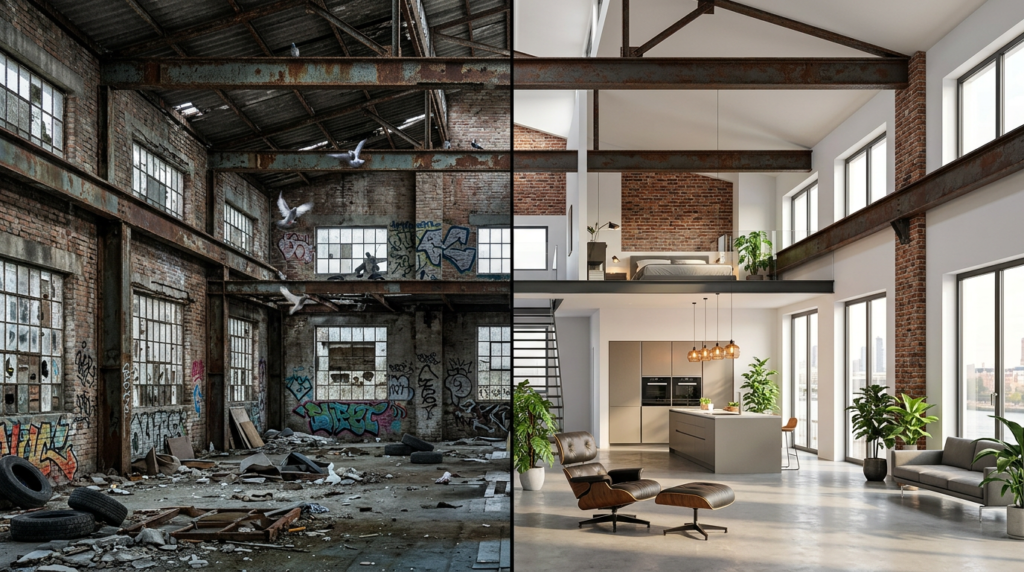
When traditional logistics deals price in every basis point of yield compression, adaptive reuse is where disused warehouses can still generate outsized returns by changing the revenue model, not just the tenant. You release value by converting low-rent bulk space into higher-margin uses—last-mile micro-fulfillment, studios, self-storage, labs, or food production—where rents and turnover scale with services.
Underwrite capex, permitting, and time-to-stabilization, then quantify rent lifts versus comparable converted assets, not “as-is” sheds. Historical preservation can also widen your buyer pool through grants and faster community approvals, improving exit liquidity.
You’ll often cut Environmental impact by reusing the structure and minimizing embodied carbon, which can lower financing spreads.
- Target uses with 30–100% rent premiums
- Model phased leasing to reduce vacancy drag
- Capture incentives, abatements, and preservation credits
- Validate power, egress, and loading constraints early
Demand Signals: Who Wants These Warehouses Now?
You’ll see the strongest demand signals from e-commerce logistics tenants that need last-mile space with clear heights, truck access, and proximity to dense ZIP codes where delivery times tighten.
You can also track growing absorption from creative and light industrial users—makers, studios, micro-fulfillment, and repair operations—that prioritize flexible floor plates, reliable power, and lower rents over Class A finishes.
If you map recent lease comps, tenant mix, and vacancy by submarket, you’ll quickly identify which buyer pool will bid and how to underwrite re-tenanting speed.
E-Commerce Logistics Tenants
As e-commerce delivery windows keep shrinking, the tenants driving demand for disused warehouses look less like traditional retailers and more like logistics operators optimizing last-mile speed. You’ll see 3PLs, parcel integrators, and dark-store grocers paying premiums for infill sites within 5–10 miles of dense ZIP codes, where minutes cut failed-delivery rates and returns costs.
You can position assets by balancing Historical preservation with retrofits that reduce Environmental impact and keep approvals moving.
- Target tenants needing cross-dock layouts, 24/7 access, and secure yards
- Verify power (480V), clear heights, and sprinkler capacity for automation
- Model throughput: dock doors per 10,000 sq ft and trailer turns/day
- Quantify ESG wins: reuse embodied carbon, add LEDs, insulation, heat pumps
Creative And Light Industrial
Although e-commerce grabs headlines, much of today’s absorption in older, well-located warehouses comes from creative and light-industrial users—maker brands, contract manufacturers, food producers, studios, R&D labs, and trade contractors—who need 5,000–50,000 sq ft near talent and customers, not 300,000 sq ft at the exurbs.
You’ll spot demand when inbound utilities are strong (200–800A power, gas, floor drains), loading is flexible (1–3 docks plus drive-in), and zoning allows production-plus-showroom.
These tenants pay for reliability: Climate control for CNC, fermentation, or content gear, and Warehouse security for higher-value inventory and tools.
Track signals like rising small-bay leasing, longer terms (3–7 years), and higher TI requests for offices, clean rooms, and demo areas.
Location Basics: Access, Labor, Neighbors, Comps
If a disused warehouse’s location can’t support efficient access, reliable labor, and compatible neighbors, the numbers won’t pencil out no matter how cheap the purchase looks.
Start with drive-time and freight logic: you want highway ramps within 10 minutes, truck-legal routes, and predictable congestion.
Then verify labor: map 30-minute commute sheds, compare wages for forklift and light assembly roles, and check local training pipelines.
Screen neighbors for nuisance risk—noise, hours, odors, and hazardous users can trigger complaints or permitting friction.
Finally, run comps: recent lease rates, concessions, absorption, and cap rates by submarket, adjusting for Historical significance and Architectural style that may lift rents or add restrictions.
Use this checklist:
- Access metrics
- Labor depth
- Neighbor fit
- Comp quality
What to Inspect First: Roof, Slab, Loading, Power
Because hidden building failures can erase your projected yield faster than vacancy ever will, you should inspect the roof, slab, loading system, and electrical capacity before you spend time polishing the pro forma.
Start on the roof: measure membrane age, verify drainage slopes, and check prior patch density; a $8–$15/sf replacement can crush year-one NOI.
Move to the slab: confirm thickness, joint condition, and flatness/levelness (FF/FL) against intended racking; repairs and grinding add weeks.
Evaluate loading: count dock-high doors, apron depth, and leveler ratings; missing capacity limits tenant mix and raises capex.
Finally, verify power: panel amps, transformer size, and 3-phase availability; upgrades drive permitting time and Environmental impact.
Note any Historical significance that constrains alterations.
Asbestos and Contamination Risks to Check
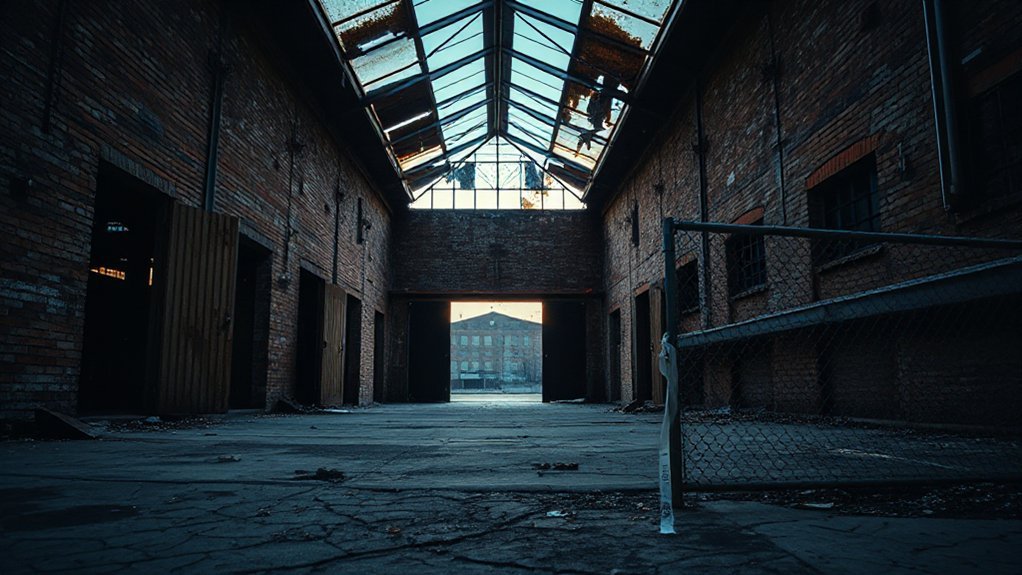
After you’ve confirmed the building’s roof, slab, loading, and power won’t blow up your budget, focus on environmental liabilities that can halt leasing and financing overnight. Start with documented contamination assessments (Phase I, then Phase II if triggered) so you can quantify cleanup scope, timelines, and escrow needs.
In older warehouses, Asbestos hazards often hide in pipe lagging, sprayed fireproofing, floor tiles, and roofing felt; one disturbed area can force abatement, air monitoring, and shutdowns. Pull prior industrial-use records and test systematically so you’re not guessing. Require lab results, chain-of-custody, and a consultant’s risk memo before you set your offer price.
- Review hazardous materials survey and asbestos register
- Order soil/groundwater sampling near drains and sumps
- Check for lead paint, PCBs, and petroleum staining
- Budget abatement, disposal, and clearance testing upfront
Planning and Zoning: Change-of-Use Dealbreakers
While the numbers can pencil out on rent and capex, planning and zoning can still kill a warehouse deal the moment you try to change how it’s used. Start by pulling the zoning map, permitted-use table, and any overlay districts; don’t rely on broker summaries.
If you need a variance or conditional use permit, ask planners for median approval timelines, appeal rates, and typical conditions (parking ratios, loading, noise, hours). Verify access: curb cuts, truck routes, fire lanes, and stormwater rules can block intensification.
Check whether the site triggers historical preservation review; that can limit façade changes, windows, or signage, and add public-hearing risk. Price in zoning challenges with a go/no-go checklist before you close.
Refurb Costs vs Redevelopment Costs (With Contingencies)
Even if your pro forma shows strong rent growth, the choice between refurb and redevelopment usually comes down to what you can fix for $/SF versus what you can’t fix at any price. Start by benchmarking hard costs: refurb often runs $40–$110/SF; full redevelopment commonly lands $140–$260/SF, before sitework and utilities.
Then add contingencies tied to unknowns: 10–15% for refurb, 15–25% for redevelopment, higher with hidden corrosion or undocumented fills. If the building has Historical significance, preservation-driven scopes can raise MEP and envelope costs but reduce demolition scope and environmental impact.
- Roof, slab, and column capacity test results
- Hazardous materials survey and remediation allowances
- MEP replacement vs upgrade scope by system
- Schedule-driven general conditions and escalation assumptions
Financing and Exits: Bridge, Lease-Up, and Resale Paths
Because capital markets price uncertainty, you’ll usually finance a disused warehouse in phases—bridge the acquisition and construction risk, then refinance or sell once you’ve proven cash flow.
Your bridge loan should match the critical path: 12–24 months, interest reserve sized to delays, and covenants tied to permits and contractor milestones.
Use Market analysis to underwrite lease-up: target rents vs comps, absorption pace, and tenant improvement costs; stress vacancy at 10–20% and exit cap-rate expansion of 50–100 bps.
As NOI stabilizes (typically 85–90% occupied for 3–6 months), you can pursue permanent debt or a cash-out refi.
For resale, pick an exit buyer profile early—core, value-add, or owner-user—and align Financing strategies and lease terms to that demand.
Frequently Asked Questions
How Do Insurance Premiums Change for Vacant or Partially Occupied Warehouses?
Insurance costs usually rise when your warehouse sits vacant or partially occupied, because insurers price higher fire, theft, and vandalism risk. Vacancy impact can trigger 10–50% surcharges, shorter terms, higher deductibles, and stricter inspections.
What Tax Incentives or Grants Apply to Brownfield Warehouse Conversions?
You’ll often qualify for federal/state brownfield tax credits, cleanup grants, and local property-tax abatements—look before you leap. Prioritize Environmental remediation deductions and heritage preservation credits; verify eligibility, match-funding ratios, and compliance reporting timelines.
How Long Does a Typical Warehouse Retrofit Take From Close to Occupancy?
You’ll typically need 6–18 months from close to occupancy. Renovation timelines hinge on permitting (2–6 months), design (1–3), build-out (3–9). Construction challenges—structural repairs, utilities upgrades, environmental remediation—often add 1–4 months.
Should I Use an LLC or SPV Structure for Warehouse Acquisitions?
You shouldn’t assume an LLC’s always best; you’ll often pick an SPV to isolate risk per deal. Compare Ownership structures and Legal considerations: liability ring-fencing, lender preferences, tax reporting, exit flexibility, investor governance.
How Do I Negotiate Seller Credits for Unknown Defects Discovered Post-Offer?
You negotiate seller credits by tying them to inspection findings: document costs, set a credit schedule, and require defect disclosure. In seller negotiation, use repair bids, cap liability, extend diligence, and add re-trade triggers.
Conclusion
You’re buying more than a shell—you’re buying a sleeping engine. If your checklist shows roof life, slab flatness, dock count, and 3‑phase power pencil out, you’ve found torque the market hasn’t priced in. But ignore asbestos, soil flags, or zoning friction, and the engine seizes fast—delays, change orders, and 20–40% contingency burn. Treat bridge debt like fuel, lease‑up like ignition, and your exit like the odometer: plan the miles before you start.