

You can usually beat HMO returns by repositioning a former hotel into serviced studios/aparthotel units, PBSA, or a clinic-led wellbeing hub, depending on local payer demand and floorplate constraints. Start by validating demand (employers, councils, NHS placements, universities) and stress-test ADR, occupancy, and operating costs. Confirm planning use class, Article 4, conservation/listing limits, and licensing triggers, then align fire strategy, means of escape, accessibility, and space standards. Next you’ll see how to budget, partner, and split uses efficiently.
Key Takeaways
- Convert to serviced apartments for corporate and contractor stays, leveraging existing en-suites while optimizing layouts for efficient housekeeping and storage.
- Reposition as short-stay supported accommodation via local authority or NHS placements, aligning eligibility, referrals, licensing, and robust fire strategy.
- Create key-worker housing through block bookings with employers, using rate cards, guarantees, and staged invoicing to stabilize occupancy and cashflow.
- Develop a hybrid model: ground-floor amenity or clinic space with upper-floor rooms, using demand signals and travel-shed sizing to validate volumes.
- Undertake a residential conversion to self-contained flats where viable, checking daylighting, structural grid, planning constraints, and building control requirements.
Is This Hotel a Good Conversion Candidate?

Although not every underperforming hotel will pencil out as an alternative to an HMO, you can quickly determine conversion viability by testing the asset’s physical configuration, planning constraints, and unit economics against your target residential model.
Start with net-to-gross efficiency: corridor depth, structural grid, and window-to-floor ratios must support compliant unit layouts and daylighting. Verify floor-to-floor heights for services distribution, acoustic separation, and sprinklers. Assess vertical circulation and fire strategy; you’ll need adequate stairs, compartmentation, and refuge where required.
Then stress-test costs: façade upgrades, MEP replacement, and remediation can erase margin. Planning risk matters: conservation status, Hotel aesthetics, and historical significance may restrict alterations, but can also support value via retention and tax relief. If constraints align, you’ve got a credible candidate.
Start With Demand: Who Will Pay to Use It?
You should start by identifying which user segments will pay for the offer—such as key workers, corporate contractors, students, or short-stay professionals—and what price points they’ll accept.
You then quantify local market demand using occupancy proxies, competitor rate surveys, employer pipeline data, and transport-linked catchment analysis.
Finally, you validate revenue potential by stress-testing achievable ADR, utilisation, and operating costs to confirm the model’s net yield beats an HMO.
Identify Paying User Segments
Three paying segments typically fund alternatives to HMOs: employers seeking predictable per-member costs and faster access (e.g., self-funded plans using direct primary care).
Households purchasing subscription-based primary care aim to reduce out-of-pocket volatility and improve continuity.
Providers or clinics adopting value-based care enablers seek to stabilize revenue while meeting quality and utilization targets.
You should segment each by user demographics and payment preferences: employer size, industry risk, turnover, and benefits maturity; household age mix, chronic burden, and income stability; and provider panel composition, payer mix, and contracting readiness.
You’ll then align each segment to a defined product: bundled primary care, extended-hours access, care navigation, or remote monitoring.
Specify who signs the contract, billing cadence (PM/PM, subscription, shared savings), and required utilization guarantees.
Measure Local Market Demand
After you’ve defined which employers, households, and provider organizations can fund an HMO alternative—and how they’ll pay—validate whether enough of them exist in a specific geography to support launch economics.
Start by sizing the addressable population within a 15–30 minute travel shed, then segment it by payer type, risk profile, and utilization patterns using census, claims proxies, and employer density data.
Assess Market saturation by mapping existing primary care panels, urgent care volumes, and specialty access constraints.
Run competitor analysis on retail clinics, FQHCs, concierge practices, and health systems’ outpatient footprints, focusing on capacity, wait times, and referral leakage.
Validate demand signals through employer RFP inquiries, provider partnership interest, and patient search intent.
Use scenario-based volumes to test staffing and space requirements without projecting prices or margins.
Validate Revenue Potential
Once local demand looks sufficient, validate revenue potential by identifying exactly which buyer segments will reliably pay for the HMO alternative and under what procurement constraints. Map segments such as NHS step-down placements, local authority temporary accommodation, key-worker lets, contractors, and short-stay corporate crews.
Then confirm eligibility rules, referral pathways, framework access, and payment terms. Convert your market analysis into a rate card and occupancy model, testing achievable ADR, void tolerance, and service-cost recovery.
Secure written expressions of interest, not informal praise, and run sensitivity scenarios against caps, inflation, and commissioning cycles.
Structure revenue diversification by layering contracted income (block bookings) with discretionary income (nightly stays, co-working, events), while ring-fencing compliance, staffing, and safeguarding obligations.
Only proceed once margin and cashflow remain robust under downside assumptions.
Planning First: Use Class, Article 4, Licensing
Before you commit to any alternative to an HMO model, you’ll need to map the planning framework that governs lawful occupation and day-to-day management.
Confirm the lawful use class and whether your intended operation constitutes a material change of use, triggering a planning application.
Check if the site sits within an Article 4 Direction area, which can remove permitted development rights and require explicit consent for conversions or intensified occupation.
If the building is listed or in a conservation area, align proposals with Historic preservation duties and secure listed building consent where applicable.
Establish whether the council will treat the scheme as licensable (mandatory, additional, or selective licensing), and design management controls accordingly.
Document fire safety strategy, refuse storage, amenity standards, and Environmental sustainability measures to support compliance decisions.
Budget and Timeline: What Conversions Really Cost
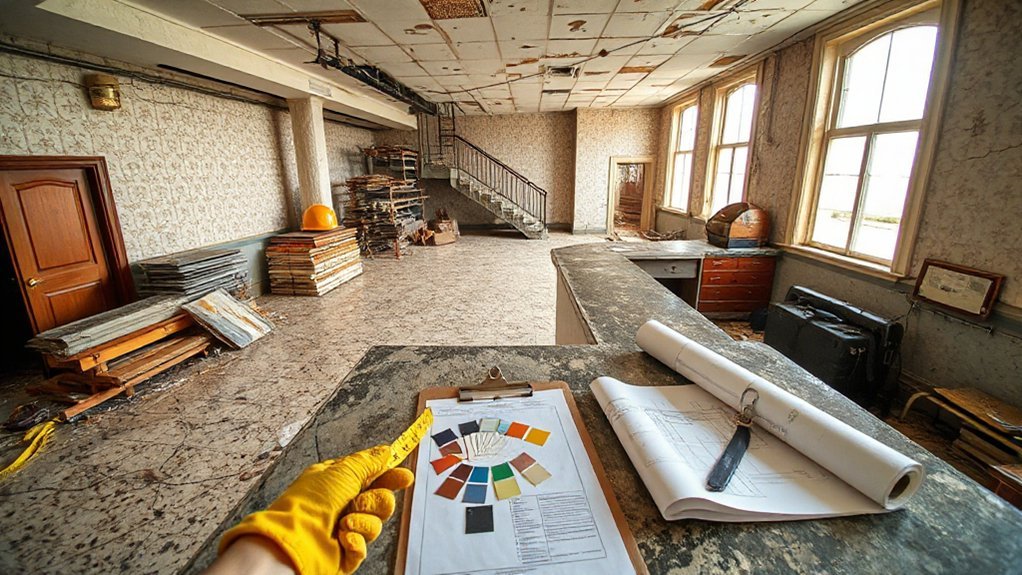
With the planning position and licensing route confirmed, you can price the conversion and set a realistic programme based on the specific use you’re creating. Start with measured surveys, intrusive investigations, and an M&E condition report, then build a cost plan with RICS NRM2.
Your Budget planning should separate base build, compliance upgrades (fire strategy, means of escape, compartmentation), accessibility works, and contingency for latent defects. Allow for utilities capacity checks, drainage CCTV surveys, and acoustic testing where layouts change.
For Timeline management, programme design, statutory approvals, procurement, enabling works, and commissioning, not just construction. You’ll lose time on asbestos discovery, structural alterations, lead-in for switchgear, and certification sign-off.
Use a critical path schedule and freeze scope early.
Pick Your Operating Model: Run, Lease, or Partner
Although your planning use and cost envelope might be fixed, the operating model you choose will still dictate the risk profile, staffing requirements, compliance burden, and ultimately the valuation of the asset.
If you self-operate, you’ll control hotel branding, SOPs, and the guest experience, but you’ll also carry payroll, procurement, H&S management, and day-to-day cashflow volatility.
A lease shifts operating risk to a tenant, stabilises income, and reduces staffing exposure, yet you’ll accept lower upside and tighter covenant scrutiny, plus capex and dilapidations negotiations.
A management or joint-venture partner can bring systems, distribution capability, and audited reporting; however, you must manage agency risk through KPIs, fee structures, termination rights, and performance tests.
Align model choice with lender covenants, insurance terms, and exit strategy.
Alternative to HMOs: Reopen as Short-Stay Lodging
If your HMO no longer pencils under current licensing, management overhead, or tenant-risk assumptions, repositioning the building as short-stay lodging can open a different regulatory pathway and revenue profile.
You’ll need to confirm planning use class, fire strategy, and building-control compliance, then model ADR, occupancy, and channel costs against staffing and linen turns.
Optimise layouts for housekeeping efficiency, secure storage, and durable finishes, and specify Luxury amenities that support rate premiums without inflating maintenance.
Implement sustainability strategies—heat-pump retrofits, LED and BMS controls, low-flow fixtures, and waste-stream segregation—to reduce utilities and improve guest appeal.
Tighten operating procedures: dynamic pricing, deposit and ID controls, noise monitoring, and incident response.
Finally, align marketing with demand generators and seasonality to stabilise cashflow.
Alternative to HMOs: Aparthotel or Serviced Flats
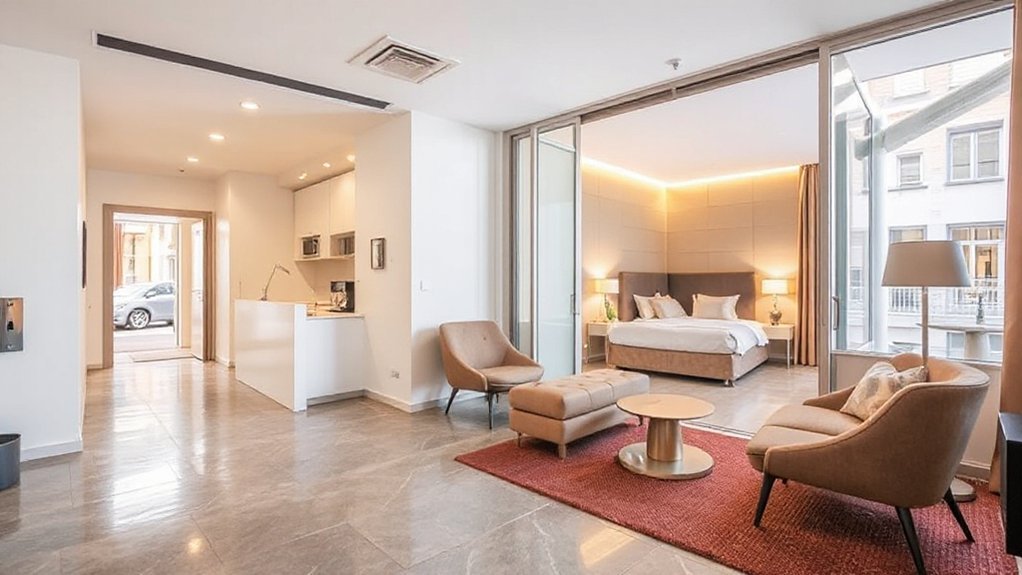
If you convert an HMO into an aparthotel or serviced flats scheme, you’ll operate self-contained units under a short-to-medium stay accommodation model with hotel-grade amenities and housekeeping.
You must align the proposal with planning use class, building control, fire strategy, and any local licensing or change-of-use requirements before you trade.
Profitability then hinges on ADR and occupancy management, channel distribution, staffing ratios, utilities control, and preventative maintenance that protects asset condition and guest ratings.
Aparthotel Model Basics
When you want HMO-level income without managing multiple sharers under one AST, the aparthotel (serviced flats) model packages self-contained units with hotel-style operations. You reconfigure the building into studio or one-bed units, each with kitchenette, private bathroom, metered utilities, and durable finishes to reduce lifecycle costs.
This aligns with Hospitality evolution: guests expect privacy plus flexible stay lengths, and you can price dynamically by night, week, or month.
You run it as an operating business, not a passive let. You’ll need front-of-house processes, housekeeping schedules, linen logistics, maintenance response times, and channel management across OTAs and direct bookings.
Strong Apartment design supports efficient cleaning routes, acoustic separation, storage, and fire-compartment integrity. Track RevPAR, occupancy, and cost per occupied room to optimise margins.
Planning And Licensing Needs
Although serviced flats can outperform an HMO on yield, you’ll only bank that upside after you’ve mapped the planning route and licensing stack, because councils often treat aparthotels as a distinct use class with tighter operational controls. Confirm the lawful use and whether you need change-of-use consent, conditions discharge, or a new planning application for self-contained units, signage, or intensified visitor turnover.
Check local plan policies, Article 4 Directions, and any CIL implications before you commit capital. You’ll also need Regulatory compliance on building regulations, fire strategy, accessibility, waste, and environmental health standards; document compartmentation, alarm category, and evacuation assumptions.
Where alcohol, late-hours reception, or public areas exist, assess premises licensing impacts. Prioritise community engagement through pre-app discussions, neighbour consultation, and a clear management plan to mitigate objections.
Operations And Profit Drivers
Once you’ve secured the correct planning and licensing position, the operational model determines whether an aparthotel or serviced flats outperform an HMO in practice. You’ll drive yield through dynamic pricing, minimum-stay rules, and channel management across OTAs, corporate agreements, and direct bookings.
For serviced flats, you’ll prioritise longer stays, tighter void control, and lower labour intensity, but you must maintain consistent housekeeping standards and rapid defect response to protect reviews and renewal rates. You should structure staffing around occupancy bands, outsource linens and laundry, and implement SOPs, SLAs, and preventive maintenance to reduce downtime.
Market diversification across leisure, corporate, and relocation segments supports revenue stabilization, while ancillary income from parking, pet fees, and late checkout improves gross operating profit.
Alternative to HMOs: Contractor and Corporate Lets
While you may want to avoid the regulatory intensity and operational churn of an HMO, contractor and corporate lets offer a structured alternative by leasing to businesses (or relocation agents) rather than individual room-by-room tenants. You’ll typically grant a fixed-term lease or serviced accommodation agreement with defined occupancy caps, cleaning schedules, and performance KPIs, improving income predictability and reducing void risk.
You can leverage your hotel history and architectural features to support premium positioning: retained reception areas, ensuite layouts, lift access, and back-of-house circulation streamline changeovers and compliance. Specify furnishing standards, linen cycles, Wi-Fi SLAs, and parking allocations, then price on a per-unit, per-night, or block-booked basis.
You’ll also harden credit control through corporate guarantees, deposit structures, and staged invoicing, protecting cashflow.
Alternative to HMOs: Co-Living Without HMO Issues
Corporate and contractor lets reduce tenant-management friction by contracting with a single counterparty, but you can also capture co-living demand without inheriting classic HMO complexity by structuring the asset as self-contained micro-units with shared amenities.
You’ll reconfigure bedrooms into studios with en-suites and kitchenette pods, then operate under assured shorthold tenancies or licences for separate dwellings, reducing HMO licensing triggers.
You can centralise services via a building-wide M&E spine, sub-meter utilities, and implement access control, CCTV, and a digital concierge to manage compliance.
Specify Eco friendly materials for fire-rated partitions, acoustic separation, and low-VOC finishes, and document heritage preservation through reversible interventions, retained façades, and sensitive common-area upgrades.
You’ll monetise shared lounges, laundry, and co-working while keeping occupier turnover manageable.
Alternative to HMOs: Supported Housing (Commissioned)
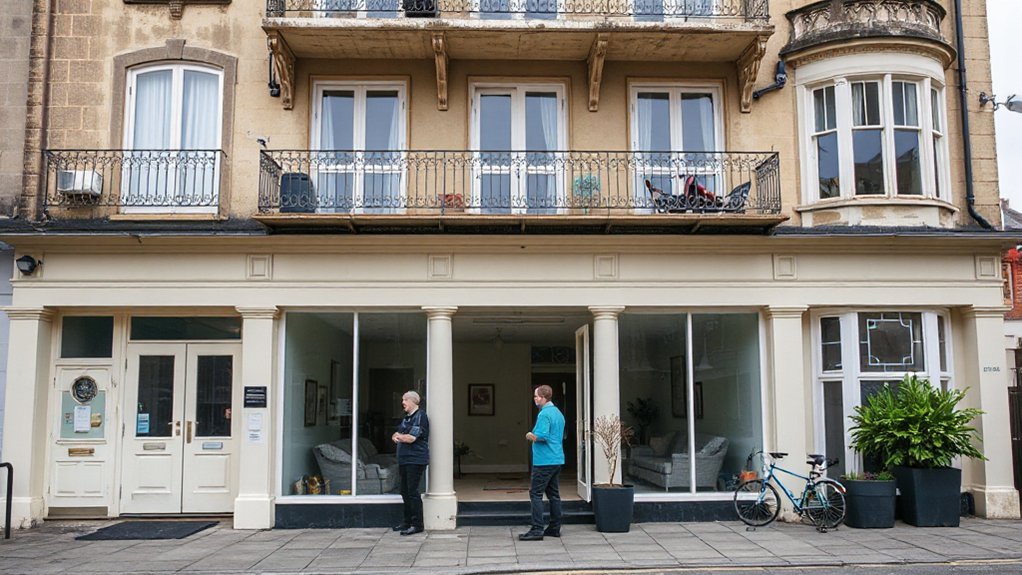
How do you capture high, resilient occupancy without stepping into full HMO licensing and day-to-day multi-tenant management? You can reposition a former hotel as commissioned supported housing, contracting with a local authority or registered provider under a lease-plus-service model.
You’ll deliver self-contained studios or clustered rooms with defined support specifications, referrals, and nomination rights, stabilising voids and arrears. You must evidence compliance: fire risk assessment, safeguarding protocols, infection control, EPC targets, and robust management plans aligned to CQC-adjacent expectations where applicable.
Structure the deal with clear KPIs, step-in rights, and index-linked rent. Use luxury branding to differentiate fit-out quality while keeping operations professional, and apply marketing strategies to win tenders, demonstrate outcomes, and secure repeat commissioning across portfolios.
Alternative to HMOs: Homelessness and Move-On Units
Commissioned supported housing suits longer-term placements with defined support outcomes, but you can also secure resilient occupancy by positioning a former hotel as homelessness accommodation and move-on units under local authority referral pathways. You’ll align with Part VII duties, set nomination rights, and agree service specifications covering safeguarding, anti-social behaviour management, and void turnaround.
Structure the building into short-stay assessment rooms and self-contained move-on studios, using clear eligibility criteria and step-down pathways to reduce repeat presentations. You’ll need compliant fire strategy, robust management plans, and data-sharing protocols.
Retain durable Hotel decor only where it supports easy cleaning and ligature risk controls, and address Historic preservation through listed-building consents and sympathetic M&E upgrades. Price via nightly-paid or block-booked models with transparent performance reporting and audit trails.
Alternative to HMOs: Key-Worker Housing Partnerships
Where can you secure stable occupancy without replicating HMO management intensity? You can position a former hotel as key-worker housing through Affordable partnerships with NHS trusts, councils, universities, and blue-light services.
You’ll negotiate nomination rights, rent-setting formulas, and service-level agreements so demand stays predictable and voids stay low. Structure contracts as block-booking or headlease arrangements to transfer day-to-day allocation and arrears management to the partner.
You must map building use to Regulatory frameworks, including planning use class, minimum space standards, fire strategy, and licensing triggers, then document compliance in a management plan.
Specify eligibility criteria, length-of-stay parameters, and safeguarding escalation routes.
You’ll also budget for light-touch concierge, repairs response times, and data-sharing protocols to support auditability.
Alternative to HMOs: Senior and Assisted Living
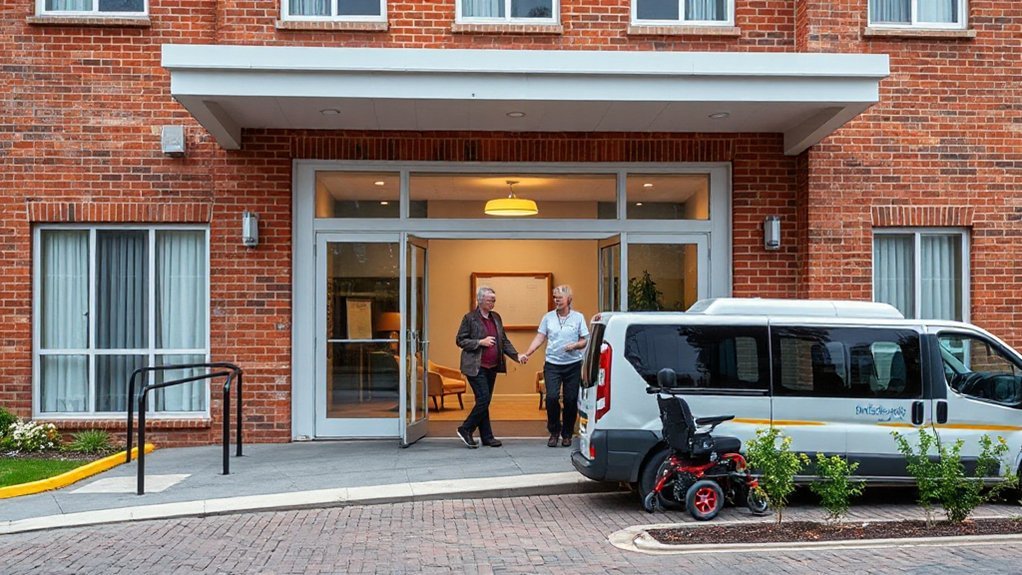
Although you may want HMO-level yields, senior and assisted living can deliver stable occupancy in a former hotel with fewer unit-by-unit management touchpoints by consolidating demand around care needs and predictable length-of-stay.
You’ll need to re-spec layouts for mobility: widen corridors, convert bathrooms to wet rooms, and add nurse-call, access control, and resilient power.
Build a clinical governance framework covering medication management, safeguarding, and incident reporting, then align staffing ratios and subcontracted therapies to your acuity model.
For a Senior focus, you can programme communal dining and activity space to improve retention and reduce void risk.
In Assisted living, you’ll price services separately from rent, ringfence CAPEX for fire-compartmentation, and guarantee CQC-aligned policies, audits, and training.
Alternative to HMOs: Student Housing or Education
How else can you achieve HMO-style cashflow without managing dozens of individual ASTs? Convert the former hotel into purpose-built student accommodation, letting on a block contract to a university, nomination partner, or specialist operator. You’ll replace fragmented tenancies with a single commercial lease, indexed rent reviews, and clearer covenant assessment.
Configure en-suites, shared kitchens, study areas, and compliant fire strategy (BS 9999, FD30S, detection, compartmentation). You’ll also need HMO licensing checks, planning use class alignment, and robust management policies for safeguarding and noise.
Alternatively, position the asset for short-course Educational programs: language schools, vocational providers, or executive training with residential packages. You’ll monetise rooms via termly cohorts, use dynamic pricing, and reduce voids through pre-agreed intake schedules.
Community/Commercial Use: Clinics and Wellbeing Hubs
Education-led residential models reduce tenancy fragmentation, but you can also stabilise HMO-style income by repurposing the building as a community/commercial clinic and wellbeing hub under a single occupational agreement.
You’ll target NHS-linked providers, private diagnostics, physiotherapy, counselling, and allied health operators who value accessibility and predictable service charges.
Reconfigure floors for compliant treatment rooms, clinical waste storage, DDA access, and HVAC upgrades; manage acoustic separation, infection control, and secure patient flows.
You can retain heritage façades and internal features through historic preservation-led design, while routing new MEP risers discreetly.
Activate underused courtyards with Urban gardening for therapeutic programmes and staff wellbeing, improving planning optics.
Structure the deal as an FRI lease with turnover components, and specify fit-out, reinstatement, and CQC responsibilities contractually.
Community/Commercial Use: Offices, Studios, Workspace
Where else can you secure HMO-like cashflow without multi-tenant residential risk? Convert the former hotel into offices, studios, and flexible workspace under commercial leases. You’ll standardise income via service charges, fixed-term tenancies, and managed utilities, while limiting void exposure by subdividing floors into modular suites.
Prioritise acoustic separation, enhanced data cabling, and access control to meet contemporary occupier requirements. Reconfigure reception as a staffed lobby, add bookable meeting rooms, and repurpose back-of-house areas for secure storage and light production.
Drive Neighborhood integration by curating local SMEs, creative practitioners, and professional services that serve nearby residents. Embed sustainability practices through LED retrofits, heat-pump systems, sub-metering, and waste-stream segregation, supporting ESG reporting and improving tenant retention.
Mixed-Use Hotel Conversions: Split the Building Smartly
When you convert a hotel into a mixed-use alternative to HMOs, you’ll start with a zoning and code strategy that aligns occupancy classifications, egress, fire separation, and accessibility requirements.
You’ll then optimize floorplate division by stacking compatible uses, rationalizing cores and risers, and setting clear demising lines to protect net-to-gross efficiency.
Finally, you’ll specify shared amenities and access—lobbies, lifts, refuse, and servicing—with controlled circulation that prevents conflicts between user groups and supports operational resilience.
Zoning And Code Strategy
Although hotel-to-residential projects often look straightforward on paper, you’ll de-risk approvals by treating zoning and building code as a partitioning exercise: split the asset into compliant “pods” (e.g., hotel/extended-stay, micro-units, co-living, retail) with clear separations by use, means of egress, and life-safety systems.
Start with an entitlement matrix by floor, then align each pod to occupancy group, allowable area, and fire-resistance ratings.
Where Historical preservation applies, you’ll document character-defining elements early and target equivalencies that keep interventions reversible.
If the use mix exceeds the base district, you’ll pre-negotiate zoning variances with a defensible hardship narrative and traffic/utilities support.
- Confirm occupancy classification per pod
- Define fire barriers and smoke compartments
- Validate egress width, travel distance, stair counts
- Coordinate MEP zoning, shutoffs, metering
- Sequence permits to isolate risk early
Optimizing Floorplate Division
How do you turn a repetitive hotel floor into a mixed-use layout without creating code conflicts and operational drag? Start by mapping structural bays, risers, and existing egress to define “hard points” you won’t move.
Then zone uses by depth: place daylight-dependent programs on the perimeter and stack wet or service-heavy functions along the riser spine to minimize new penetrations. You’ll gain floorplan flexibility when you standardize unit modules and align demising walls with column lines, allowing multiple tenancy sizes without reworking structure.
Drive design adaptability by selecting reversible partitions, coordinated MEP distribution, and consistent slab-edge details for future reconfiguration. Finally, separate acoustic and vibration criteria early, so each program meets performance targets without overbuilding assemblies.
Shared Amenities And Access
Where do shared amenities add value without creating inter-occupancy conflicts? You’ll get the best outcomes when you centralize Shared facilities on neutral circulation and separate them from private thresholds. Design them as bookable, auditable zones, then harden edges with rated partitions, acoustic seals, and clear wayfinding.
Your Access management strategy should combine physical layering and digital control, so each use class operates independently while sharing cost-efficient plant and services.
- Assign each amenity a primary user group and secondary hours
- Use fob, PIN, or mobile credentials with time-based permissions
- Create separate lift modes and lobby routes for different tenancies
- Meter utilities per zone; allocate OPEX through transparent schedules
- Install CCTV, intercoms, and incident logs to support compliance
Frequently Asked Questions
How Do Lenders Value a Former Hotel Used for Non-Hospitality Purposes?
You’ll see lenders value a former hotel by appraising its highest-and-best use, applying Hotel valuation via income, sales, and cost approaches, then stress-testing cashflow, lease terms, and condition against lending criteria and borrower covenants.
What Insurance Challenges Arise When Changing From Hotel to Residential Use?
You’ll face coverage gaps because insurers often treat hotel-to-residential conversions as higher risk; test the theory that claims spike after occupancy shifts. Hotel zoning changes trigger new insurance policies, underwriting scrutiny, exclusions, and revised liability limits.
Do I Need Separate Council Tax or Business Rates Assessments After Conversion?
Yes—you’ll usually need a new property taxation entry: separate council tax assessments for each self-contained dwelling, while any retained commercial areas stay on business rates. You should notify the VOA and council promptly post-conversion.
How Can I Structure VAT to Minimise Costs on Refurbishment and Fit-Out?
Test the theory that VAT’s unavoidable: you can reduce it. You’ll register voluntarily, opt to tax where appropriate, use zero-rating for qualifying conversions, apportion mixed-use inputs, and evidence Tax planning for Cost reduction.
What Exit Strategies Work Best if the New Use Underperforms?
You’ll mitigate downside by pre-agreeing break clauses, pivoting Hotel branding and Guest experience, executing a lease-to-operator, refinancing on stabilised cashflow, or disposing via asset sale. You’ll also structure step-in rights and mixed-use conversion options.
Conclusion
You don’t have to default to an HMO to make a former hotel work. If you worry the layout is “too hotel-like,” picture each room re-specified as a compliant studio, consulting suite, or managed workspace, tied together by upgraded services risers and a rationalised means of escape. When you validate demand, confirm use class and licensing constraints, and cost the programme realistically, you can choose an operating model that stabilises income and de-risks delivery.