Looking at ways to create privacy without making the area look bland or boring? Start by mapping your privacy zones and sightlines from sidewalks, patios, and upstairs windows, then target the most-used areas first. Layer light-friendly window treatments like sheers with tailored shades or lined drapes so you keep daylight while blocking silhouettes. Add renter-friendly frosted or reeded window film on lower panes for instant coverage. Use slatted screens, open shelving, and tall planters to interrupt views without feeling boxed in. Keep lighting aimed inward and angle mirrors thoughtfully for more ideas.
Key Takeaways
- Start with a sightline walk-through, targeting privacy fixes where neighbors can see your most-used zones from windows, patios, or sidewalks.
- Layer breathable coverings—sheers plus shades or lined drapes—to keep daylight while blocking direct views and silhouettes.
- Use renter-friendly window film (frosted, reeded, fluted) on lower panes for instant privacy without sacrificing light or style.
- Add stylish dividers and tall plants in matching planters to break sightlines and define zones without building permanent walls.
- Rebalance lighting and mirrors: brighten interior walls, avoid backlit windows, and angle mirrors toward art or greenery, not entrances.
Map Your Privacy Zones and Sightlines
Before you buy a single screen or plant a hedge, walk your space and map where privacy actually matters. Stand at your entry, sofa, desk, and dining table, then look outward to the street, neighbors, and shared corridors. Mark the moments you feel exposed and the activities you want protected: relaxing, working, entertaining, or sleeping. This is Privacy mapping, and it keeps you from over-treating every window and wall.
Next, do Sightline planning. Identify exact viewing angles from sidewalks, upper-story windows, and adjacent patios, then note heights: seated eye level, standing eye level, and second-floor overlook.
Prioritize fixes where sightlines intersect your most-used zones. You’ll design targeted privacy that preserves light, views, and layout.
Layer Window Treatments for Daytime Privacy
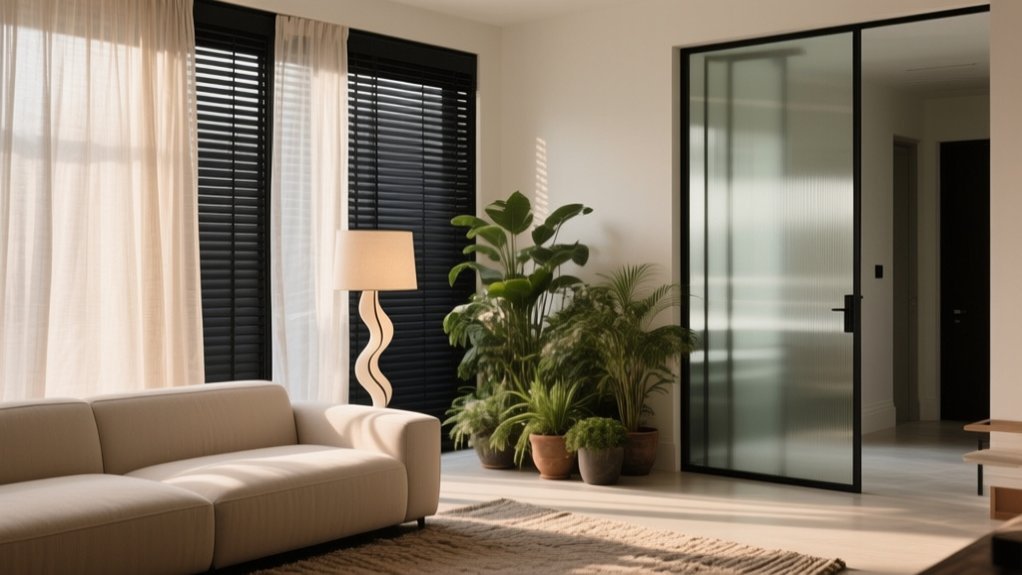
For daytime privacy without sacrificing light, you’ll get the best results by layering: pair airy sheers with a clean-lined shade so you can soften views while controlling glare.
You can also layer full-height curtains with slim blinds to add texture and a tailored frame, then fine-tune coverage as the sun shifts.
Choose coordinated fabrics and finishes, and you’ll keep the window looking intentional from both inside and out.
Combine Sheers And Shades
When you want daylight without feeling on display, layering sheers with shades gives you the cleanest, most design-forward solution. Start with sheer fabrics closest to the glass; they blur views, soften glare, and keep your room bright.
Add a tailored shade over top so you can shift from filtered light to full privacy in seconds without changing the look.
Choose a light, neutral sheer to keep color true, then match your shade to the wall or trim for a seamless line. For bedrooms and street-facing rooms, use a room-darkening roller or cellular shade; for living areas, a light-filtering shade keeps the atmosphere airy.
This window layering reads intentional, not fussy, and it works in modern, transitional, or classic spaces.
Layer Curtains With Blinds
Sheers and shades keep the window line crisp, but curtains paired with blinds give you more texture and stronger control over sightlines. Start with slim wood or aluminum blinds for daytime privacy; tilt slats to block eye level views while still admitting light.
Then add full-length curtains to soften edges, hide hardware, and deepen color.
Use layered window treatments strategically: choose light-filtering curtains in social rooms and heavier liners in bedrooms. Mount curtains wider than the frame so you can stack them clear and keep glass exposed.
Apply Privacy zone mapping by identifying street-facing windows, neighboring sightlines, and seating heights, then set blind tilt angles accordingly.
Finish with matched rods and blind tapes for a cohesive, tailored look.
Add Renter-Friendly Privacy Window Film
Although you mightn’t be able to swap out windows in a rental, you can still control sightlines with renter-friendly privacy window film that installs in minutes and peels off cleanly at move-out. Treat it as one of the smartest Renter friendly solutions for bright rooms that need discretion without heavy drapery.
Choose Window film options that match your aesthetic and light needs: frosted for a clean, gallery-like look; reeded or fluted patterns to mimic vintage glass; or subtle geometric prints to add quiet texture.
Measure carefully, clean the pane, then mist with water and squeegee from center outward for a bubble-free finish. Apply film to the lower sash for street-level privacy while keeping the top clear for daylight. It’s polished, practical, and reversible.
Use Room Dividers as Stylish Privacy Screens
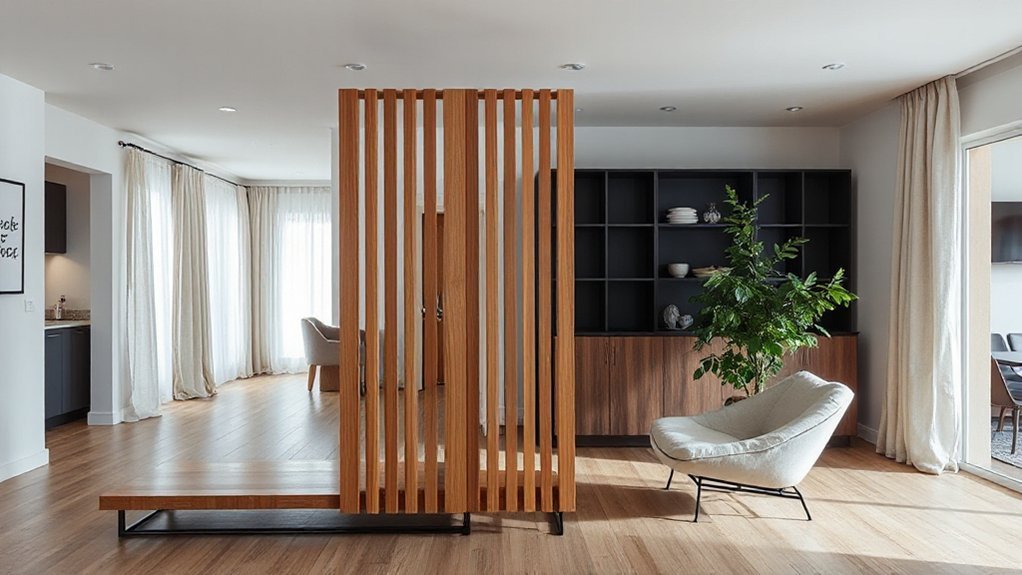
If your space needs privacy but can’t spare square footage for permanent walls, a well-chosen room divider gives you instant separation with a strong style payoff. Use room dividers to zone a studio bed area, conceal a work nook, or shield an entry sightline without construction.
Choose a folding screen for flexibility, a ceiling-track panel for a clean, architectural line, or open shelving to block views while keeping light moving. Prioritize proportion: the divider should reach near eye level when seated, and its width should cover the viewing angle you’re trying to control.
Treat it like furniture—match finishes to your hardware, repeat a color from your textiles, and add texture with cane, slats, or upholstered panels for stylish screens.
Add Privacy With Tall Plants and Planters
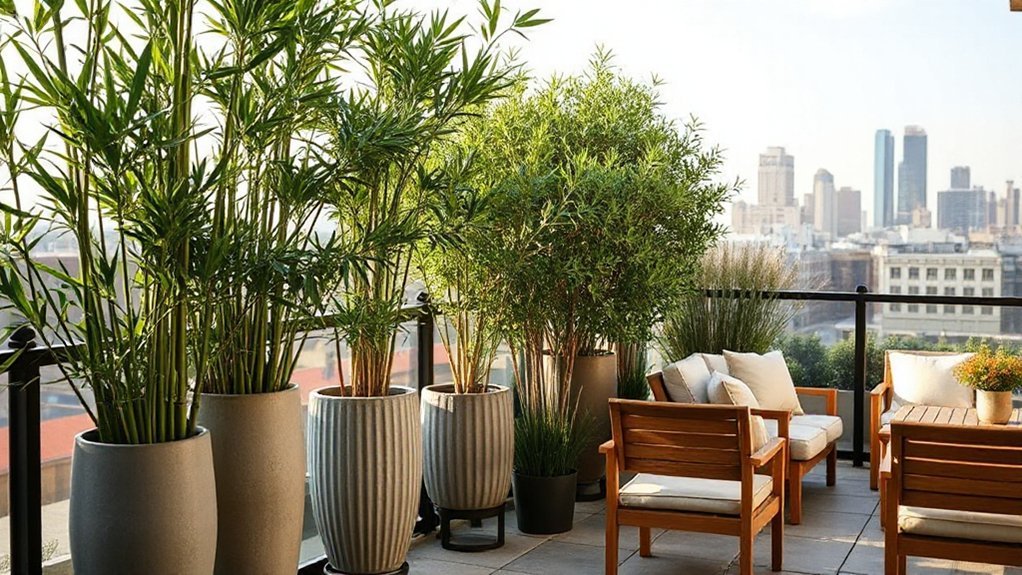
You can get instant privacy with tall plant screens that soften sightlines while keeping the room feeling elevated and intentional. Place oversized planters to block key angles—along window lines, behind seating, or at entry passages—so the layout does the work without adding visual clutter.
Choose low-maintenance options and consistent containers to create a clean, green barrier you won’t have to babysit.
Tall Plant Privacy Screens
When sightlines from neighbors or nearby buildings cut into your outdoor comfort, tall plant privacy screens deliver a clean, design-forward fix that feels intentional rather than improvised. Choose a tall plant with upright structure—clumping bamboo, Italian cypress, arborvitae, or columnar grasses—so you gain height without losing usable space.
Use oversized planters with a consistent finish to read like outdoor furniture, not garden clutter. Keep the palette tight: one species for a crisp architectural wall, or two for controlled texture. Prioritize dense foliage, wind tolerance, and sun exposure so coverage stays reliable through seasons.
Add drip irrigation or self-watering inserts to keep the screen lush with minimal effort. Finally, repeat the same planter size and plant rhythm to make your privacy screens look custom and cohesive.
Planter Placement Strategies
Although the plants bring the height, smart planter placement delivers the privacy. Start by mapping sightlines from seats, doors, and neighboring windows, then set planters where they break the view at eye level.
Use corners to create a visual “wall,” and stagger units to avoid a flat, hedge-like line. Match plant height to the viewing angle: taller specimens behind, medium in front, so coverage stays solid without feeling bulky.
Anchor key edges—balcony rails, patio perimeters, or along a fence—with evenly spaced planters to define your outdoor room. Choose container styles that reinforce your look: slim troughs read modern, pedestal pots feel classic, and oversized cubes signal architectural intent.
Keep clear paths and keep the composition balanced.
Low-Maintenance Green Barriers
Smart placement sets the framework; low-maintenance green barriers make it feel finished and lived-in. Use tall, architectural plants in slim planters to screen views without building walls.
Stick to sustainable plant choices that thrive in your light and climate, so your privacy looks intentional year-round. Repeat one planter finish to keep the line clean, then stagger heights for depth and a softer edge.
For low-maintenance landscaping, choose drought-tolerant varieties and automate irrigation so you won’t babysit growth. Keep the footprint tight, but anchor corners with bigger containers to stop the screen from feeling temporary.
- Columnar evergreens for steady, vertical coverage
- Clumping bamboo (noninvasive) for fast, elegant density
- Ornamental grasses for movement and texture
- Self-watering planters to reduce weekly chores
Use Lighting and Mirrors to Limit Views
Because sightlines matter as much as square footage, you can use lighting and mirrors to control what people see without adding a single curtain or screen. Start by shifting ambient lighting away from windows and toward interior walls; a brighter room reads welcoming, but a brighter window turns you into a silhouette. Use wall washers, picture lights, and dimmable floor lamps to create a luminous core that keeps attention inside.
Next, place mirrors to redirect views, not extend them. Angle a mirror to capture artwork or greenery, not a doorway. Choose reflective surfaces with softened finishes—antiqued, smoked, or reeded glass—to bounce light while blurring detail.
Keep mirrors out of direct alignment with entries and seating, and you’ll quietly cut through-lines without losing openness.
Make Bedroom Privacy Feel Light and Airy
When you treat bedroom privacy as a layering problem—not a blackout mandate—you can block sightlines and sound without making the space feel boxed in. Start at the window: pair sheers with lined drapes so daylight stays, but silhouettes don’t. Then soften acoustics with Textile textures—upholstered headboards, a wool rug, and heavier bedding that absorbs echo.
Keep Color palettes light and tonal; warm whites, sand, and pale gray read airy while still feeling cocooned. Finally, manage views at the door and beyond with subtle boundaries that don’t add bulk.
- Ceiling-mounted drapery tracks to widen windows visually
- Top-down shades for privacy with skylight
- Layered bedding: linen + quilt + throw for depth
- A slim screen or bookcase to interrupt direct sightlines
Turn Outdoor Privacy Into a Cozy Retreat
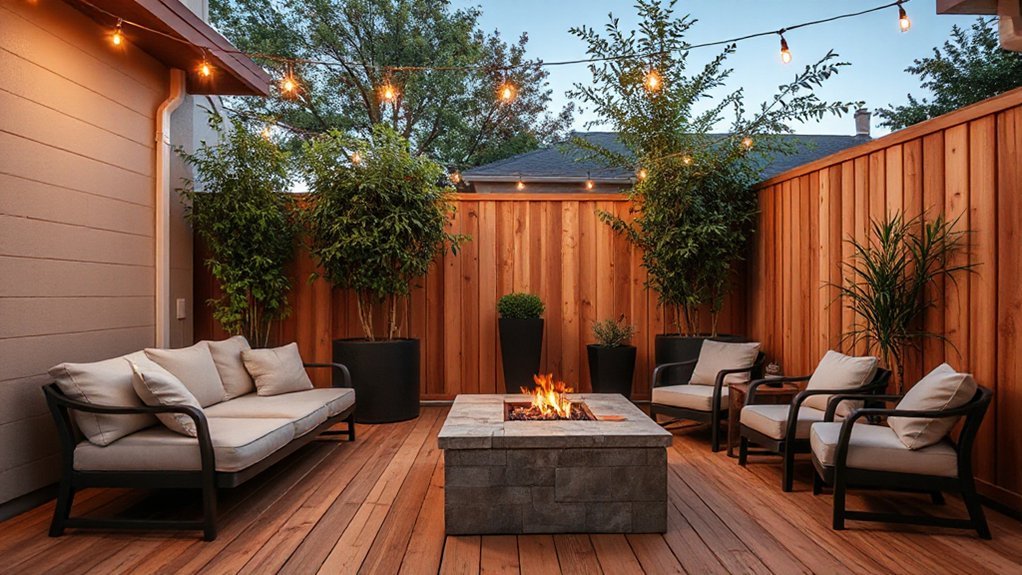
Bedroom layers teach you a simple rule: privacy works best in soft, breathable increments, and the same idea holds outdoors. Start with a permeable boundary—slatted screens, tall grasses, or a trellis—so light and air still move. Then add a second layer that you can adjust: outdoor curtains, a cantilever umbrella, or a roll-down shade to block sightlines when you need it.
Anchor the space with a weatherproof rug and a compact loveseat to signal “room,” not “yard.” For outdoor ambiance, use warm string lights, a low lantern, and one focused task light near seating.
Finally, tune privacy aesthetics with consistent materials—black metal, pale wood, or woven resin—and keep the palette tight. Add texture, not clutter.
Frequently Asked Questions
How Can I Reduce Noise for Privacy Without Adding Bulky Panels?
Reduce noise discreetly by adding dense curtains, sealing gaps with acoustic weatherstripping, and laying thick rugs. Choose soundproofing solutions like bookcase walls, plus window film options and cellular shades to mute street sound.
Which Paint Colors Make a Room Feel Private yet Still Bright?
Choose soft, misty greens, pale clay, or warm off-whites; they wrap you like linen while keeping daylight buoyant. Color psychology favors muted midtones for intimacy. You’ll want eggshell or satin for paint durability.
How Do I Create Privacy in an Open-Plan Home Without Blocking Airflow?
Create privacy in your open-plan home without blocking airflow by layering Frosted glass panels and Movable screens. You’ll zone sightlines, not breezes. Choose slatted, perforated, or sheer-backed designs and keep gaps at floor and ceiling.
What Smart-Home Settings Improve Privacy Without Making the Space Feel Closed?
You’ll boost privacy by automating Smart window tinting, scheduling Privacy screens, and geofencing presence—like drawing a theater curtain only when needed. Set motion-activated lighting, camera privacy modes, and voice-assistant mic cutoffs during gatherings.
How Can I Add Privacy on a Tight Budget Without Permanent Renovations?
You can add privacy cheaply with peel-and-stick window film, decorative window treatments, and movable room dividers. Layer budget sheers with blackout panels, use tension rods, and place tall plants or bookcases to block views.
Conclusion
You don’t have to choose between privacy and style—you can design for both. Map your sightlines, then layer solutions: sheers plus drapes, renter-friendly film, and dividers that double as decor. Anchor corners with tall plants, and use lighting and mirrors to control what’s seen. Keep bedrooms airy with soft textures and pale tones. Outdoors, add screens and greenery to create a retreat that feels like a calm hug after a long day.