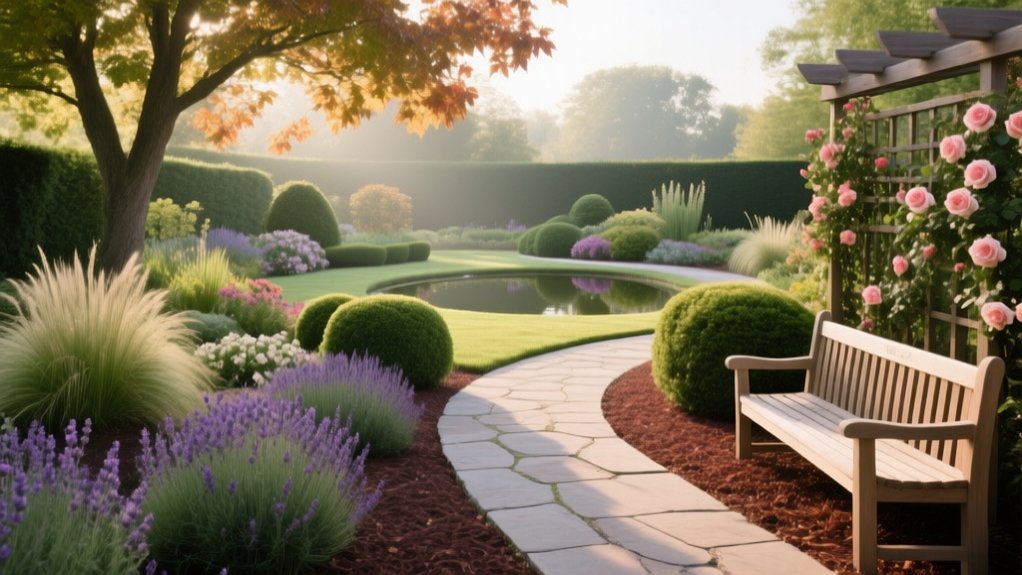
You design a well-designed garden by first evaluating sun paths, shade and reflected heat, then testing soil pH, structure and drainage with a percolation check. You map these constraints into zones for access, seating, storage and cultivation, and set primary routes on desire lines with safe, permeable surfaces and proper falls. You choose plants for hardiness and microclimate, layer heights for scale, and suppress weeds with dense groundcover plus 75 mm mulch. Continue for the full method.
Key Takeaways
- Assess sun, shade, soil pH/texture, and drainage to match plants and construction methods to site conditions.
- Plan functional zones and direct routes, ensuring every bed is accessible for maintenance and everyday use.
- Choose plants suited to hardiness zone and microclimates, placing sun-lovers in bright areas and shade plants in protected zones.
- Layer plants by height and repeat reliable forms and a restrained palette to create structure, rhythm, and cohesion year-round.
- Use permeable paths, edge restraints, dense groundcovers, and 75 mm mulch to control weeds, prevent compaction, and reduce upkeep.
Read Your Space for Light, Soil, Drainage
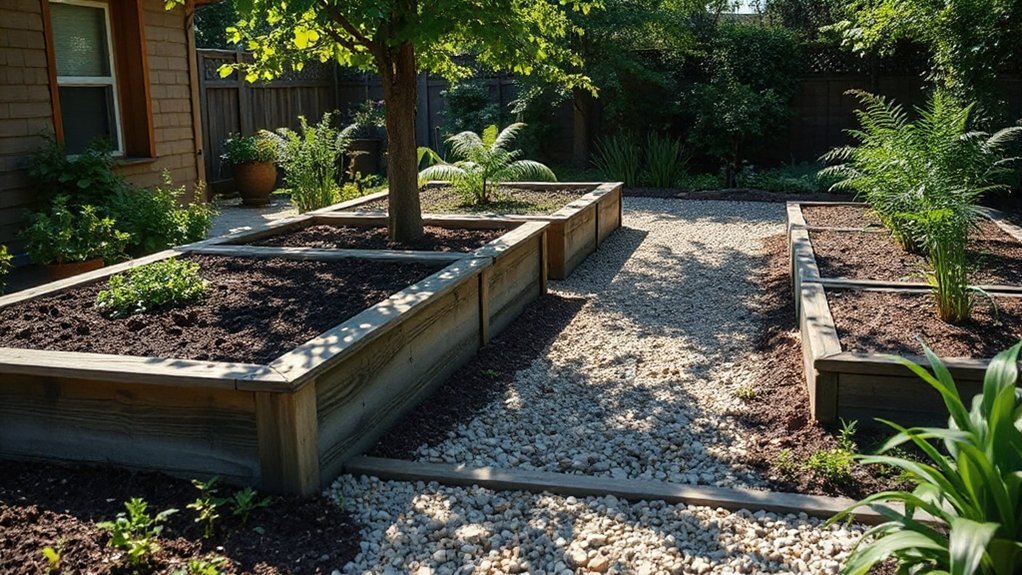
Although you may feel tempted to start planting straight away, you’ll get better results by first reading your space for light levels, soil type, and drainage. Begin with a light assessment: observe sun paths in morning, midday, and late afternoon, noting shade cast by buildings, fences, and mature trees. Record exposure as full sun, partial shade, or deep shade, and consider reflected heat from hard surfaces.
Next, carry out soil testing. Take samples from several points, measure pH, and assess texture by hand to distinguish sand, silt, and clay. Check structure, compaction, and organic matter, as these govern aeration and root penetration.
Finally, evaluate drainage with a percolation test: fill a 30 cm hole with water twice, then time infiltration. Address waterlogging and run-off before adding plants.
Plan Your Garden Design Layout With Zones and Paths
Once you’ve mapped light, soil, and drainage, translate that information into a layout that organises the garden into functional zones linked by efficient paths. You’ll improve usability by assigning clear purposes: access, seating, storage, service, and cultivation. Establish zone delineation with edges, level changes, or linear features so circulation remains legible and maintenance stays contained.
Set primary routes first, keeping desire lines direct and widths practical for barrows and tools. Then add secondary paths that reduce compaction and provide reach to beds without over-fragmenting the plan.
Select pathway materials to suit load, permeability, slip resistance, and visual hierarchy; compacted gravel, bound aggregate, brick, and paving each impose different tolerances and detailing. Specify consistent falls, durable restraints, and drainage interfaces to prevent ponding and frost heave.
Choose Plants That Fit Your Climate and Light
You’ll achieve reliable performance by selecting plants suited to your hardiness zone, as this defines their tolerance to minimum winter temperatures.
You should then assess light conditions across the site, mapping full sun, partial shade, and deep shade created by buildings, fences, and tree canopies.
Match each species to these climatic and light parameters so your planting scheme establishes quickly and remains resilient.
Match Plants To Hardiness Zone
Where should you begin when selecting plants for a new border or bed? You’ll start by identifying your hardiness zone, because it defines the lowest winter temperatures your garden must endure. Choose species rated to survive that threshold, and you’ll secure Plant compatibility with local conditions and reliable Climate adaptation.
Check the label’s zone range, then match it to your postcode-based guidance, allowing for microclimates near walls, paving, or exposed corners. Aim for resilient structure first, then refine your palette.
- A clipped evergreen hedge that holds colour after a hard frost
- Herbaceous perennials that re-emerge cleanly each spring, unscorched
- A small ornamental tree whose buds don’t blacken after late freezes
Record failures; adjust selections by zone tolerance each season.
Assess Sun And Shade
Hardiness sets your baseline for winter survival, but light levels govern daily performance and long-term vigour. You should map Sun exposure across the garden in mid-summer and mid-winter, noting aspect, building shadows, and canopy cover. Record hours of direct light: full sun (6+), partial shade (3–6), or full shade (<3).
Next, match each planting zone to species’ Shade tolerance and heat demand. Place sun-loving perennials and fruiting crops in south- or west-facing beds, where irradiance and soil warmth peak. Reserve north-facing borders and areas beneath deciduous trees for woodland plants that tolerate low light yet exploit spring sun before leaf-out.
You’ll reduce etiolation, scorching, and chronic stress, and you’ll improve flowering, fruit set, and foliar density.
Layer and Place Plants for Scale and Flow
Once you’ve matched plants to your climate and light, you must layer them by height to control scale and maintain clear sightlines. Place taller specimens to the rear of borders or as structural anchors.
Then step down through mid-storey shrubs to low ground cover at the edge. Arrange beds and repeating groups to guide movement and create a coherent flow through the garden.
Build Plant Height Layers
Although you might select plants for colour or texture first, the garden’s structure depends on height layering, which controls scale, sightlines, and movement through the space. You achieve Vertical layering by assigning each plant a clear role, using Plant height variation to prevent visual congestion and to anchor focal points. Establish a stable hierarchy, then repeat it consistently so the composition reads as deliberate rather than accidental.
Keep mature dimensions foremost, and site plants to avoid future shading conflicts and suppressed growth.
- Place structural shrubs or small trees as the upper canopy, framing boundaries and borrowing views.
- Set mid-storey perennials and grasses to define mass, rhythm, and seasonal lift.
- Thread low groundcovers at the front to seal edges, cool soil, and soften hard lines.
Arrange Beds For Flow
Before you finalise plant choices, shape each bed to direct how you and the eye move through the garden. Use gentle arcs to pull sightlines onwards, or crisp geometry to frame a focal point. Keep bed symmetry where paths demand formality, and relax it in informal areas to soften shifts.
Set consistent bed widths beside routes so circulation feels unforced and maintenance stays efficient.
Then organise planting borders by scale: tall structure at the back or centre, medium mass in front, and low edging to define lines. Repeat key species at measured intervals to create rhythm and prevent visual stops.
Align plant spacing to mature spread, not pot size, so beds knit together without crowding.
Choose Garden Paths, Edging, and Hardscape Features
When you define how people will move through the space, you establish the garden’s underlying structure, so select paths, edging, and hardscape features early and specify them with measurable intent.
Set primary routes at 1.0–1.2 m wide for two-person passage, and secondary runs at 0.6–0.8 m.
Choose a path material that matches load and drainage: compacted gravel over geotextile, permeable pavers on a sharp-sand bed, or sawn stone on a concrete base.
Fix levels with a 1:60 fall away from buildings, and keep thresholds flush.
Specify edging styles to restrain aggregate and define mowing lines, using steel, setts, or brick-on-edge.
Visualise:
- A straight gravel spine to the shed.
- Curved setts crisply containing beds.
- A small paved sitting pad anchored by steps.
Design Your Garden for Year-Round Color and Texture
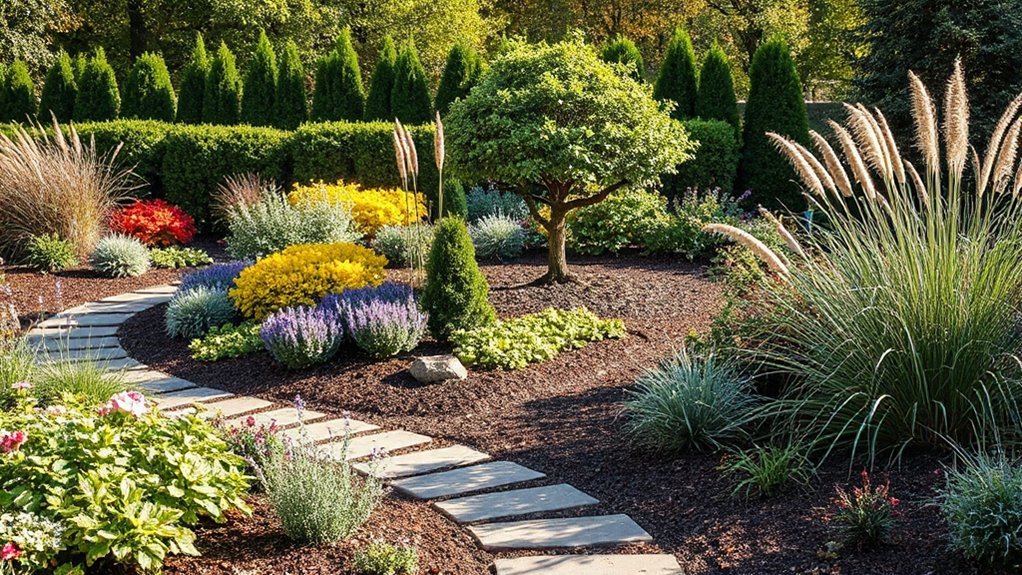
As you finalise the garden’s framework, plan a planting palette that carries colour and texture through every season rather than peaking in summer.
Establish a balanced structure of evergreen shrubs, grasses, and architectural perennials, then layer seasonal performers for succession.
For spring, prioritise bulbs and early blossom, backed by fresh seasonal foliage.
In summer, reinforce your scheme with long-flowering perennials and drought-tolerant salvias, ensuring color coordination across adjoining beds.
For autumn, specify plants with reliable pigment and seedheads, such as asters, sedums, and ornamental grasses, to sustain visual mass.
In winter, rely on bark, stems, and persistent fruit: birch, dogwood, and hollies provide crisp contrast.
Maintain consistent leaf scale and repeat key forms to unify the composition.
Make Your Garden Design Easy to Maintain
Although a richly planted border can look complex, you can keep maintenance predictable by designing for access, weed suppression, and controlled growth from the outset. Plan paths and stepping stones so you can reach every square metre without compacting soil. Specify permeable surfaces and install edge restraints to prevent gravel migration.
For Garden maintenance, reduce bare ground by using dense groundcovers and a 75 mm organic mulch layer, topped up annually. Your plant selection should prioritise stable habit, disease resistance, and appropriate ultimate size, so you won’t rely on constant pruning.
Group plants by water demand and light requirement to simplify irrigation and feeding.
- A clear service route beside each bed
- A continuous mulch “carpet” under shrubs
- A restrained palette of dependable, long-lived species
Frequently Asked Questions
How Much Does a Professional Garden Design Typically Cost?
You’ll typically pay £500–£5,000 for a professional garden design, rising to £10,000+ for complex schemes. Budget planning and designer selection determine fees, set by scope, surveys, scaled drawings, and planting specifications.
Do I Need Permits or HOA Approval for Garden Structures?
You’ll often need planning permission, building regulations compliance, or HOA consent for sheds, pergolas, walls, and lighting; check covenants and local authority thresholds. Align Garden decor and Plant selection with approved dimensions, materials, and boundary offsets.
What Are the Best Ways to Deter Deer, Rabbits, and Rodents?
You’ll deter deer, rabbits, and rodents best with Wildlife exclusion and Plant deterrents; fencing cuts browse by up to 90%. Install 2.4m mesh, bury 30cm, fit guards, rotate repellents, remove cover, secure food.
How Can I Make My Garden Safe for Children and Pets?
Make your garden safe by fencing hazards, locking tools, and covering water features. Choose Child proof plants, remove toxins, and use Pet safe fertilizers. Install soft surfacing, guarantee gates self-close, and supervise play.
What Irrigation System Is Best: Drip, Soaker Hoses, or Sprinklers?
Choose drip irrigation: you’ll deliver precise root-zone water, minimise evaporation, and reduce foliar disease. You should fit soaker hoses for dense beds; use sprinklers only for lawns. Align with Garden layout and Plant selection.
Conclusion
When you read your site’s light, soil structure, and drainage, you set a reliable baseline for every decision. You then zone the layout, define paths, and select plants matched to climate and aspect, placing them in layered proportions for coherent scale and movement. By specifying durable paving, edging, and hardscape, you control circulation and wear. You also plan seasonal succession for colour and texture. Why not prioritise maintainability, so routine tasks stay efficient year-round?