

Choose loft and conversion flooring by matching material to use and weight limits—engineered wood, LVP, or cork stay lighter and more stable than thick tile. Identify your subfloor: test concrete for moisture and add a vapor barrier; re-screw wood to stop squeaks and fix soft spots. Flatten dips before install, seal drafts, and leave expansion gaps. Add acoustic underlay and tight connectors for quiet, continuous sightlines. Next, you’ll see how to pick each layer and trim detail.
Key Takeaways
- Choose lightweight, stable flooring like engineered wood, LVP, or cork when loft framing limits weight and movement.
- Test and prep subfloors: add vapor barriers on concrete, re-screw wood decks, and fix slopes beyond 3/16 inch over 10 feet.
- Manage acoustics by sealing gaps and using continuous acoustic underlay with perimeter isolation to reduce impact and airborne noise.
- Control moisture and temperature swings with insulation, ventilation, acclimation, and perimeter expansion gaps to prevent cupping, gaps, and drafts.
- Keep open plans cohesive with long planks, consistent finishes, and low-profile transitions or metal trims that protect edges without visual breaks.
Loft Flooring: How to Choose (Fast Checklist)?
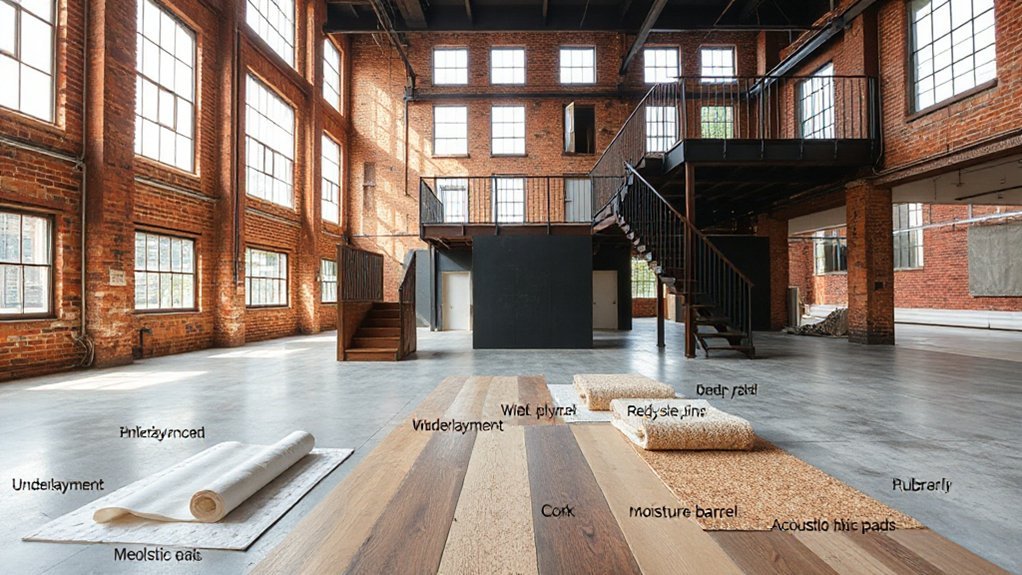
If you’re picking flooring for a loft, start by matching the material to how you’ll actually use the space and what the structure can support. Confirm Structural support for the final load (flooring, furniture, people), then choose lighter options if limits are tight: engineered wood, LVP, or cork; save thick stone or tile for robust framing. Prioritize acoustic control: add underlayment to cut footfall noise and protect neighbors below. Check Loft insulation requirements so your build-up doesn’t compress insulation or block ventilation paths. Plan for movement: specify expansion gaps and conversions at stair landings and doorways. Choose finishes that handle sun, grit, and spills—lofts often have big windows and open plans. Finally, verify fire rating and slip resistance for stairs.
What Subfloor Do You Have: Concrete or Wood?
After you’ve narrowed your loft flooring options by weight, noise, and wear, check what you’re installing over: a concrete slab or a wood subfloor. Concrete usually feels colder and can wick Subfloor moisture upward, so you’ll need a vapor barrier and a flooring system rated for slabs. Test with a moisture meter or taped plastic before you commit. Plan subfloor insulation if the slab sits over an unheated garage or ground to reduce chill and condensation risk.
A wood subfloor moves with seasonal humidity and may squeak if fasteners are loose. Walk it, listen, then re-screw to joists and replace any soft spots. Use underlayment for sound control and add subfloor insulation between joists when you can.
Can Your Loft Floor Handle Uneven Levels?
Because many lofts inherit decades of settling, you can’t assume the floor runs flat enough for every flooring type, so check for slope, dips, and high spots before you buy materials. Use a 6-foot level or laser, map deviations, and note anything over 3/16 inch in 10 feet, which can telegraph through planks and cause floating floors to separate.
If you find unevenness, don’t just stack underlayment. Verify Structural integrity first: look for cracked joists, soft spots, or bouncing that suggests overload or rot. Then correct the plane with sistered joists, shims, or a pourable leveling compound rated for your subfloor. Also plan for insulation challenges in cavities you open; re-pack or replace without compressing.
Loft Flooring for Temperature Swings and Drafts

Although lofts often feel charmingly airy, temperature swings and perimeter drafts can punish the wrong flooring choice by shrinking boards in winter, swelling them in summer, and opening seams that collect grit. Choose dimensionally stable options like engineered wood, quality LVP, or porcelain tile that won’t react wildly to humidity shifts. Acclimate materials on-site, then maintain consistent indoor RH with ventilation and a humidifier/dehumidifier as needed. Specify an underlayment that adds thermal insulation and includes a continuous vapor retarder where codes and conditions call for it. For draft prevention, seal rim joists, gaps at exterior walls, and pipe penetrations before you lay flooring, and use perimeter expansion gaps plus properly installed base and shoe to cover them. Avoid wide solid planks in unconditioned lofts.
How to Quiet Loft Flooring (Acoustic Underlay)
To quiet a loft floor, you’ve got to identify the main sound paths—impact noise through the deck and airborne noise leaking through gaps and penetrations. Then you can match the problem to the right acoustic underlay type, whether it’s rubber, cork, foam composites, or mass-loaded layers designed for higher IIC ratings. You’ll get the best results by installing it as a continuous, sealed layer with perimeter isolation and tight seams, so vibration can’t short-circuit into the structure.
Understanding Loft Sound Paths
In a loft, sound doesn’t just travel straight down through the floor—it also shoots across the deck, slips into joist cavities, and reappears through walls, stairs, and even exposed structural elements. You’ll hear two main types: impact noise (footfalls, chair scrapes) and airborne noise (voices, TV), and they take different routes.
Track flanking paths first: gaps at rim joists, penetrations for plumbing, HVAC, and conduit, and hard connections where flooring meets stair strings, steel columns, or brick. Your Loft lighting layout can add penetrations and vibrating fixtures, so plan wiring routes and isolate junction boxes. Don’t ignore ventilation strategies either; ducts can act like megaphones unless you decouple supports and seal leaks. Map these paths before you treat the floor.
Choosing Acoustic Underlay Types
Once you’ve mapped the flanking paths, choose an acoustic underlay that matches both the noise you’re fighting and the floor you’re installing, because no single pad fixes every loft problem. For impact noise (footfall), pick resilient rubber, cork, or high-density foam with verified IIC ratings; thicker isn’t always quieter if it compresses. For airborne noise (voices, TV), use mass-loaded vinyl composites or fiber mats with strong STC support, ideally paired with a decoupling layer. Match underlay to your finish: floating laminate tolerates softer pads, while engineered wood often needs firmer, low-compression options to prevent joint failure. If sustainability matters, prioritize Eco friendly materials like cork or recycled rubber. For aesthetic customization, guarantee the underlay suits your floor height transitions and trim reveals.
Installation Tips For Quieting
Although the best acoustic underlay can’t overcome sloppy prep, you can cut loft noise dramatically when you install it like a system: start with a flat, rigid subfloor, then seal every seam, gap, and penetration before the pad goes down. Snap chalk lines, dry-fit sheets, and stagger joints so vibrations don’t track in straight paths. Run perimeter isolation strips and leave a small expansion gap, then cover it with base trim for clean aesthetic considerations. Use the manufacturer’s tape on all seams; don’t substitute duct tape. If you’re floating a floor, keep fasteners out of joists and avoid bridging through thresholds; add transition profiles instead. Choose low-VOC adhesives and Eco friendly materials, and weigh added thickness against door clearances and stair nosings.
Moisture-Proof Loft Flooring for Basements
Because basements trap humidity and wick moisture through concrete, you can’t treat loft flooring like a typical dry-room install. Start by testing the slab’s RH or calcium-chloride rate, then address liquid water and vapor before you lay a single plank. Use Moisture barriers that match your system: a taped 10–15 mil poly under sleepers, or a manufacturer-approved epoxy vapor primer under floating panels. Pair that with Ventilation strategies—dehumidifier sizing, mechanical exhaust, and clear air paths—to keep seasonal spikes from cycling your subfloor.
- Seal cracks, joints, and perimeter gaps with urethane before barrier layers.
- Elevate the floor assembly with dimple mat or sleepers to create drainage/air space.
- Choose mold-resistant underlayment and fasteners rated for below-grade conditions.
What Loft Flooring Holds Up to Heavy Traffic?

When your loft sees constant foot traffic, rolling carts, pets, and the occasional dropped tool, the flooring has to resist abrasion, denting, and joint failure—not just look good on day one. Choose 20–22 mil wear-layer LVP with rigid core for scratch resistance and stable click-locks, or spec commercial linoleum with heat-welded seams for long corridors. If you prefer wood, go with factory-finished engineered planks, not soft pine, and demand a hard species and aluminum-oxide finish. Install over a flat, stiff subfloor; add underlayment rated for rolling loads. Keep Loft lighting bright to spot grit early, and maintain Wall insulation so temperature swings don’t open joints. Use felt pads and entry mats always.
Best Loft Flooring for Open-Plan Continuity
If you want your loft to read as one continuous volume instead of a patchwork of “zones,” choose a flooring system that runs uninterrupted across the entire open plan and tolerates the same wear level everywhere. Prioritize long planks or large-format panels that visually “stretch” the footprint and minimize visual breaks. Engineered oak works well because it stays stable over big spans, handles radiant heat, and can be finished in a low-sheen tone for Vintage charm. For Sustainable materials, look for FSC-certified wood, reclaimed boards, or bio-based finishes with low VOCs. To keep continuity convincing, lock in these specs:
- Consistent plank width and grade across all areas
- A uniform sheen level and stain color
- Underlayment that controls sound and minor subfloor variation
Loft Floor Trims, Transitions, and Edge Details
To keep an open-plan loft looking intentional, you’ll specify seamless trim profiles that sit flush, protect corners, and match your floor thickness. You’ll also choose loft gradation solutions that manage height changes at stairs, thresholds, and material breaks without creating trip points. For exposed edges at mezzanines and stair landings, you’ll finish with durable nosings or metal edge trims that lock down the flooring and deliver a clean, code-friendly line.
Seamless Trim Profiles
Although lofts and other unconventional spaces often celebrate exposed edges and hard shifts, your flooring still needs trim profiles that look intentional and protect the installation. Choose seamless trim profiles that match thickness, sheen, and color so edges read as deliberate, not unfinished, preserving a unified aesthetic across big, open sightlines. Specify trims that solve real constraints without calling attention to themselves.
- Use low-profile metal or color-matched PVC edge trims at stair lips, mezzanine perimeters, and platform fronts to prevent chipping and reduce trip risk.
- Detail base or shadow-gap reveals to keep irregular brick, steel, or concrete walls clean while allowing movement.
- Maintain consistent reveal widths and fastener patterns so every edge aligns visually, even where substrates vary.
Measure precisely and dry-fit before cutting.
Loft Transition Solutions
Where do loft floors actually fail first—right at the junctions, edges, and level changes you walk across every day. Treat crossings as structural details, not décor, and you’ll stop squeaks, chipping, and trip hazards before they start.
Choose a reducer where the loft meets thinner flooring, and a T-molding where two surfaces meet flush. Specify metal profiles in high-traffic paths; use wood only when movement is minimal. Leave the correct expansion gap under every transition strip, then anchor into the subfloor, not floating planks. At stair landings, use a nosing that matches your flooring thickness and fasten it mechanically. Coordinate Loft lighting so transition lines don’t cast confusing shadows. Pair clean transitions with insulation solutions beneath to reduce vibration and sound transfer.
Exposed Edge Finishing
Because loft edges take the most abuse from foot traffic, cleaning, and seasonal movement, you need to finish every exposed perimeter like a load-bearing detail, not an afterthought. Plan exposed edge finishing to protect the flooring core, prevent splintering, and keep nosings tight over time. Use stair nosings at open loft fronts, reducer profiles at height changes, and T-moldings where floating floors meet fixed surfaces. Match metals to railings and fasteners for a coherent look, or specify decorative trim when you want the edge to read as intentional architecture, not a patch.
- Leave a proper expansion gap, then cover it with a secured profile.
- Seal cut edges on engineered wood or laminate before trimming.
- Fasten into substrate, not flooring, to avoid buckling.
Frequently Asked Questions
How Do I Match Loft Flooring to Industrial Beams and Exposed Brick?
Match loft flooring by echoing beam tones and brick warmth: choose reclaimed oak or wide-plank engineered wood for Rustic aesthetics. Add Modern contrasts with matte concrete-look tile. Keep undertones consistent, use low-sheen finishes, and simple trim.
Are There Flooring Options That Preserve Historic Materials in Converted Spaces?
Yes—you can preserve historic materials by floating engineered wood or cork over existing planks, using breathable underlay and reversible adhesives. Choose sustainable materials, document subfloor conditions, and follow historic preservation guidelines to avoid moisture damage.
What Flooring Is Best for Mezzanines With Limited Headroom Clearance?
Choose slim, sturdy surfaces: engineered wood, cork, or low-profile LVT. You’ll maximize headroom, add noise reduction with underlayment, and pick sustainable options like FSC wood or recycled cork. Keep connections flush, finishes thin.
How Can I Install Flooring Without Disturbing Existing Radiant Heating Pipes?
You’ll protect radiant heating by using a floating Flooring installation: lay a compatible underlayment, click-lock planks, and avoid nails/screws. Map pipe runs, keep fasteners shallow at edges only, and follow manufacturer temperature limits.
Do Building Codes Restrict Certain Flooring Types in Live-Work Loft Conversions?
Yes—codes can restrict flooring in live-work loft conversions. You’ll meet fire ratings, slip resistance, and egress rules, so choose fire resistant options and waterproof solutions. You must also verify sound, structural-load, and accessibility requirements.
Conclusion
Choose loft flooring with a clear, careful checklist: confirm concrete or wood subfloor, fix dips and dodgy levels, and plan for temperature swings and drafts. Silence stomps with acoustic underlay, block basement moisture with proven barriers, and pick a finish that shrugs off heavy traffic. For open-plan flow, favour finishes that match room to room. Finally, nail the neat nuances—trims, connections, and edges—so your converted space looks crisp, cohesive, and durable.