

You’ll usually fill residential units faster (15–45 days), reset rents annually, and spread risk across many tenants, but you’ll handle higher turnover and frequent maintenance. Commercial can offer higher cap rates and NNN pass-throughs (taxes/insurance/CAM), plus multi-year lease stability, yet vacancies can run 6–18+ months and re-tenanting often requires costly TI/LC and concessions. Financing also differs: commercial underwrites NOI and DSCR, while residential leans on DTI and comps. Next, you’ll see which fits your goals.
Key Takeaways
- Residential units typically re-tenant in weeks with annual rent resets, while commercial vacancies can last 6–18+ months with longer lease lock-ins.
- Commercial value is driven by stabilized NOI and cap rates; residential value leans on comparable sales and neighborhood turnover.
- Commercial often achieves higher cap rates and expense pass-throughs (NNN), but may require costly TI/LC and longer downtime to backfill.
- Residential financing relies on borrower income, credit, and DTI; commercial underwriting centers on rent rolls, DSCR, reserves, and third-party reports.
- Residential demand is more recession-resilient; commercial performance depends on business health, employment, and lease rollover timing.
Commercial vs Residential: Which Fits You Fast?

How quickly do you need your investment to match your goals? If you’re targeting faster stabilization, evaluate lease-up timelines and rollover risk. Residential often fills quicker because demand is broad and marketing cycles run weeks, not quarters.
Commercial can accelerate cash flow when you lock in credit tenants on multi-year terms, but vacancy typically lasts longer and re-tenanting costs more.
To decide, model speed-to-income: expected days vacant, tenant improvements, and leasing commissions versus residential turn costs and renewal rates. Tenant diversity matters: a single commercial tenant can create binary income risk, while multiple residential units spread it.
Also stress-test zoning regulations; rezoning delays, use restrictions, and parking ratios can slow commercial execution. Match your timeline to the asset’s friction points.
Commercial vs Residential Basics: What Counts as “Commercial”?
Speed-to-income depends on what the market and lenders classify as “commercial,” so you need a clean definition before you run lease-up and vacancy models.
In practice, “commercial” usually means income property with five-plus residential units, or any non-residential use (office, retail, industrial, self-storage, hospitality). But classification isn’t just labels—it’s underwriting, appraisal comps, and zoning map codes.
Historical trends matter: older mixed-use corridors can underwrite like commercial even when units sit above storefronts. Zoning regulations can flip a deal from residential to commercial overnight if use, parking ratios, or occupancy limits change.
Confirm classification by checking:
- Unit count and intended use under the zoning ordinance
- Lender program (residential vs DSCR/commercial) and appraisal scope
- Tax assessor class and permitted uses on title/CO
Returns Compared: Cap Rate, Cash Flow, Appreciation
Because lenders and appraisers underwrite commercial property on income, your return math hinges on three drivers—cap rate (price relative to NOI), cash flow (NOI minus debt service), and appreciation (NOI growth and exit cap).
In commercial, you’ll often see higher going-in cap rates than residential, but heavier TI/LC reserves can compress real cash-on-cash.
Stabilized leases and expense pass-throughs can smooth NOI, while vacancy can hit harder at rollover.
Property location drives tenant demand, rent growth, and re-leasing downtime; a weak node can turn a “high cap” into a value trap.
Zoning regulations affect permitted uses, parking ratios, and redevelopment optionality, which feeds upside and exit liquidity.
On residential, appreciation often dominates, but rent caps and turnover keep cash flow tighter.
How Commercial vs Residential Properties Are Valued

Return metrics like cap rate and cash-on-cash only matter if the property’s valuation method reflects the income you’re underwriting. Commercial value typically follows the income approach: you stabilize NOI, then apply a market cap rate adjusted for lease term, credit, and expense recoveries.
Residential value leans on comparable sales, where price per unit or per square foot dominates and rent plays a secondary role.
- Commercial: Underwrite NOI to market, stress vacancy/renewals, then test value sensitivity to ±50 bps cap-rate moves.
- Residential: Bracket value with recent comps, then adjust for condition, bed/bath mix, and neighborhood turnover.
- Both: Confirm Property zoning supports current use, and model Tax implications (assessments, depreciation schedules, appeal risk) that can shift net value.
Financing Commercial vs Residential: What Lenders Require
Although both deal types use debt to amplify returns, lenders underwrite commercial and residential loans with different “proof” standards: commercial credit teams size proceeds off in-place and market cash flow (DSCR, debt yield, stabilized NOI, and lease rollover risk), while residential lenders lean on borrower income/credit, appraised comparable sales, and standardized DTI thresholds.
On commercial deals, you’ll deliver rent rolls, trailing-12 financials, capex plans, and third-party reports (appraisal, Phase I, sometimes PCA). You’ll also show compliance with Zoning regulations, because nonconforming use can cut leverage or kill proceeds.
Expect tighter covenants, escrowed reserves, and higher pricing tied to DSCR floors.
On residential loans, you’ll bring W-2s, tax returns, bank statements, and comps.
In both, Property insurance limits and deductibles must match lender specs.
Lease Terms: How Each Creates Predictable Cash Flow
Lenders price and size your loan off the stability of the income stream, and lease terms are where that stability gets created—or lost. In commercial, you often lock 3–10 year leases with scheduled escalations, so you can model NOI growth and debt service coverage with tighter variance.
In residential, 12-month terms reset faster, letting you reprice to market but adding more underwriting noise.
- Rent structure: commercial escalations, percentage rent, and CPI bumps smooth cash flow; residential relies on annual renewals.
- Expense pass-throughs: NNN clauses shift taxes, insurance, and Maintenance costs to tenants; residential owners carry more operating risk.
- Credit and Tenant diversity: multiple smaller tenants can diversify income, but you’ll track lease rollover dates, reporting, and covenants.
Vacancy Risk: What Happens When a Unit Goes Dark

When a unit goes dark, you lose rent immediately while still paying fixed carry costs like debt service, taxes, insurance, and CAM or utilities.
You’ll often re-tenant residential faster (weeks to a couple months in balanced markets), while commercial backfill can run 6–18+ months due to build-outs, permitting, and credit approval.
Your lease structure also changes the risk profile: residential spreads vacancy across many small leases, but commercial concentrates it in fewer tenants where one default can wipe out a large share of NOI.
Revenue Loss And Carry Costs
Even if you’ve underwritten to market rents, a dark unit hits your NOI immediately while fixed costs keep running. Your revenue fluctuations widen because rent drops to zero but debt service, insurance, taxes, and CAM/HOA obligations don’t.
In commercial, one vacancy can remove a large share of gross potential rent; in residential, you’re often more granular, but you still bleed on every empty door.
- Quantify burn: model daily lost rent plus fixed OpEx, then compare to your DSCR covenant threshold.
- Stress utilities and security: vacant spaces often carry higher HVAC minimums, alarm monitoring, and vandalism risk.
- Plan reserves: set vacancy and TI/turn reserves based on trailing vacancy, not just pro forma, with strict carry cost considerations.
Re-Tenanting Timelines Compared
Carry costs don’t pause just because a space goes dark, so the next variable you’ve got to underwrite is how long it takes to get back to paying rent.
In residential, you can often backfill in 15–45 days if you’re priced to market, advertise aggressively, and keep turns tight; even a weak submarket typically clears within a quarter.
In commercial, downtime commonly runs 3–12+ months because you’re hunting fewer qualified users, approvals take longer, and build-out coordination can drag.
Tenant retention becomes your cheapest hedge: every avoided move-out saves make-ready, marketing, and lost rent.
Track Lease renewal probability by tenant sales trends, credit, and upcoming expirations, then budget vacancy at the unit level, not just a blended rate.
Lease Structure Risk Differences
Because lease terms dictate who pays what during downtime, a dark unit hits commercial and residential cash flow in fundamentally different ways.
In commercial, you’re often underwriting NNN income, but vacancy can flip expenses back onto you fast: taxes, CAM, and insurance don’t pause. If your Lease escalation resets with a new tenant, you may lose embedded rent growth and face months of free rent to stabilize.
In residential, you usually carry utilities and turns, but the loss window is shorter and rents reprice faster, improving tenant retention through tighter leasing cycles.
Manage vacancy risk by stress-testing:
- Expense stop clauses and recoveries during vacancy
- Downtime plus TI/LC as a % of annual NOI
- Rent roll rollover concentration and renewal probability
Tenant Screening: Guarantees, Credit, and Default Risk
After you’ve priced vacancy risk, you’ve got to underwrite the tenant: you’ll compare creditworthiness using FICO/Vantage (residential) or business credit plus financial statements and DSCR (commercial).
You’ll also decide how much protection you need through guarantees—personal guarantees, corporate guaranties, or co-signers—and when to require additional security like larger deposits or letters of credit.
To keep default risk tight, you’ll watch for early indicators like thin files, high utilization, prior evictions/collections, inconsistent cash flow, and rent-to-income or rent coverage that’s already stretched.
Creditworthiness And Scoring
While both asset classes rely on tenant screening, creditworthiness and scoring drive very different default-risk profiles in commercial versus residential deals.
In residential, you’ll lean on FICO, debt-to-income, and eviction history; scores correlate tightly with late-pay probability and help you price deposits and lease terms.
In commercial, you’ll underwrite the tenant’s business cash flow, balance sheet, and industry cyclicality, then stress rent coverage against property tax increases and zoning regulations that can cap use or foot traffic.
- Pull bureau data and validate identity; false positives inflate delinquencies.
- Model payment risk: residential via score bands; commercial via DSCR and liquidity.
- Monitor leading indicators—NSF rates, sales trends, and aging receivables—to trigger early interventions.
Guarantees And Co-Signers
Even when a tenant’s credit looks solid on paper, a well-structured guarantee can cut expected loss far more than a higher deposit ever will. In commercial leases, you’ll often negotiate personal, corporate, or “good-guy” Guarantee structures, then tie them to specific triggers like early termination, unamortized TI, or rolling rent.
You should cap exposure (e.g., 6–12 months’ rent) and require financial covenants, annual statements, and notice periods so enforcement stays practical.
In residential, Co signer roles usually function as joint-and-several liability, so you’ll verify income, assets, and jurisdictional enforceability before you rely on it. You’ll also document consent, service addresses, and duration (lease term plus holdover) to avoid collection gaps.
Default Risk Indicators
A guarantee or co-signer can reduce your downside, but you still need to spot default risk early so you’re not relying on enforcement after the fact. Start with credit, but don’t stop there: in commercial, analyze rent-to-revenue and bank statements; in residential, verify income stability and recent delinquencies.
Stress-test the tenant against Market saturation in their sector or submarket, because soft demand turns “good” credit into late pay.
- Track DSCR or rent coverage: flag <1.2x (commercial) or >35% income-to-rent (residential).
- Review lease compliance signals: prior NSFs, payment timing, and unresolved CAM/utility disputes.
- Underwrite external constraints: Zoning regulations, permit risk, and relocation exposure that can disrupt cash flow.
Who Pays What: Expenses and Reimbursements Explained
Because operating expenses can make or break your net yield, you need to know exactly who’s on the hook for what in commercial versus residential deals.
In residential, you typically cover property taxes, building insurance, HOA dues, and most utilities, while tenants handle metered electric and sometimes gas; reimbursements are limited and often capped by local rules.
In commercial, the lease structure drives outcomes: gross leases bundle expenses into rent, while NNN shifts taxes, insurance, and common-area maintenance into pass-throughs with annual reconciliations.
You’ll also budget Tenant incentives (TI allowances, free rent) that effectively reduce net rent and can be amortized over the term.
Don’t ignore zoning regulations that trigger higher assessments, mandated upgrades, or compliance costs you can’t fully pass through.
Model both scenarios in your pro forma.
Management Workload: Repairs, CAM, and Tenant Turnover
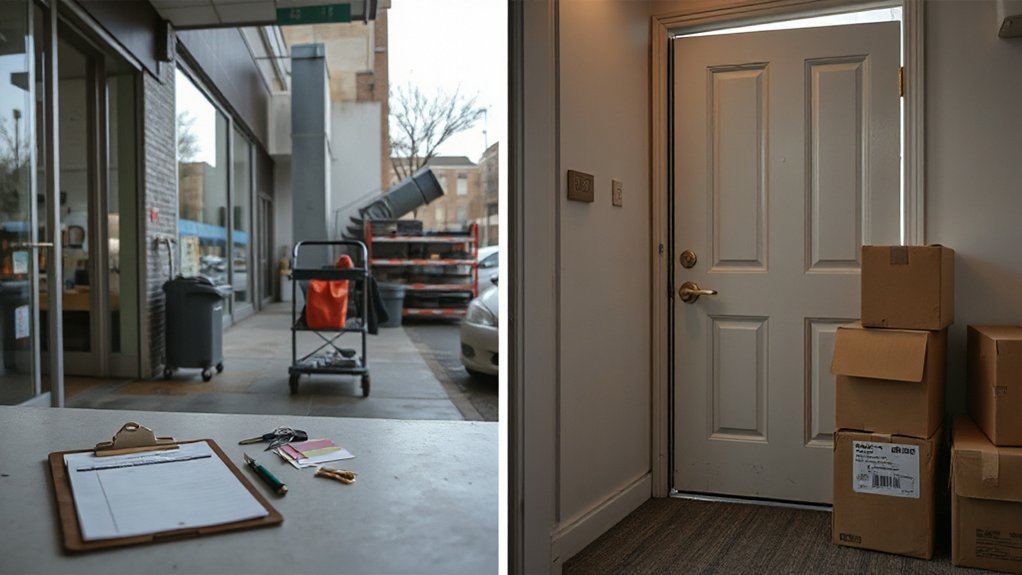
While cash flow grabs the headlines, management workload often determines whether your returns hold up in practice: residential portfolios usually generate high-frequency, low-dollar service calls and recurring turnover costs.
In contrast, commercial assets concentrate effort into fewer but higher-stakes events—capital repairs, CAM budgeting/reconciliations, vendor compliance, and lease-driven build-outs.
To keep workload predictable, you’ll want systems that price time, not just invoices, because maintenance costs balloon when response SLAs slip and scopes creep.
Tenant relations also differ: you’ll field more emotional, immediate requests in residential, but you’ll negotiate tighter documentation and notice requirements in commercial.
- Track work orders per unit/sf and cost per ticket monthly.
- Standardize CAM caps, audit rights, and reconciliation timelines.
- Model turnover: make-ready days, leasing commissions, TI, and downtime.
Market Cycles: Which Is More Recession-Sensitive?
When a recession hits, you’ll see residential demand supported by household formation and necessity housing, while commercial absorption tracks business revenue, employment, and capex cuts.
You can lock in longer terms with many commercial leases, but you’ll face sharper renewal risk at rollover and more tenant-specific exposure than with shorter residential leases that reset rents faster.
You also need to underwrite credit and vacancy risk differently: one weak anchor or a wave of tenant defaults can spike downtime in commercial, while residential typically spreads that risk across more payers.
Recession Demand Drivers
Even though both asset classes feel pressure in a downturn, commercial real estate typically shows wider performance dispersion because demand ties directly to business revenues, hiring, and credit conditions. To gauge recession resilience and demand stability, track which end-users can keep paying and operating when GDP and lending tighten.
Residential demand often anchors to household formation and “trade-down” behavior, while many commercial categories reset with capex cuts, store closures, and delayed expansions.
- Follow employment mix: markets heavy in logistics, healthcare, or government support steadier absorption than office- or discretionary-retail hubs.
- Watch consumer baskets: grocery-anchored centers outperform experiential corridors when real wages fall.
- Monitor financing: spreads and bank pullbacks hit construction pipelines, creating vacancy risk in cyclical sectors and faster repricing.
Lease Stability Differences
Because leases govern your cash-flow “stickiness,” the biggest cycle difference shows up in how fast revenue resets: residential rents typically reprice within 6–18 months as 1-year leases roll.
Whereas many commercial assets lock in 3–10+ year terms that delay pain but can concentrate it at rollover. In a downturn, you’ll feel residential softness sooner, but you can also recover faster as comps rebound and you adjust renewals.
With commercial, you’ll spend more time on Lease negotiations, indexing, concessions, and renewal options; structure matters because CPI bumps, fixed steps, or percentage rent change how quickly NOI tracks inflation and demand.
To improve tenant retention, you’ll budget for renewal TI, right-size escalations, and start renewal outreach 9–18 months ahead so rolldowns don’t cluster.
Credit And Vacancy Risk
Lease length dictates how quickly cash flow reprices, but tenant credit and vacancy determine how hard a recession actually hits your NOI. In commercial, you’re underwriting fewer, larger tenants; one default can wipe out months of rent, and re-leasing often requires TI, concessions, and longer downtime.
Residential spreads risk across many leases, so vacancy usually rises in smaller increments, but collections can soften fast when layoffs spike. Tenant diversity and local job mix matter more than asset class labels, so stress-test DSCR and break-even occupancy.
- Track rollover: % rent expiring in 12–24 months and top-tenant concentration.
- Model recession vacancy: 5–15% office/retail vs 3–8% multifamily.
- Budget opex shocks: higher Maintenance frequency in resi, higher capex/TI in CRE.
Exit Options: Selling Commercial vs Residential Smoothly
While both asset classes can deliver a clean exit, you’ll typically sell residential faster and with more price transparency, whereas commercial sales hinge on income performance and buyer underwriting.
Single-family comps update weekly, and buyer pools are deep, so you can price to market and close in 30–60 days, assuming clean inspections and financing. With Market segmentation, you’ll target retail buyers, small investors, or iBuyers, reducing days-on-market volatility.
Commercial exits take longer because buyers re-trade value off NOI, cap rates, and lease rollover. Expect 90–180+ days, plus lender scrutiny of DSCR, tenant credit, and trailing-12 income.
To sell smoothly, stabilize occupancy, document expenses, and pre-negotiate renewals. Investment diversification helps too: a broad tenant mix or multiple units lowers perceived risk and widens bidder demand.
Frequently Asked Questions
How Do Tax Benefits Differ Between Commercial and Residential Investments?
You’ll typically claim faster Tax depreciation on commercial assets and deduct more operating expenses, while residential depreciation runs longer. On sale, Capital gains rates apply; commercial often triggers higher recapture, but 1031 exchanges can defer taxes.
What Insurance Coverages Are Unique to Commercial Properties Versus Residential?
You’ll need broader commercial coverages: general liability, business interruption, equipment breakdown, commercial auto, and E&O, plus higher limits. Residential focuses on dwelling, personal liability, loss-of-rent. You’ll still manage Tenant screening, Property maintenance.
How Does Zoning Impact Allowable Uses and Future Redevelopment Potential?
Zoning restrictions dictate your allowed uses, density, height, parking ratios, and setbacks, shaping ROI. You should verify permitted uses, variances, and overlay districts, because they directly cap Future redevelopment potential and entitlement timelines.
Can Investors Use 1031 Exchanges Differently for Commercial and Residential Assets?
Yes—you can, because 1031 rules hinge on like-kind business/investment use, not asset class. Like swapping chess pieces midgame, you’ll defer gains. Track Property valuation and Market trends; I’ve rolled rentals into triple-net deals.
What Legal Liabilities Vary Between Commercial Landlords and Residential Landlords?
You’ll face stricter Tenant rights, habitability, fair-housing, and security-deposit liabilities in residential; commercial shifts risk via negotiated Lease agreements. You must meet OSHA/ADA, disclose hazards, and carry higher premises-liability exposure for public access.
Conclusion
If you want steadier demand and simpler financing, residential usually fits faster; you’ll trade higher turnover for easier exits. If you can underwrite leases, expense recoveries, and cap-rate risk, commercial can drive stronger cash flow, but vacancies hit harder and funding is tighter. You’ll value commercial on NOI and cap rates, not comps, so operations matter daily. Pick the asset that matches your time, risk tolerance, and liquidity needs—it’s like switching on a cash-flow firehose.