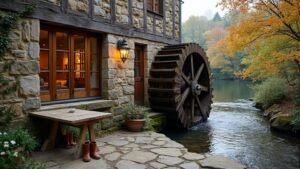
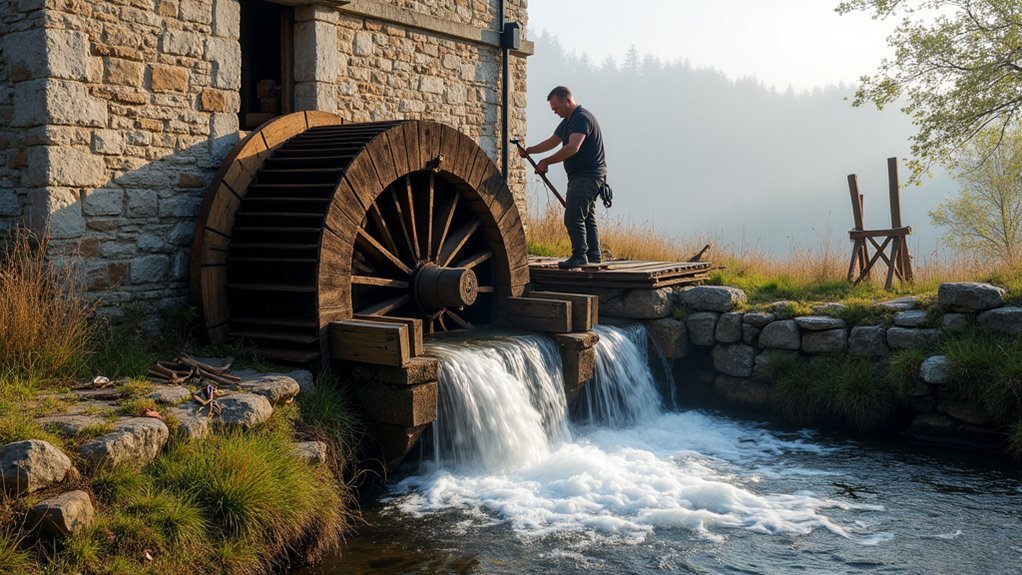
Take a derelict 18th‑century water mill on the River Wye: you start by fixing the end use, then you survey head and flow, inspect the leat, sluices, and masonry, and check what’s left of the wheel, pit gear, and line shaft. You’ll map the original layout, secure abstraction consent and listed-building approval, and rebuild channels to modern safety and fish-pass standards. Once you recommission the drivetrain and add guards and controls, the real constraints appear…
Key Takeaways
- Define the mill’s end use, throughput targets, and product specifications, aligning operations with food hygiene, staffing, and market requirements.
- Secure abstraction, impoundment, and heritage consents, documenting historic use, flow constraints, fish passage, and reversible interventions for listed structures.
- Assess head, flow variability, and hydraulic losses, then inspect millrace, pond, sluices, and tailrace for leakage, siltation, scour, and damage.
- Map the original layout and create a tagged parts inventory, linking each component’s dimensions, materials, and condition to heritage records.
- Restore and recommission wheel/turbine and gearing, then add guarding, safe access, controls, and a maintenance plan validated by load testing.
Define the Water Mill’s End Use and Output
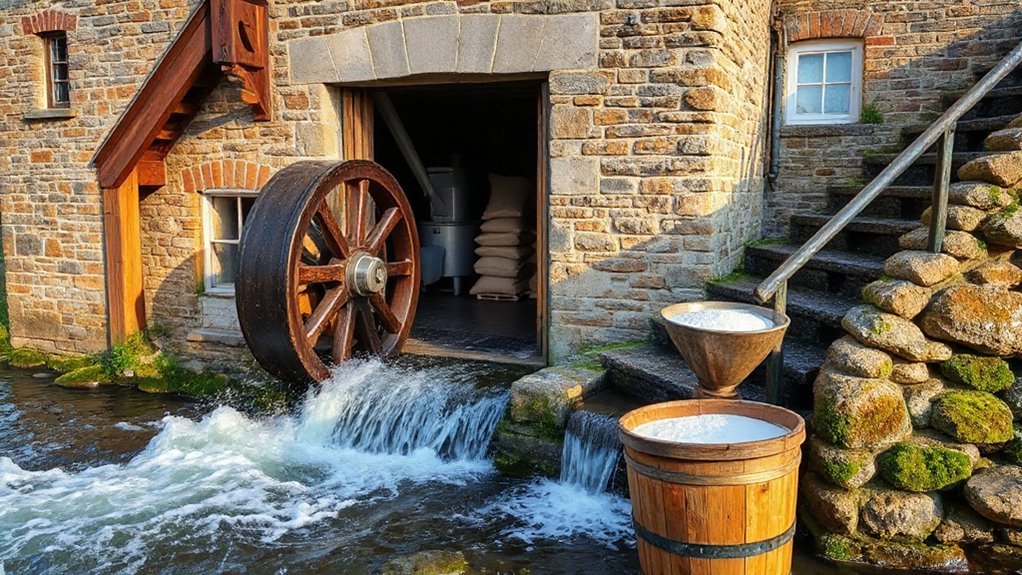
Before you touch the headrace or order new stones, you need to pin down exactly what the mill will produce and for whom, because end use drives every engineering and compliance decision.
Decide whether you’re milling flour, pressing oil, sawing timber, generating electricity, or running a mixed heritage-and-trade operation.
Quantify target throughput (kg/hour), duty cycle, and product specification (ash content, particle size, moisture), then map these to staffing, hygiene regimes, and packaging.
If you’ll sell food, align with UK Food Standards Agency guidance and plan traceability.
If you’ll export power, define kW rating, grid-connection route, and Hydropower efficiency targets.
For Historical preservation, set which fabric must remain untouched and where reversible interventions are mandatory.
Write a brief, measurable output statement.
Survey the Water Mill Site: Head, Flow, and Condition
You’ll start on site by measuring gross and net head and confirming the available fall between the upstream level and the tailrace, using staff gauges or differential GPS where access allows.
You’ll then characterise streamflow variability across seasons, checking low-flow constraints, abstraction limits, and any Environment Agency records against your own spot measurements.
Finally, you’ll inspect the millrace, weir, sluices, wheelpit, and associated masonry for leakage, siltation, scour, and structural movement, noting defects that’ll govern repair scope and safe operation.
Measure Head And Fall
Once you’ve confirmed the leat and tailrace still connect cleanly through the site, measure the available head and fall, because they dictate the mill’s achievable power far more reliably than anecdote.
Set a temporary datum on stable masonry, then run a level and staff from upstream water surface at the control point to the tailwater surface.
Record head at working flows if possible, but don’t infer it from wheel diameter alone.
Note backwater effects at the outfall and any weir crest levels, as these constrain usable fall.
Check invert levels through culverts and penstocks for hidden drops and losses.
Document results for Historical preservation consents and for community engagement discussions, presenting clear sections, chainage, and photographs with a scale bar.
Assess Streamflow Variability
Although the measured head sets the theoretical ceiling, streamflow variability governs how often you can actually use it, so survey the watercourse across seasons rather than relying on a single site visit.
You’ll log spot gaugings at baseflow and after rainfall, then correlate them with EA gauging-station records and catchment area to derive a provisional flow-duration curve.
Use simple staff-gauge readings tied to a datum, and note any abstractions, discharges, or upstream impoundments that skew natural regime.
For streamflow forecasting, combine Met Office rainfall data with soil moisture and antecedent conditions to estimate dependable winter and summer yields.
Quantify drought frequency, spate peaks, and sediment transport risk, and document climate impact by comparing recent hydrographs with long-term normals and projections.
This defines workable hours and safe operating windows.
Inspect Millrace And Works
Streamflow records tell you when water’s available; the millrace and associated works determine whether you can take it safely and efficiently. Walk the leat from intake to wheelpit, checking lining integrity, bank stability, and evidence of scour, seepage, or burrowing.
Measure head at operating level, confirm invert levels, and note constrictions that raise losses or trap debris.
Inspect the weir, sluices, penstock, and trash screen for corrosion, timber decay, bent guides, worn seals, and safe access for raking. Verify stop-log grooves and bywash capacity for spate conditions typical of UK catchments.
Photograph, map, and record fabric to support Historical preservation. You’ll also brief neighbours and angling clubs early, building community engagement around maintenance windows and flow management.
Map the Original Water Mill Layout and Missing Parts
Before you source timber or cast new ironwork, you need a measured map of the mill’s original layout and a clear schedule of what’s missing. Start with a taped baseline and datum, then record wall thicknesses, bearing pockets, penstock centres, and wheel-pit geometry. Photograph every interface, and tag surviving fasteners so you can match threads and pitches to British standards.
For Historical preservation, you should cross-check your survey against parish records, insurance plans, and any surviving millwright’s marks. For community engagement, invite local historians to identify altered bays, blocked doors, and removed gearing.
Build a parts register that links each item to dimensions, material, and condition:
- Power train: shafting, couplings, hangers
- Waterwheel: buckets, sole boards, axle
- Stones: spindle, tentering, bridge tree
- Ancillaries: sluices, racks, governors
Get Water Rights and Heritage Approvals
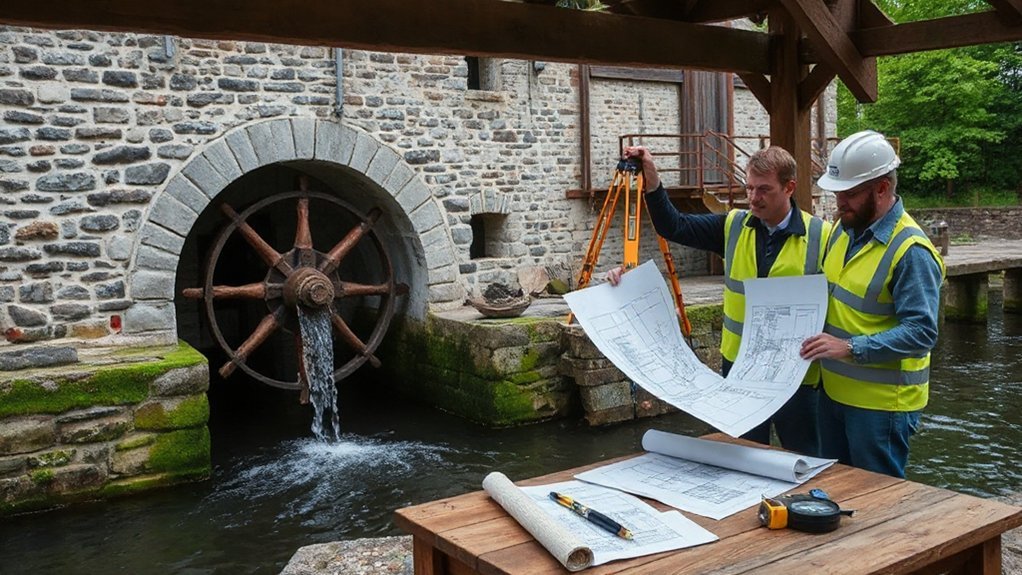
Once your survey pins down the intake, wheel-pit, and tailrace levels, you must secure the legal right to abstract and return water and obtain the heritage consents that govern any alteration to the fabric.
In England, you’ll typically engage the Environment Agency on abstraction/impoundment licensing and flow conditions, evidencing hands-off flows, fish passage constraints, and flood-risk implications. You should document historic usage, current catchment pressures, and operating hours, then agree monitoring and reporting duties for Legal compliance.
In parallel, you’ll consult the Local Planning Authority’s conservation officer and, where listed, apply for Listed Building Consent (and possibly Scheduled Monument Consent).
You must justify interventions against the mill’s Cultural significance, provide a heritage impact assessment, and specify reversible methods, materials, and recording requirements.
Rebuild the Mill Race, Sluice Gates, and Pond
With abstraction conditions and heritage consents agreed, you can move from paperwork to physical water management by reinstating the mill’s hydraulic chain: the mill race, sluice gates, and mill pond.
You’ll survey levels, set out the original alignment, and reinstate banks with clay puddle or geotextile where appropriate, keeping permeability consistent with Historical preservation.
You must clear silt, remove invasive roots, and rebuild revetments in stone or timber to match local vernacular.
- Re-profile the race to design section, maintaining freeboard and avoiding pinch points.
- Rebuild head- and tail-sluices with hardwood, stainless fixings, and accessible penstocks.
- Dredge and de-water the pond, then stabilise the bund, spillway, and overflow weir.
- Add screens, bywash controls, and safe access, and document works for community engagement.
Restore or Upgrade the Water Wheel or Turbine
You’ll start by checking the wheel’s structural integrity, inspecting the hub, arms, shrouds and buckets for rot, corrosion, cracked fastenings, misalignment, and bearing wear. Then confirm clearances and run-out against the original drawings where available.
If the wheel’s beyond economical repair or you need more output, you can specify a turbine retrofit—typically a low-head Kaplan, crossflow, or Archimedes screw—matched to your measured head, flow, and available penstock geometry.
You’ll then compare efficiency gains against heritage constraints, grid connection requirements, and UK consenting, so the upgrade improves performance without compromising the mill’s character.
Assess Wheel Structural Integrity
Before you commit to any refurbishment, inspect the water wheel or turbine as a load-bearing machine rather than a picturesque relic: check the main shaft for run-out and journal wear, measure bearing clearances, and look for cracked hubs, distorted buckets/paddles, and localised thinning from corrosion or abrasion.
Balance historical preservation with aesthetic considerations by documenting original section sizes, fasteners, and timber or wrought-iron details before you touch anything.
Then verify capacity against present duty: you’ll need evidence, not guesswork. Use simple, defensible checks:
- Set up a dial gauge on the shaft and record total indicated run-out at several stations.
- Sound and probe timbers/plates; map softening, pitting, and edge loss.
- Inspect rivets, keys, and cotters for fretting; torque-test accessible bolts.
- Check alignment to the launder and tailrace; note uneven loading and washback.
Select Turbine Upgrade Options
Your run-out readings, wear maps, and alignment notes now need turning into an upgrade decision: restore the existing wheel/turbine as-built, or replace the hydraulic prime mover with a modern unit that still suits the site and its constraints.
If the wheel’s crown, buckets, and shafting can be trued within tolerances, restoration preserves heritage, keeps civils unchanged, and limits consenting risk. You’ll still address bearing clearances, seal leakage, and guide geometry to claw back turbine efficiency.
If losses stem from poor part-load behaviour or cavitation, you’re better specifying a low-head Kaplan, crossflow, or Archimedes screw, matched to measured flow duration and net head.
Check generator speed, gearbox ratios, trash screen headloss, and fish passage.
Run hydropower economics with capex, O&M, and export tariff.
Recommission the Water Mill Gearing and Machinery
- Inspect the pit wheel, wallower, and crown wheel: check tooth profiles, lash, and run-out. Dress wooden cogs or replace like-for-like.
- Verify shaft journals, plummer blocks, and thrust faces: scrape to fit, set end-float, and oil with appropriate grades.
- Rebuild the auxiliary drives: tension belts, true pulleys, and set clutch take-up to avoid shock loading.
- Test under load: measure temperature rise, vibration, and noise. Then retighten fasteners and recheck mesh.
Add Guards, Safe Access, and Control Systems
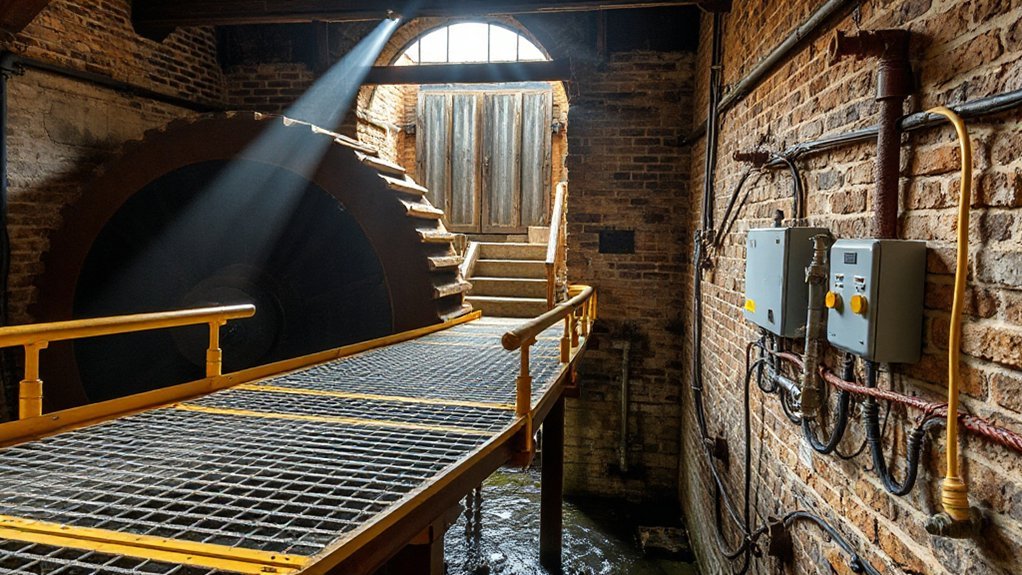
Once the gearing turns smoothly under load, you must treat guarding, access, and controls as integral to the mill’s recommissioning, not an afterthought. Fit fixed guards to spur gears, belts, and line-shafts, with interlocked hinged panels where inspection is required, keeping clearances tight and fixings tamper-resistant.
Provide safe access with galvanised walkways, toe-boards, handrails, and non-slip grating. Add task lighting and marked exclusion zones around pinch points.
Install lockable isolators for electric drives, and a clearly labelled stop system: mushroom E-stops at ingress points, a pull-cord along the machinery line, and a local reset that prevents unexpected restart.
Document security measures for public areas, and post emergency protocols covering flooding, entanglement, and fire response.
Train operators on permit-to-work basics.
Commission the Water Mill and Plan Maintenance
With guards fitted, safe access in place, and stop/isolation circuits proven, you can commission the mill in a controlled sequence and lock in a maintenance regime before regular operation starts. You’ll validate water levels, penstock response, and governor action, then run unloaded to check vibration, bearing temperature, and leakage. Record baseline readings to support Historical preservation and provide evidence for insurers and the Environment Agency.
Build community engagement by hosting a supervised proving day and explaining operating limits.
- Prove interlocks, overspeed trip, and E‑stop under dry and wet conditions.
- Align shafts, set belt tension, and confirm coupling runout within tolerance.
- Load-test progressively, logging flow, torque, output, and power factor.
- Schedule lubrication, debris clearance, seal inspection, and annual condition monitoring.
Frequently Asked Questions
How Much Does It Cost to Insure a Restored Working Water Mill?
You’ll typically pay £2,000–£10,000 annually; Insurance costs depend on rebuild value, flood risk, liability limits, and machinery cover. Declare Restoration expenses, secure listed-building consent, and commission surveys, or underwriters’ll surcharge or decline.
Can a Restored Mill Qualify for Renewable Energy Grants or Tax Incentives?
Yes, you can, if you install compliant micro-hydropower and meet hydropower regulations. You’ll often access UK grants, Feed-in-style support, or tax relief when historic preservation consents align with planning, grid-connection, and metering requirements.
What Visitor Amenities Are Needed if the Mill Operates as a Public Attraction?
You’ll need accessible parking, clear wayfinding, ticketing, toilets, and a small café/retail area. Provide interpretation boards supporting Historical preservation. Guarantee visitor safety with guarded machinery, non-slip routes, handrails, first aid, and compliant fire exits.
How Do You Market and Sell Products Made by a Working Water Mill?
You market and sell by turning every product into a turning wheel: story, craft, provenance. Use Artisanal branding, clear batch labels, and British compliance. Build Local collaborations, run tastings, supply farm shops, and sell online.
What Staffing or Training Is Required to Operate the Mill Daily?
You’ll need operational staffing: a trained miller/technician for daily starts, monitoring and shutdowns, plus cover for holidays. Staff training must include HSE risk assessments, LOTO, guarding, water-level control, routine maintenance, and emergency response.
Conclusion
When you’ve nailed the head and flow, squared away rights, and rebuilt every inch of race, gate, and pond, you won’t just “restore” a mill—you’ll practically bend time. You’ll spin a wheel or turbine that’ll feel capable of powering half the parish, then watch gears mesh like they’ve never slept. With proper guards, access ladders, and sensible controls, you’ll commission it safely. Keep to a strict maintenance log, and it’ll outlast your grandad.