Modern exterior finishes last when you choose durable claddings and install them as tested assemblies, not just attractive panels. Start with a clean, dry, sound substrate, verify moisture/salts per SSPC/NACE, and prime for the material. Detail a drained, ventilated rainscreen with flashing, end dams, and weeps, and specify ASTM E331/E547 (water) and E330 (wind). Brick can run 75–100+ years; fiber cement and HPL offer decades with periodic sealant checks. Next, match systems to your climate.
Key Takeaways
- Choose proven long-life materials like brick, HPL panels, fiber cement, or metal, balancing lifespan, installed cost, and maintenance cycles.
- Prioritize meticulous substrate prep: clean, dry, sound surfaces; verify moisture, salts, and profile; remove chalking, mill scale, and loose paint.
- Specify tested assemblies with drainage: continuous WRB, rainscreen cavities, flashed openings, end dams, weeps, and pressure-equalized joints to limit leaks.
- Require standards-based performance: ASTM E331/E547 for water penetration, E330 for wind load, and C1063/C926 for durable stucco systems.
- Match finishes to climate stressors: UV-stable pigments for heat, ventilated claddings for humidity, and low-absorption masonry with flexible sealants for freeze–thaw.
What Makes an Exterior Finish Last Longer?
Although every exterior coating ages in sun, rain, and temperature swings, the finishes that last longest share the same fundamentals: a substrate that’s clean, dry, and sound; proper surface preparation and priming matched to the material; and a system applied at the manufacturer’s specified film thickness with correct cure conditions.
You extend service life by verifying moisture content, soluble salt contamination, and profile per SSPC/NACE guidance, then removing chalking, mill scale, and loose paint.
You prevent premature failure when you honor recoat windows, edge-stripe metals, and seal end-grain on wood.
Choose chemistry for exposure: UV-stable topcoats, vapor-permeable systems for masonry, and compatible elastomerics for movement joints.
For Historical preservation, you specify reversible, breathable layers and minimal-abrasion prep.
Pair that with innovative application—controlled spray, back-rolling, and wet-film gauges—to hit spec.
Exterior Finish Lifespan Chart (Cost + Upkeep)
When you compare exterior finishes by lifespan, don’t look at years alone—pair service life with installed cost per square foot and the upkeep cycle required to keep the system within spec. Your chart should list: cladding type, expected service life, $/sf installed, recoating/cleaning interval, and critical failure modes.
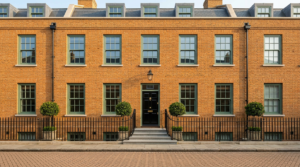
Brick: 75–100+ years, $20–$40/sf, repoint 30–50 years; watch flashing and weeps.
Stucco (3-coat): 30–50 years, $10–$18/sf, recoat 8–12 years; control cracking with proper lath and joints.
Aluminum siding: 30–50 years, $6–$12/sf, wash yearly; avoid denting.
High-pressure laminate panels: 40–60 years, $15–$30/sf, inspect sealants 5–10 years.
Track Color customization and verify installation techniques meet manufacturer details.
Fiber Cement Exterior Finish: Long Life, Easy Repainting
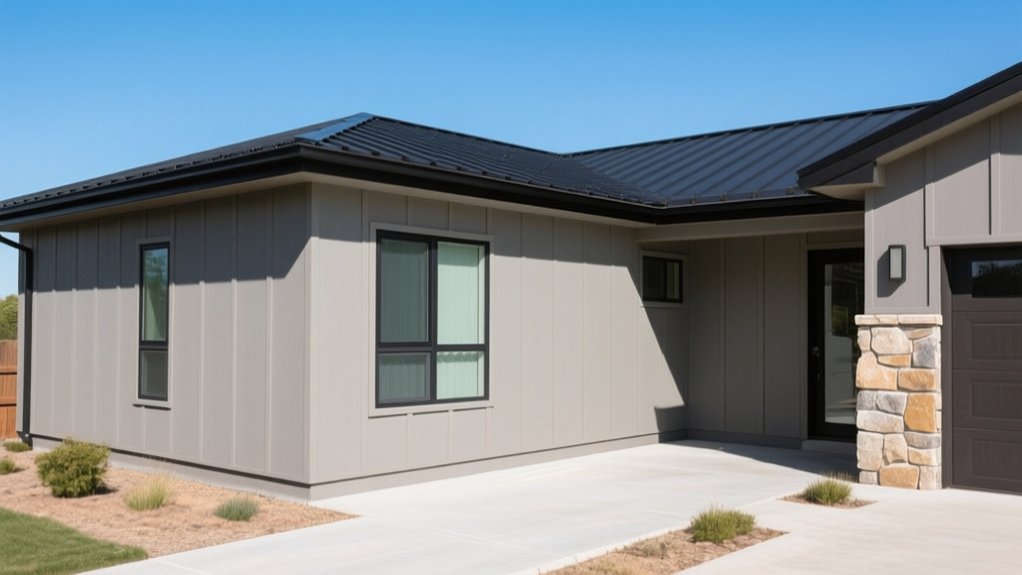
If you want an exterior finish that holds up to UV, wind-driven rain, and freeze–thaw cycling, fiber cement gives you stable, impact-resistant cladding when it’s installed per manufacturer specs and flashed to code.
You’ll get strong weather resistance without the rot and insect risk that drives premature repainting in wood systems.
When the coating eventually weathers, you can clean, spot-prime, and repaint on a predictable cycle with standard exterior paint systems and basic maintenance.
Durability And Weather Resistance
Because fiber cement combines Portland cement, silica, and cellulose into a dimensionally stable panel, you get an exterior finish that holds up under UV exposure, wind-driven rain, freeze–thaw cycling, and impact better than many wood-based claddings. You’ll see fewer checks, warps, and edge failures where fasteners and joints concentrate stress.
Specify products tested to ASTM E84 for surface burning characteristics and ASTM E330 for structural performance under wind pressure.
In high-rain zones, follow a drained-and-ventilated rainscreen approach per code to manage bulk water and drying.
Factory-applied Weatherproof coatings improve water shed and reduce surface erosion, supporting long-term Paint durability at cut edges and field joints. You also limit moisture uptake, so dimensional change stays low and sealant joints work within design movement ranges.
Simple Repainting And Maintenance
That same stability under sun, rain, and freeze–thaw also simplifies upkeep: fiber cement holds paint films longer and makes repainting a predictable, low-disruption task.
You’ll clean annually with low-pressure water and a mild detergent, then inspect joints, flashings, and penetrations to keep the water-resistive barrier performing per manufacturer instructions.
Spot-prime any exposed substrate and reseal with a compatible, paintable sealant before topcoating.
When it’s time to repaint, you can scuff-sand gloss, remove chalking, and apply a 100% acrylic exterior system at the specified mil thickness and spread rate.
Plan Color coordination across trim and field, and use texture contrast with smooth panels versus cedar-grain boards to refresh the façade without changing the substrate.
Engineered Wood Exterior Finish: Fights Rot and Warping
When you specify engineered wood siding, you’re relying on rot-resistant composite layers that are manufactured to shed moisture and limit fungal decay exposure.
You also get a warp-control core design that stabilizes the panel by balancing stresses and reducing swell/shrink cycling.
Verify compliance with the manufacturer’s installation standard—especially edge sealing, fastener spacing, and required clearances—so the system performs as rated.
Rot-Resistant Composite Layers
Although traditional wood siding can wick water through end grain and fastener penetrations, rot-resistant composite layers in engineered wood finishes block moisture pathways and stabilize the panel. You get a sealed interface where fibers and resins limit capillary uptake, so fungal decay can’t stay active.
- Specify products that document ASTM D1037 moisture cycling and show low thickness swell after soak tests.
- Detail fasteners per manufacturer requirements and verify the factory-applied overlay fully encapsulates edges you’ll expose during cuts.
- Maintain code-required clearances and drainage planes so the composite layer works as designed, not as a bandage.
This composite material innovation gives you predictable field performance because it reduces wetting potential at the surface, where failures often start, and it supports consistent coating adhesion over service life.
Warp-Control Core Design
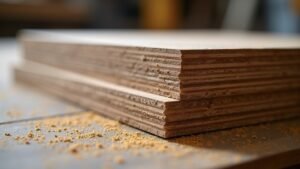
Because panel geometry drives long-term flatness, a warp-control core design uses balanced veneers/strands, aligned grain orientation, and uniform resin distribution to limit differential swelling across the thickness.
You’ll see this in engineered wood siding and trim where cross-banded plies or oriented strands cancel moisture-driven stresses. Specify products tested to relevant standards (e.g., ASTM D1037 for mechanical properties and thickness swell, ASTM D4442 for moisture content) and verify edge-seal and face-coating compatibility.
Good warp control technology also requires tight density profiles and consistent press parameters so the core doesn’t telegraph. With core material innovation, manufacturers tune strand geometry, adhesive chemistry, and wax loadings to reduce cupping and bowing.
You should demand documented exposure cycling and straightness tolerances before installation.
Composite Cladding Exterior Finish: Low Upkeep Looks
How do you get the clean lines of modern cladding without committing to a high-maintenance repaint cycle? Specify composite boards with factory-capped surfaces and tested fastening systems. You’ll get Composite cladding benefits like color stability, reduced checking, and consistent joint detailing, while keeping low maintenance options on the table for owners.
- Confirm compliance: check product data for UV exposure ratings, dimensional tolerances, and third-party testing aligned with your local building code.
- Detail the assembly: provide rainscreen gaps, flashed openings, and movement joints; don’t rely on sealant as primary weather protection.
- Control installation: require substrate flatness, correct fastener spacing, and end-cut sealing per manufacturer instructions.
Specify washable finishes and periodic inspections, not repaint schedules, to keep elevations crisp.
Metal Exterior Finishes: Rain, Wind, Fire Resistance
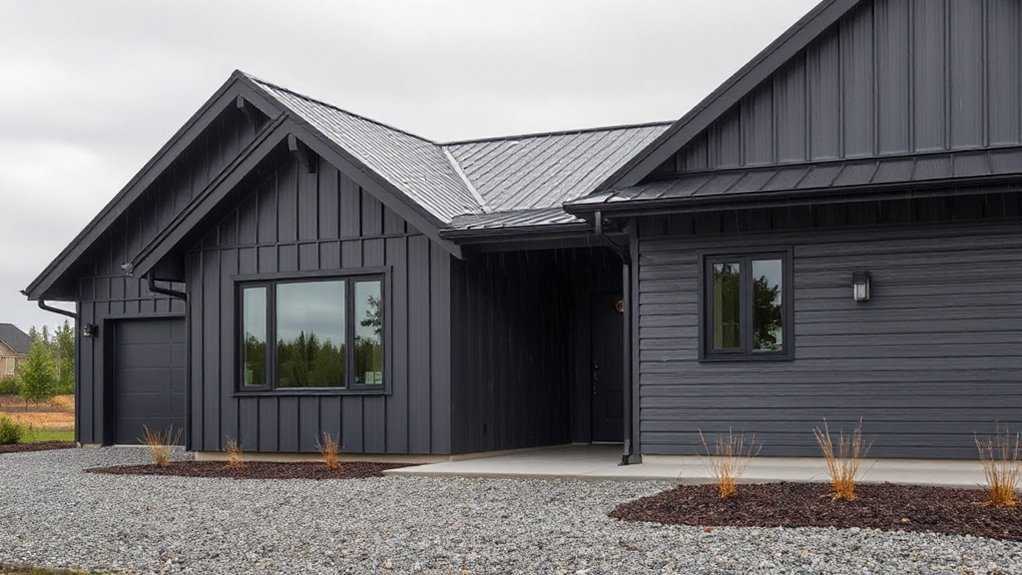
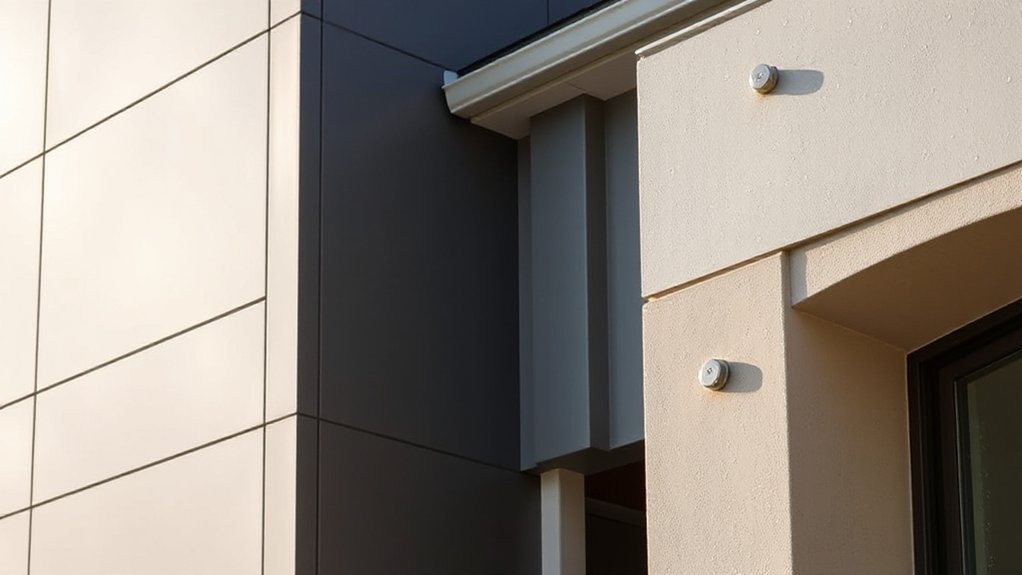
When you need an exterior finish that holds up under driving rain, high wind pressures, and elevated fire risk, metal cladding systems give you measurable performance instead of finish-dependent durability. Specify tested assemblies, not just panels: demand ASTM E331/E547 water-penetration compliance, ASTM E330 structural load ratings, and verified air-barrier continuity.
You’ll control leakage by detailing rainscreen cavities, end dams, and pressure-equalized joints, then confirming shop drawings match field conditions.
For wind, set fastener spacing and subgirt design from site-specific wind loads, then require pull-out and clip tests.
For fire, choose noncombustible substrates and Fireproof coatings with documented classification to ASTM E84 and assembly performance where applicable.
You can still get Metal textures via embossed, anodized, or PVDF finishes without compromising these criteria.
Brick, Stone, and Veneer Exterior Finishes: Decades of Durability
- Provide a continuous WRB, drainage plane, and flashing with end dams at heads, sills, and bases; add weeps and ventilation where required.
- Design a reliable backup and anchorage: stainless ties/anchors, proper embedment, and corrosion separation; don’t exceed allowable spans.
- Manage movement with control/expansion joints, soft joints at dissimilar materials, and flexible sealants at penetrations; verify compatibility.
Stucco and EIFS Exterior Finishes: How to Prevent Cracks
Although stucco and EIFS can deliver long service lives, they’ll crack quickly if you don’t control substrate movement, moisture, and detailing at junctions. Start with a stable, code-compliant sheathing and fastening schedule, and verify allowable deflection before you install lath or foam.
Use ASTM C1063/C926 practices for stucco thickness, curing, and lath attachment; follow the manufacturer’s EIFS details for basecoat, mesh laps, and minimum embedment.
You’ll reduce stress by placing control/expansion joints at changes in substrate, floor lines, and re-entrant corners, and by keeping joint spacing within published limits.
Manage water with a continuous WRB, properly integrated flashings, and sealed penetrations.
Finish confidently with Texture options and color customization, but don’t substitute aesthetics for proper detailing.
Best Exterior Finishes by Climate (Hot, Wet, Freeze)
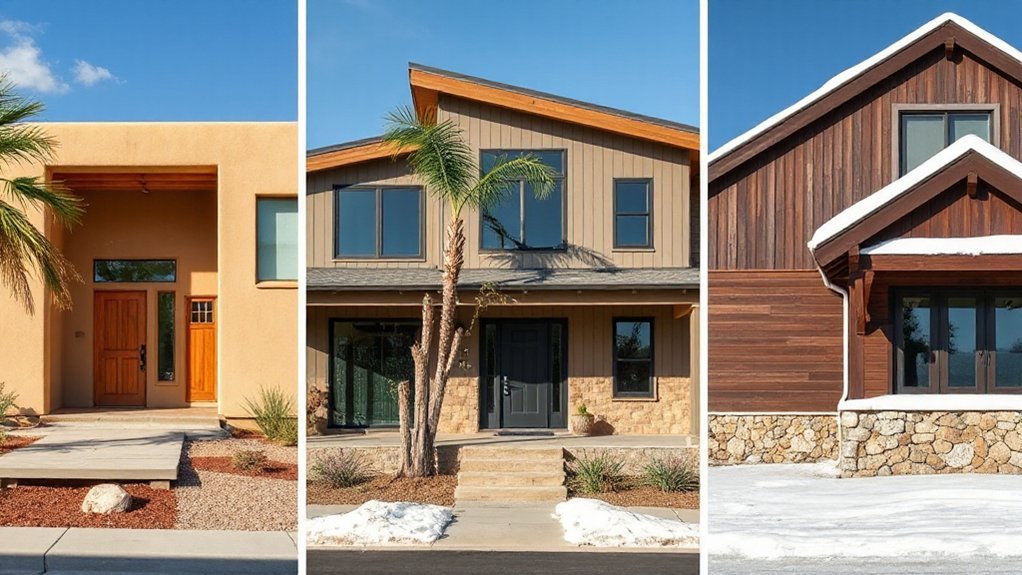
Because climate drives moisture load, UV exposure, and thermal movement, you’ll get the longest service life by matching the finish system to the dominant local stressor—heat, bulk water, or freeze–thaw cycling—rather than defaulting to a single “all‑purpose” cladding.
Use assemblies that meet ASTM/ICC criteria, and detail drainage, joints, and fasteners before you pick textures or sheen.
- Hot/UV climates: Specify light-stable pigments, high-SR “cool” colors, and an innovative coating with tested color longevity. Control substrate temperature swings with ventilated rainscreens.
- Wet/humid climates: Choose drained-and-ventilated claddings, WRBs with taped seams, and factory finishes. Prioritize mildew resistance and back-primed wood.
- Freeze–thaw zones: Use low-absorption masonry or fiber cement, flexible sealants, and capillary breaks. Keep water out of joints, edges, and cut ends.
Frequently Asked Questions
Do Exterior Finishes Affect Home Insurance Premiums or Eligibility?
Yes—your exterior finishes can raise or lower premiums and affect eligibility. You’ll get better rates if you document Exterior material durability and Finishing techniques longevity, meeting fire, wind, and moisture standards insurers underwrite.
Which Exterior Finishes Best Reduce Noise From Traffic or Neighbors?
Sure, trust “thin” finishes—except you’ll want mass: fiber-cement over resilient furring, stucco on insulated sheathing, or brick veneer with air gap. These soundproofing options use noise reduction techniques meeting STC targets; seal joints.
How Do Exterior Finishes Impact Indoor Air Quality and VOC Exposure?
Exterior finishes impact Indoor air quality by driving VOC emissions that infiltrate via gaps, vents, and diffusion. You’ll reduce exposure by specifying low-VOC, third-party certified products, proper curing schedules, and continuous air/water barriers meeting ASTM/ISO.
What Finishes Are Easiest to Clean Graffiti off Of?
You’ll love how vandals “decorate” you—until you choose Graffiti resistant coatings on sealed, nonporous fluoropolymer paints or glazed tile. These Easy to clean surfaces meet ASTM D6578 performance and let you remove tags with mild solvents fast.
Are There HOA Restrictions on Colors, Textures, or Finish Materials?
Yes—most HOAs restrict your Color palette, Texture options, and finish materials through CC&Rs and architectural guidelines. You’ll need pre-approval, match adjacent homes, and use listed products; violations trigger rework, fines, or liens.
Conclusion
You’ll get the longest-lasting exterior finish when you match material to climate, detail it per manufacturer specs, and install to code. Prioritize drainage planes, flashing, back-venting, and corrosion-rated fasteners; then control joints and sealant intervals to limit movement and water entry. Choose fiber cement, composite, metal, masonry, or well-detailed stucco/EIFS based on exposure and maintenance tolerance. Treat your exterior like a ship’s hull: inspect annually, repair early, and it’ll outlast trends.