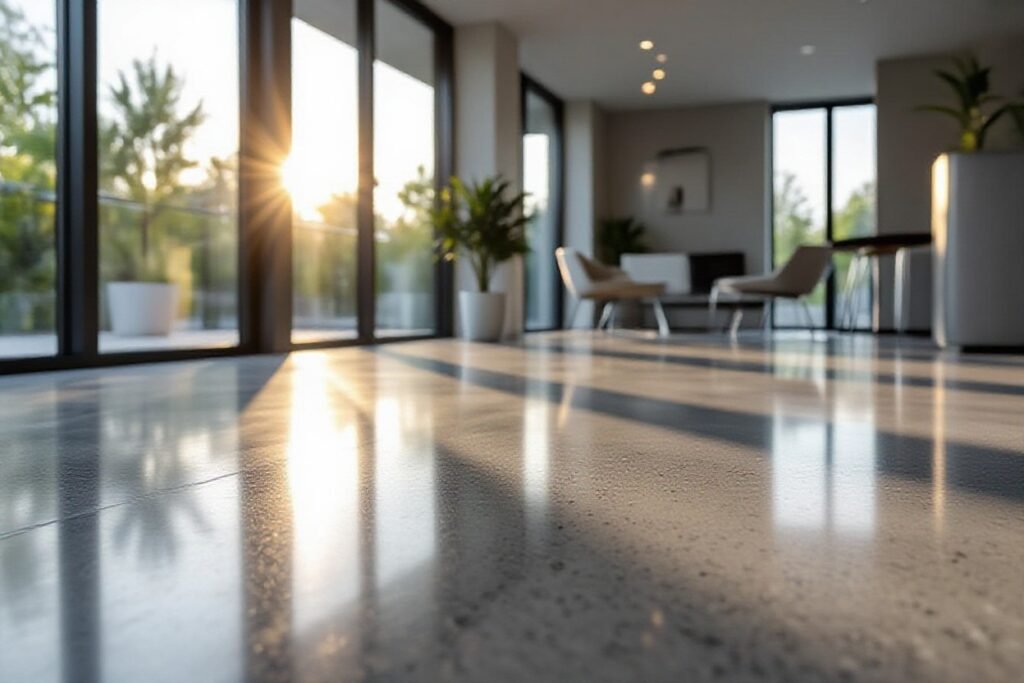
Let’s look at sustainability regarding materials. With polished concrete slashing embodied carbon, cutting energy use and lasting decades, you get a real sustainable win that pays back fast. It’s low-maintenance, often uses what’s already in your slab, and skips toxic sealers so indoor air stays cleaner. Sounds good, right? But be aware, poor prep can trap moisture and wreck the finish, so proper installation matters. You’ll save money, lower emissions, and get a durable floor that actually works for 2026 and beyond.
Why polished concrete is actually a top green choice in 2026
Real energy and emissions wins over the building lifecycle
When you step into a renovated office you notice the floor stays cool on hot afternoons, and that’s not just comfort, it’s thermal mass doing work. Polished concrete smooths temperature swings and can reduce HVAC peak loads by up to 20% in temperate climates, while avoiding frequent replacement of carpets and tiles cuts embodied carbon over time. Industry retrofits often report lifecycle GHG drops of 10-25% versus resilient coverings once maintenance and replacement cycles are counted.
Better indoor air – low VOCs and fewer additives
When you walk into a daycare that swapped vinyl for polished concrete the chemical smell is gone almost immediately. Polished concrete itself off-gasses very little and modern densifiers and water-based sealers typically have very low VOCs, with many meeting GREENGUARD or similar standards. And because there’s no padding or glue to trap fumes, you get lower ongoing emissions and much easier cleaning, so your space just breathes better.
When your facilities team stopped hauling in heavy strippers and solvent cleaners you felt the change – less smell, fewer irritants. Hospitals and schools increasingly spec polished concrete because it reduces VOC sources and dust-trapping fibres, and lets you clean with microfiber and mild detergents instead of solvent cocktails, lowering both cleaning-related emissions and occupational exposure.
Polished concrete helps cut both source VOCs and cleaning-related emissions.
The real deal about durability – it seriously outlasts other floors
You might assume polished concrete is just decorative and fragile; it’s not. With chemical densifiers, stain guards, and staged diamond polishing you get a surface that routinely hits 50+ years in commercial installs, far beyond vinyl or wood. In retail and industrial sites you see decades of foot traffic and forklift use with only periodic burnishing. So your up-front install gives you long-term resilience, lower lifecycle cost, and far fewer headaches down the road.
How wear, impact, and heavy use are handled
You may think impacts and forklifts will wreck it – they usually don’t. Treated and polished slabs increase surface hardness, and targeted topical coatings or epoxy in loading zones take the brunt where needed. Installers routinely spec diamond grits and densifiers for warehouses handling 5,000-10,000 lb lifts; result is minimal pitting, low abrasion and easy spot repairs. Want proof? Industrial facilities often report years of heavy use before any major resurfacing.
Fewer replacements – the sustainability payoff
You might believe every commercial floor needs replacing every decade; polished concrete changes that math. Typical competing floors hit 10-20 year lifespans, while polished concrete commonly stretches to 50 years or more, meaning you cut replacement cycles by multiple factors. That translates to less material waste, fewer transport emissions, and lower embodied carbon across a building’s life – real sustainability, not just green talk.
You probably wonder how that actually reduces environmental impact. When your floor lasts decades you avoid repeated manufacturing, shipping and disposal – the big hidden drains on sustainability budgets. For example, swapping out vinyl every 15 years vs keeping a polished slab for 50+ means you eliminate several cycles of adhesives, backing and fall-off waste, plus the energy to produce replacements. The upshot: fewer interruptions, lower total cost, and a tangible drop in lifecycle waste for your project.
Polished concrete vs other floors – which one should you pick?
Polished concrete often wins on sustainability and total cost of ownership. If you want long life and low waste, polished slabs typically last 25-50 years with minimal upkeep, while carpet usually needs replacing every 5-10 years and vinyl about 10-20. You cut material demand by using the existing slab, lower cleaning water and chemical use, and in many climates the slab’s thermal mass can shave HVAC peaks. Retailers like IKEA and many warehouses choose polished concrete for these practical, low-waste savings.
vs carpet and vinyl – health and maintenance
Polished concrete beats carpet and vinyl for indoor air and cleaning simplicity. You won’t have trapped dust, pet dander or mold reservoirs like carpet, which also hides stains and needs deep-cleaning or replacement every few years. Vinyl can emit VOCs after installation and sometimes contains additives you may want to avoid. With polished concrete you mop or auto-scrub, use far less detergent, and cut allergen loads-so if someone in your home has asthma or chemical sensitivity, your air quality improves.
vs hardwood and tile – longevity and recyclability
Polished concrete gives you long life and on-site material reuse that hardwood and tile often can’t match. You get 25-50+ years with little intervention; tile can last decades but grout requires resealing and repair, and hardwood needs periodic refinishing and careful sourcing. Because you often finish the existing slab, polished concrete reduces new-material demand and landfill waste-concrete can be crushed for aggregate or left in place as the finished floor, which is a clear sustainability advantage.
Don’t overlook upfront emissions and end-of-life fate-they change the lifecycle math. Cement production accounts for roughly 7-8% of global CO2 emissions, so pouring new slab has a carbon cost, but polishing an existing slab avoids that entirely. Reclaimed or FSC hardwood is great and refinishing can add decades, while porcelain tiles are durable but tough to recycle and often end up as waste. Crushing existing concrete for base or new aggregate keeps material in use and substantially reduces landfill and embodied-material impacts.
What about embodied carbon – is it really low?
You care because embodied carbon is what sticks with your building for decades, and with concrete the lion’s share comes upfront. Cement manufacture emits about 0.7-0.9 tCO2 per tonne of clinker, and typical concrete mixes sit roughly in the 200-400 kg CO2e/m3 range depending on cement content and power mix. So yes, polished concrete can be low-carbon – but only if you factor in slab reuse, low-clinker mixes, and onsite decisions that cut material and maintenance over the long haul.
Using and reusing existing slabs vs pouring new concrete
When you keep and polish an existing slab you avoid tons of emissions from new cement, adhesives, and cover-ups – it’s often the single biggest win. For example, skipping 10 m3 of new concrete (about a 100 mm slab over 100 m2) can save roughly 3 tCO2e if your mix is ~300 kgCO2e/m3. So ask: can the slab be patched and polished instead of demoed? Usually the answer pays off big.
Low-carbon mixes, cement alternatives, and carbon tech
You can push down embodied carbon by swapping clinker with SCMs and using carbon-tech. Portland-limestone cement trims clinker by about 10%, slag and fly ash can replace anywhere from 20-70% of cement in mixes, and carbon curing solutions typically cut another 5-10% on top. Combine tactics and you actually make a dent that matters for your project’s lifecycle footprint.
Digging deeper, GGBFS replacements commonly go to 50-70% in structural mixes, fly ash is often used at 15-40% depending on availability, and LC3 (calcined clay-limestone) research shows lifecycle CO2 reductions around ~30% versus OPC in many cases. Carbon injection tech mineralizes CO2 during curing so it’s permanently stored, but supply chains and local standards matter – some regions lack slag or fly ash, and mix designs need testing for strength and setting. You’ll want to pilot mixes and measure actual kgCO2e/m3, not just rely on labels.
Cost and ROI – don’t freak out about the price
You care about dollars and timelines – so here’s the short version: polished concrete usually runs about $4 to $12 per sq ft for typical projects, but it often outlives other floors by decades, needs minimal upkeep, and can cut lighting loads because of high reflectivity. For most homeowners and businesses that means lower lifetime cost and fewer disruptive replacements, so the upfront sticker isn’t the whole story.
Upfront costs, lifetime savings, and simple math
If you’re sizing a 1,000 sq ft job at a mid-range $8/sq ft, that’s $8,000 installed. Compare that to hardwood: maybe $12,000 up front and a $2,000 refinish every 10 years. Do the math over 20 years and polished often wins on total cost because you skip multiple replacements and heavy-maintenance cycles. And don’t forget potential lighting savings of up to 20-30% from better reflectance – that adds up.
Incentives, green credits, and resale value in 2026
You can often stack incentives: LEED points, local utility rebates, and sometimes commercial retrofit grants. Those incentives commonly shave hundreds to thousands off project cost, and homes with verified sustainable upgrades frequently see a 5-10% resale premium – so your floor can actually boost market value, not just save on bills.
Dig a little deeper and you’ll find practical examples: some utilities offer retrofit rebates of a few hundred to a few thousand dollars for durable, low-maintenance finishes; lenders may include energy-efficient improvements in loan underwriting; and green certifications often translate into faster sales. If you’re renovating, get quotes that list eligible rebates and ask your contractor to itemize how polished concrete contributes to LEED or other certifications – that paperwork is what flips incentives from rumor to real cash-back.
My take on installation and maintenance – here’s what I’d expect
With the recent push in 2025 toward low-carbon specs and faster turnarounds, you’ll see installers swapping old methods for high-speed diamond tooling and advanced densifiers that some crews say cut schedules by up to 30-40%. You should expect careful moisture testing up front, staged grinding in several passes, and a day or two for densifier cure before final burnishing; when done right the surface lasts years with modest upkeep, but shortcuts bite you later.
Typical steps, timeframes, and what to watch for
Start with surface prep and moisture testing (ASTM F1869 or F2170), then grind through coarse to fine grits – usually 30/60, 120, 400, then 800+ for a glossy finish. Small rooms can be done in 1-3 days, retail floors in 3-7 days, warehouses in one to two weeks. Watch for residual adhesives, rising moisture, and untreated cracks – those are the usual dealbreakers that add days and cost.
Routine care, when to polish again, and common mistakes
Dust-mop daily, wet-clean weekly with a neutral pH cleaner, and buff high-traffic zones every few weeks; you’ll likely need a light re-burnish or screen-and-buff every 1-3 years in busy spaces, longer in offices – think 5+ years. Avoid waxes and acid cleaners, they build up or etch the surface and force premature restoration.
In practice, set a simple schedule: daily dusting, weekly damp-mop with a microfiber and neutral solution, and monthly walk-throughs to mark scuffed zones. If you see dull bands in aisles, try a quick 800-1500 grit burnish first – it’s cheaper than a full diamond re-polish.
Full re-polishing (diamond grit progression and densifier touch-up) is what you do when scratches penetrate the matrix or when the surface has lost luster across large areas; that typically happens every few years depending on traffic. Common mistakes you’ll run into: using black scrubbing pads that are too aggressive, layering topical finishes over polished concrete, and ignoring joint movement – all of which lead to uneven sheen, trapped dirt, or cracking.
To wrap up
Now, surprisingly, the slab under your floor can be your greenest move yet, reusing materials, cutting waste and lasting for decades, so you dodge repeat renovations and big embodied-carbon hits. You get low maintenance, better thermal performance that shrinks energy bills, and design flexibility – sounds odd, but sustainable and stylish do mix. Why wouldn’t you pick it? It’s practical, proven, and a smart long-term bet for your building.