
In 2024, you’ll spot emerging real estate markets by matching net in-migration and job gains (tech, healthcare, logistics) against permits velocity, units under construction, absorption, and vacancy below 5%. You’ll want rent growth beating inflation, shrinking concessions, and faster days-on-market, plus cap rates stabilizing in walkable, transit-served infill. Watch design cues—adaptive reuse, mixed-use nodes, and streetscape upgrades—that convert demand into pricing power. Up next, you’ll see which metros and metrics lead.
Key Takeaways
- Identify emerging markets via rising absorption, faster days-on-market, rent growth above inflation, and stabilizing inventory, prices, and cap rates.
- Track leading indicators like permit velocity, job postings, airport traffic, and school enrollment to spot early-cycle growth.
- Prioritize metros with strong in-migration, household formation, and resilient job growth in tech, healthcare, and logistics.
- Watch submarket supply-demand balance: new deliveries versus absorption, vacancy under 5%, and Class B rent growth outperforming Class A.
- Consider 2024 high-growth contenders: Austin/Raleigh outer rings, Boise/Colorado Springs, Columbus/Indianapolis, plus Tampa–St. Pete and Sacramento infill nodes.
What Is an Emerging Real Estate Market in 2024?

Even if you’ve tracked hot metros for years, an emerging real estate market in 2024 isn’t just “the next big thing”—it’s a city or submarket where the data shows accelerating demand ahead of full pricing maturity. You spot it when absorption rises, days-on-market compresses, and rent growth outpaces inflation without the froth of peak-cycle bidding.
You’ll also see Market stabilization: price volatility narrows, inventory finds a new equilibrium, and cap rates stop drifting. Demographic shifts do the heavy lift—new households, inbound employers, and higher-earning renters reshape unit mix toward flexible layouts, home offices, and walkable amenities.
You don’t chase hype; you follow leading indicators like permit velocity, job postings, airport traffic, and school enrollment. If design cues upgrade—adaptive reuse, streetscape investment, mixed-use infill—you’re early, not lucky.
2024 Shortlist: Emerging Real Estate Markets by Region
Where should you look first when you’re screening for 2024’s next upcycle? Start with four regional buckets and compare pricing gaps, new-supply pipelines, and renter demand in each.
In the Sun Belt, watch Austin’s outer ring and Raleigh-Durham’s corridor, where build-to-rent and tech hiring support absorption without peak Market saturation.
In the Mountain West, track Boise and Colorado Springs for migration-led household formation and mid-rise infill.
In the Midwest, shortlist Columbus and Indianapolis, where logistics and healthcare anchor steady leasing and value-add rehabs.
On the coasts, scan Tampa–St. Pete and Sacramento for mixed-use nodes, transit upgrades, and selective Luxury developments that reset comps.
Keep your shortlist tight, then layer deal-level design and unit mix for fit.
The 2024 Metrics That Signal a High-Growth City
Because headline buzz can hide weak fundamentals, you’ll spot a true high-growth city in 2024 by tracking a tight set of leading indicators: net in-migration and household formation, job gains in durable sectors (tech, healthcare, logistics), rent growth versus new-supply deliveries, and vacancy trends by submarket—not just citywide averages.
Then you’ll pressure-test Market saturation: compare permits, units under construction, and absorption to see whether demand actually clears new inventory. You’ll read demographic shifts in age, income, and education mix to gauge future renter/buyer depth and retail spend.
Watch wage growth versus home-price appreciation for affordability stress. Track office-to-industrial rebalancing, transit adjacency, and infrastructure spend as design signals of lasting velocity.
Finally, benchmark tax base expansion and business formation rates to confirm momentum isn’t cyclical.
Sun Belt Emerging Real Estate Markets Still Surging
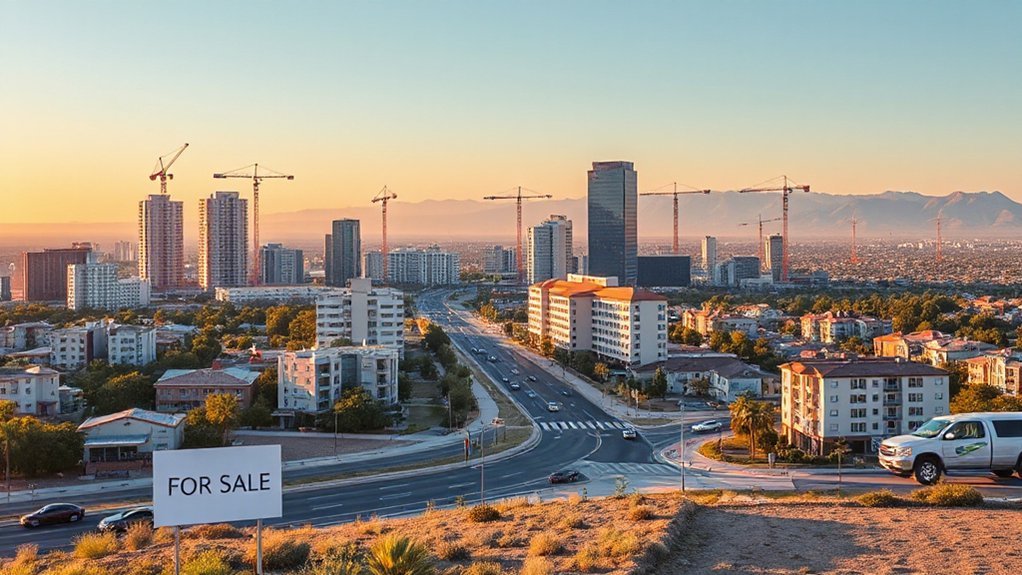
Those 2024 growth signals—migration, durable job creation, rent-to-supply balance, and submarket vacancy—keep lighting up the Sun Belt, and the pattern isn’t subtle. You’re seeing net in-migration concentrate around logistics hubs, healthcare corridors, and tech-adjacent metros, keeping absorption resilient even as new deliveries rise.
Track Market Trends at the submarket level: Class B rent growth outpacing Class A, vacancy tightening near mixed-use nodes, and concessions staying contained where household formation remains strong.
You’ll also notice cap rates stabilizing sooner in walkable infill and transit-served edges, where design-led density captures premium demand. Underwrite with higher insurance and utility loads, but don’t ignore wage growth and permitting friction—both support pricing power.
Midwest Emerging Real Estate Markets With Value Upside
You’ll see the Midwest gaining share as affordability pushes first-time buyers and investors toward metros where price-to-income ratios still pencil out.
You can track the next leg of growth in new infrastructure spend, logistics hubs, and advanced manufacturing expansions that lift job counts and wage floors.
If you’re design-conscious, you’ll also notice adaptive-reuse districts and walkable redevelopments turning “value” neighborhoods into high-demand submarkets.
Affordability-Driven Price Growth
As coastal metros keep resetting affordability ceilings, Midwest cities with strong job bases and modest entry prices are seeing demand spill over into meaningful appreciation. You’ll notice buyers recalibrating expectations: a $250K–$350K ceiling still accesses updated bungalows, brick duplexes, and walkable neighborhoods, keeping market affordability intact while bids tighten.
Track the signals: shorter days on market, shrinking seller concessions, and rent-to-price ratios that still pencil for small investors. When affordable housing supply stays constrained, price growth can remain steady even without luxury-driven speculation.
Focus on design-forward rehabs—energy-efficient windows, warm modern kitchens, and flexible office nooks—because turnkey finishes pull the highest premiums. You’re not chasing coastal multiples; you’re capturing valuation catch-up in overlooked zip codes.
Infrastructure And Jobs Surge
When new fabs, battery plants, and logistics hubs land within a 30–60 minute commute, Midwest housing demand doesn’t just rise—it reprices fast. You’ll see it first in permit volumes, job postings, and highway counts, then in tighter rental vacancy and quicker days-on-market.
Follow state and federal infrastructure investments—interchange rebuilds, rail spurs, port upgrades, and broadband—because they compress commute times and expand the buyer radius.
Track wage growth in advanced manufacturing and distribution; it supports higher rents without coastal-level pricing.
You can target infill corridors where Urban renewal is translating into safer streets, updated utilities, and mixed-use nodes.
Prioritize walkable blocks, energy-efficient rehabs, and resilient materials; buyers will pay for performance.
Mountain West Emerging Real Estate Markets to Watch
Even though national home sales have cooled, several Mountain West metros still post above‑average in‑migration, job growth, and building permits—three leading indicators that tend to precede price resilience and rent upside.
If you’re tracking mountain west real estate, watch Boise, Colorado Springs, and Spokane for steady payroll expansion and comparatively affordable price-to-income ratios.
You’ll also see momentum in Reno and Ogden, where logistics, advanced manufacturing, and hybrid-work spillover keep absorption healthy even as rates bite.
Design cues matter: newer townhome infill, ADU-friendly lots, and walkable “15‑minute” nodes are leasing faster than car-dependent tracts.
As builders pivot to smaller footprints and higher-efficiency envelopes, you can expect tighter vacancy in well-planned submarkets near universities, hospitals, and intermodal corridors.
How to Vet Emerging Real Estate Markets (Buyers + Investors)
To vet an emerging market, you’ll start with the local economic engine—job growth by sector, major employers, wage gains, and inbound migration trends.
Next, you’ll quantify supply and demand with inventory months, building permits, vacancy rates, days on market, and rent-to-income ratios.
If the numbers show durable growth and tight, balanced absorption, you’re positioned to target neighborhoods where the product mix and streetscape support long-term value.
Evaluate Local Economic Drivers
Because price momentum rarely survives weak fundamentals, you’ll want to pressure-test an “emerging” market by mapping its local economic drivers—job growth concentration, wage gains, employer diversity, and the pipeline of new payrolls. Start with BLS employment and wage series, then cross-check company announcements, venture funding, and public capex to gauge Local economic stability.
Tie those signals to demographic trends: in-migration by age, educational attainment, and household formation, which shape the buyer profile you’ll face.
- Measure resilience: track top-5 employer share, sector mix, and recession performance.
- Price labor, not hype: compare wage growth to national, and watch underemployment.
- Validate the runway: quantify permitted projects, campus expansions, and federal/state awards.
If the data stacks, you’re looking at durable demand, not a headline spike.
Analyze Supply And Demand
While a market’s story sells headlines, supply-and-demand math sets your actual ceiling on rent growth and resale velocity. Start by mapping new inventory: permits, planned deliveries, condo conversions, and short-term rental regulation shifts.
Then size demand with net in-migration, job adds, household formation, and absorption rates by unit type. Track vacancy and months of supply; under 5% vacancy and shrinking supply often signal pricing power, but watch for market fluctuations tied to rate moves and seasonal leasing.
Compare pricing dynamics across submarkets, not citywide averages: look at $/sq ft spreads, rent-to-income ratios, and concessions.
Finally, stress-test: if deliveries rise 20% next year, can rents hold, or will design-forward renovations be required to compete?
Frequently Asked Questions
How Do Zoning Changes Affect Investment Timelines in Emerging Cities?
Zoning changes shift your investment timeline by resetting zoning regulations, triggering new development approvals, and adding review cycles. You’ll see delays or acceleration as density rules evolve, permitting queues fluctuate, and design standards tighten.
What Tax Incentives Apply to Relocating Businesses in High-Growth Markets?
Like a tailwind, you’ll tap Tax credits and relocation incentives: state income/apportionment credits, job-creation credits, property-tax abatements, sales-tax exemptions, payroll rebates, and expedited permitting. You’ll qualify by meeting headcount, wage, capex, and lease-term thresholds.
How Can Investors Mitigate Climate and Insurance Risks in 2024 Hotspots?
You mitigate risks by modeling hazard data, buying layered insurance coverage, and prioritizing climate resilience upgrades. You’ll diversify geographies, require resilient design standards, secure parametric policies, and stress-test rents, capex, and premiums annually.
Should I Use a Local Property Manager or a National Firm?
You should start with a local property manager, then scale to a national firm as you grow. National operators cut vacancy about 8% on average. Pair strong property management with investment partnerships for consistent, design-forward, trend-aligned execution.
What Exit Strategies Work Best if Market Growth Stalls?
If market growth stalls, you’ll win with Exit planning: refinance on Market stabilization, convert to cash-flow rental, add design upgrades for rent premiums, or sell to 1031 buyers. You’ll track cap rates and absorption monthly.
Conclusion
You’ve seen how emerging markets in 2024 stack up: job growth, net in-migration, housing supply gaps, and rent-to-income resilience all point to the next winners. But can you picture a city where cranes outnumber vacancies and new transit lines reshape entire districts? If you track permits, absorption, wage gains, and price-to-rent ratios—not hype—you’ll spot momentum early. Vet neighborhood-level data, stress-test cash flow, and buy where fundamentals are accelerating.