You choose outdoor materials by matching your site’s UV index, rain, freeze–thaw, salt spray, and pollutants to verified test ratings. Specify UV stability (ASTM G154/ISO 4892), corrosion resistance (ISO 9223/9227), galvanizing (ASTM A123), and wood treatment (AWPA). Favor nonferrous or protected metals near coasts and isolate dissimilar metals to prevent galvanic corrosion. Detail drainage, sealed edges, and movement joints for moisture and heat cycling. Keep going to compare climate-fit options and maintenance costs.
Key Takeaways
- Map site exposures (UV, freeze–thaw, salt, wind-driven rain, pollutants) and choose materials rated for those climate loads.
- Require verified performance data to ASTM/ISO standards for corrosion, UV stability, moisture uptake, slip resistance, and fire behavior.
- Prevent water damage with low-absorption materials, proper drainage/ventilation, sealed edges, and detailing that avoids trapping moisture.
- Control corrosion and movement: use compatible fasteners, isolate dissimilar metals, protect cut edges, and allow thermal expansion with slip joints.
- Compare lifecycle cost and sustainability using maintenance schedules, warranties, EPDs, recycled content, and end-of-life recyclability.
Best Outdoor Materials by Climate and Project
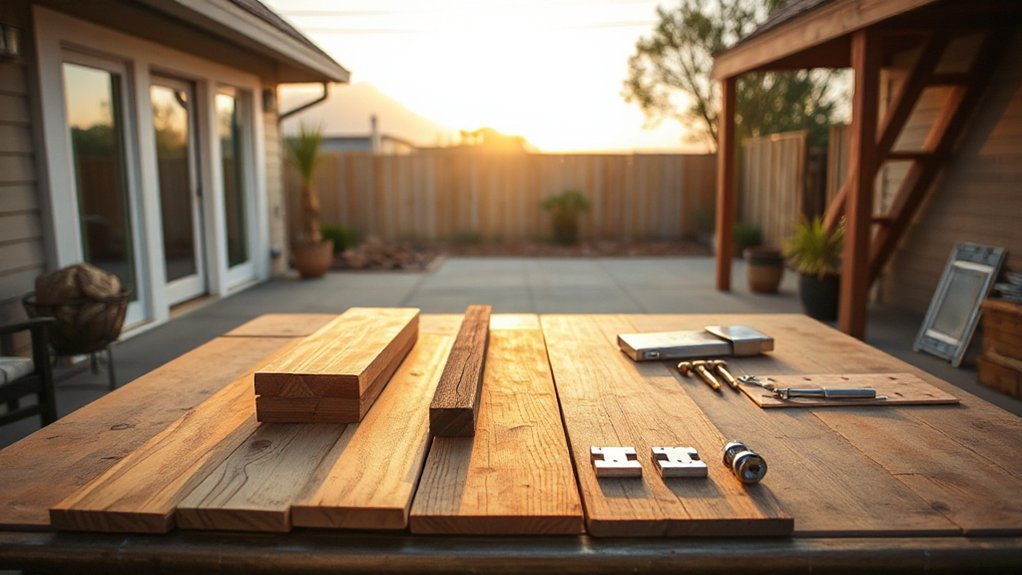
If you match material performance to your site’s climate loads and your project’s use class, you’ll get longer service life with fewer maintenance cycles. Start by mapping exposure: UV index, freeze–thaw frequency, salt spray, wind-driven rain, and airborne pollutants.
Then specify materials with verified ratings to ASTM/ISO test methods for corrosion, UV stability, moisture uptake, slip resistance, and fastener compatibility. In coastal zones, prioritize nonferrous or protected metals and isolate dissimilar metals to control galvanic action.
In cold regions, choose low-absorption assemblies and detail drainage to limit spalling and heave. In hot, high-UV sites, require colorfast coatings and stabilized polymers to slow material weathering.
For high-traffic projects, set abrasion and impact thresholds and plan for replaceable wear layers. Balance environmental impact using EPDs and durability-based service-life design.
Quick Comparison: Wood, Metal, Composite, Plastic
Once you’ve mapped climate loads and use class, you can narrow choices quickly by comparing how wood, metal, composites, and plastics behave under UV, moisture, temperature cycling, and wear.
Choose wood when you can specify durability class, preservative treatment, and moisture detailing; you’ll also need clear Finishings options and inspection intervals.
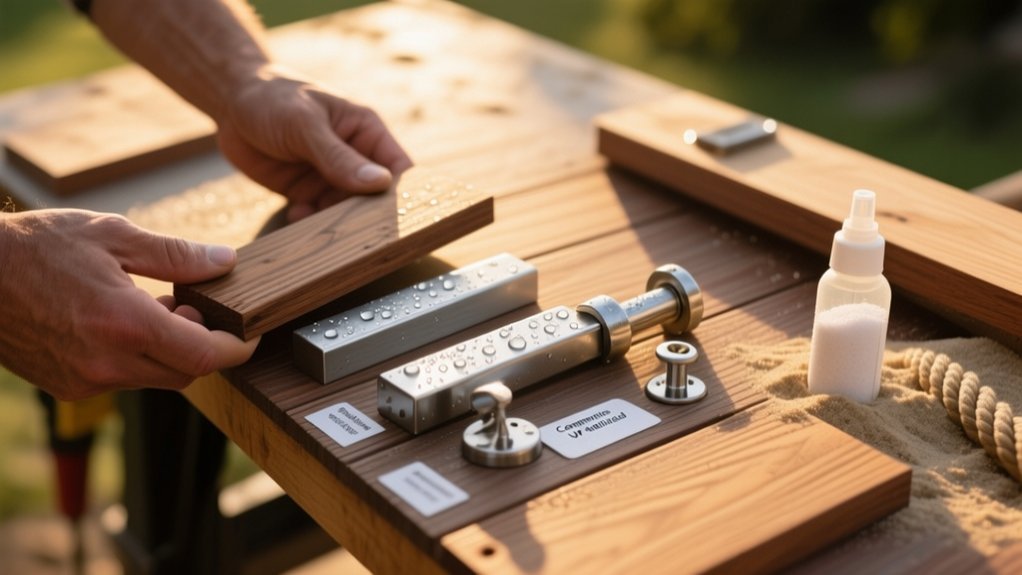
Specify metal when you can control galvanic coupling and require certified coatings or anodizing; check fastener compatibility and cut-edge protection.
Pick composites when you want stable profiles and low maintenance, but verify fiber content, slip resistance, and fastening rules in the manufacturer’s ETA/ICC-ES report.
Use plastics for corrosion immunity and tight tolerances; confirm creep limits, UV stabilizers, and fire rating.
Compare Environmental impact via EPDs, recycled content, and end-of-life pathways.
Sun, Water, and Heat: Durability That Matters Outdoors
Because outdoor assemblies fail at their surfaces first, you should treat UV exposure, wetting/drying frequency, and temperature cycling as primary design loads and specify materials and details that control them.
Start by demanding documented UV resistance: look for ASTM G154 or ISO 4892 accelerated weathering data tied to your expected service life, and specify colorfastness limits where appearance matters.
For water, design for drainage and rapid drying; choose materials tested to relevant soak, freeze–thaw, or moisture-cycling methods, and require sealed edges or caps where standards recommend them.
For heat, calculate thermal expansion mismatch across interfaces, then detail slip joints, oversized holes, or compliant sealants to prevent stress buildup.
Finally, align your selections with local climate data and exposure class assumptions in project specs.
Prevent Rust, Rot, Warping, and Cracking
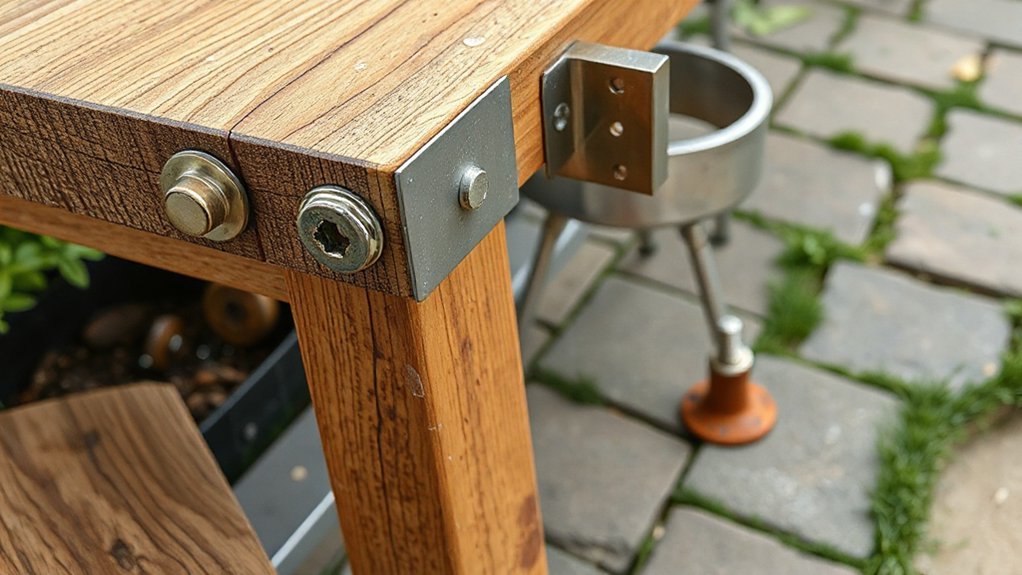
Although UV and moisture set the pace outdoors, most assemblies actually fail through everyday degradation mechanisms—corrosion in metals, decay in wood, and dimensional movement that drives warping and cracking—so you should treat material selection and detailing as a prevention plan, not a patch strategy.
Specify corrosion resistance by environment: use stainless per ISO 9223/9227, hot-dip galvanizing per ASTM A123, and isolate dissimilar metals to prevent galvanic attack.
Demand Finish quality: verify coating thickness, adhesion, and edge coverage, and avoid cut edges left unsealed.
For wood, choose naturally durable or preservative-treated stock compliant with AWPA; keep end grain sealed, provide drainage, and maintain ventilation gaps.
Control movement with stable species, engineered products, correct fasteners, and expansion joints.
Reduce Environmental impact by selecting low-VOC finishes and responsibly sourced lumber.
Cost vs. Maintenance: Choose the Best Lifetime Value
Even if the sticker price looks higher, you’ll often get a lower total cost of ownership by choosing materials that cut inspection, cleaning, recoating, and replacement cycles. Use life-cycle costing: estimate installed cost, annual upkeep, and expected service life.
Favor finishes with documented performance per ASTM B117, ASTM D3359, and ISO 12944, so you’re not guessing about corrosion and adhesion. Specify UV-stable polymers or naturally durable species with certified treatment; you’ll reduce wash frequency and spot repairs.
Check manufacturer maintenance intervals and warranty exclusions, and plan access costs (lifts, labor, shutdowns).
Prioritize Material sustainability by choosing recyclable metals or responsibly sourced wood that meets FSC/PEFC.
Protect aesthetic appeal by selecting colorfast coatings and low-chalking surfaces suited to exposure class.
Frequently Asked Questions
What Outdoor Materials Are Safest for Children and Pets?
Choose sealed, splinter-free cedar or composite decking with Child safe finishes, plus non-toxic rubber pavers or poured-in-place EPDM. Specify Pet friendly surfaces with ASTM/EN slip resistance, low VOCs, rounded edges, and lead-free hardware.
How Can I Match Outdoor Materials to My Home’s Architectural Style?
You’ll match outdoor materials to your home’s style by mirroring dominant forms, textures, and era-specific finishes; enforce color coordination with façade tones, and guarantee landscape integration through compatible aggregates and joints. Follow local codes and ASTM-rated products.
Are These Materials Recyclable or Eco-Friendly at End of Life?
Yes—many are recyclable; EPA reports ~35% of U.S. municipal waste gets recycled. You should verify local Recycling programs for metals/plastics, and specify Eco friendly options like FSC wood or recycled-content composites, per EPDs.
Which Outdoor Materials Are Best for DIY Beginners and Simple Tools?
For DIY beginners with simple tools, you’ll do best with pressure-treated lumber, composite deck boards, and galvanized hardware. They support basic landscape design and offer reliable weather resistance; follow manufacturer specs, ASTM ratings, and local code.
Do I Need Building Permits or HOA Approval for Certain Outdoor Materials?
Yes—you often do. About 20% of homeowners face compliance issues yearly. Check local permit requirements for fences, decks, sheds, and electrical. Get HOA approval for visible changes. Verify setbacks, height limits, fire-rating, and drainage.
Conclusion
Choose outdoor materials by matching climate loads to material properties, then verify performance against recognized standards (ASTM/ISO). UV, moisture, and temperature cycling drive most failures, so you’ll get better lifetime value by prioritizing protective coatings, drainage, and stable substrates over the lowest upfront cost. One telling metric: in accelerated weathering, some polymers lose up to 50% of impact strength after 1,000 hours of UV exposure—proof that “outdoor-rated” must be validated, not assumed.