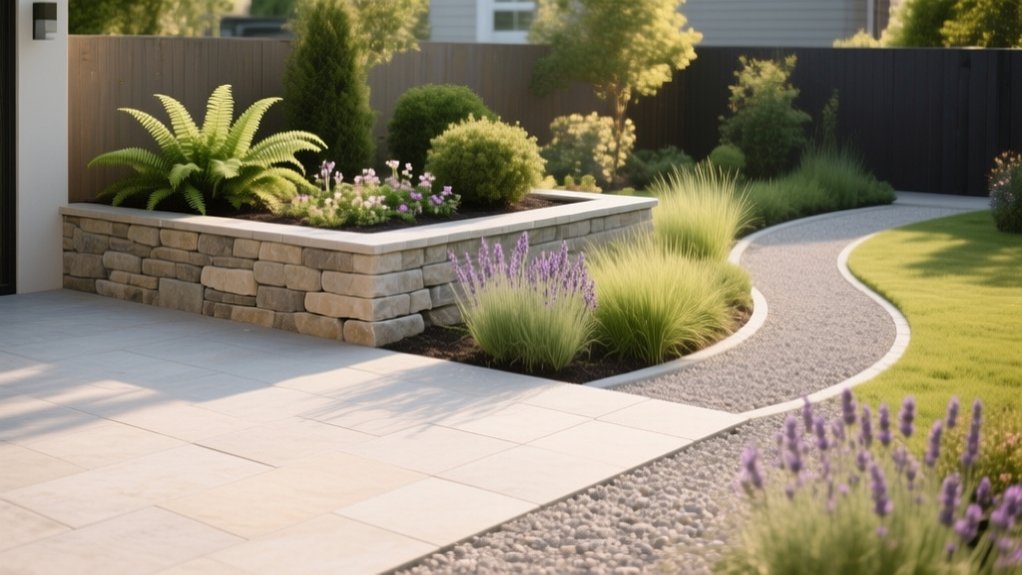
Combine hardscaping and soft landscaping by starting with a scaled site plan that maps grades, drainage, utilities, and sightlines, then assigning planting zones by sun, soil, and irrigation coverage. Keep impervious area balanced, typically 30–50% in residential yards, and offset added paving with canopy trees and deep beds. Build clear outdoor “rooms” with code-width paths, stable seating pads, and defined thresholds. Pitch hardscape 1–2% and blend edges with insets and lighting; more refinement follows.
Key Takeaways
- Start with a scaled site plan showing grades, drainage, utilities, and sightlines to place hardscape and planting zones correctly.
- Define outdoor “rooms” using paths, patios, and low walls, then frame them with planting beds for clear circulation and softer edges.
- Balance hardscape and softscape by limiting impervious area (often 30–50%) and adding canopy trees and deep beds to offset heat and runoff.
- Design transitions with proper slopes, thresholds, and permeable materials, keeping water draining away from foundations and into infiltration areas.
- Coordinate materials and lighting with the home, and plan maintenance like joint re-sanding, debris cleanup, and winter-safe deicers for longevity.
Map Your Hardscape and Planting Plan
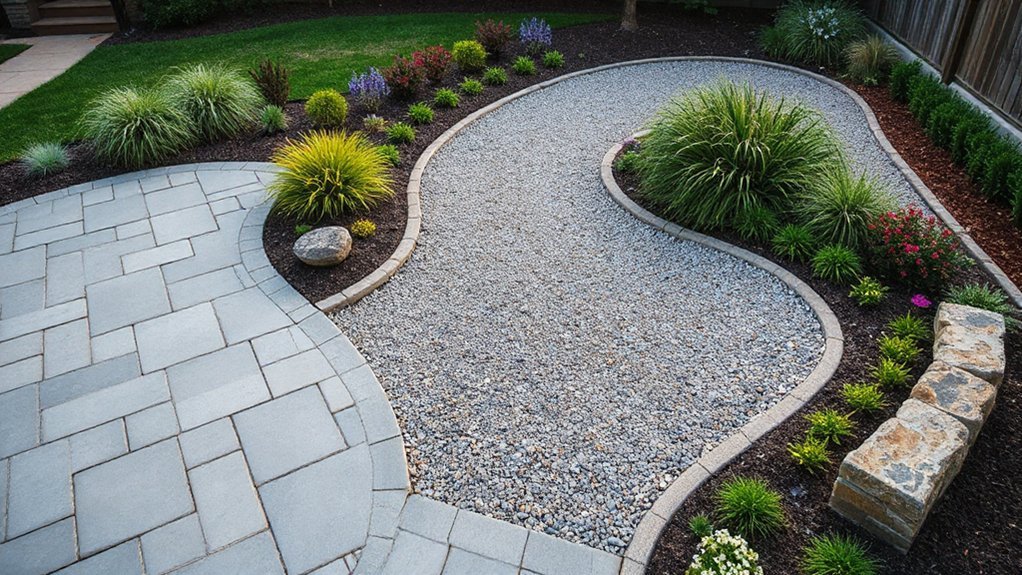
Before you break ground, map your hardscape layout and planting zones on a scaled site plan so every element aligns with grades, drainage paths, and access clearances. Establish a base map from a property survey, then plot existing utilities, canopy drip lines, and sightlines from doors and windows.
Dimension garden pathways to code-grade widths and turning radii, and mark edge restraints, step risers, and slope gradations to control runoff. Locate outdoor furniture pads where subgrade compaction, shade, and circulation support use without obstructing maintenance routes.
Assign planting zones by sun exposure, soil texture, and irrigation coverage, and coordinate root setbacks from footings and paving. Finally, specify material thicknesses and joint patterns to confirm elevations and prevent trip hazards.
Decide the Right Hardscape-to-Softscape Ratio
Although a balanced landscape looks effortless, you need to set an intentional hardscape-to-softscape ratio early because it controls stormwater performance, heat gain, maintenance workload, and how spacious the site feels.
Start by quantifying impervious coverage as a percentage of total area, then benchmark it against local runoff limits and your irrigation capacity. For most residential yards, keep hard surfaces near 30–50% unless you’ve engineered infiltration with permeable pavers, gravel reservoirs, or rain gardens.
Increase softscape integration on south- and west-facing exposures to moderate surface temperatures and glare. If you require more paving, offset it with tree canopy, deep planting beds, and high-infiltration soils.
Recheck hardscape balance after adjusting grades, edging, and material thickness so your numbers stay accurate.
Use Hardscaping to Create Clear Outdoor Zones
Once you’ve set your hardscape-to-softscape ratio, use hard elements to define outdoor “rooms” that organize circulation and activities without relying on excessive fencing or walls. Establish primary pathways with consistent widths and align them to doors, gates, and service areas to reduce cross-traffic through planting beds.
Use grade changes, low retaining edges, and paving insets to signal passages between dining, play, and utility zones. Position outdoor seating on a stable pad sized for chair pullback and clear egress, then frame it with planters or seat walls to improve garden privacy without blocking sightlines.
Add thresholds—steps, landings, or narrow gravel bands—at entries to cue movement, manage runoff, and keep maintenance boundaries explicit.
Choose Hardscape Materials That Fit Your Home
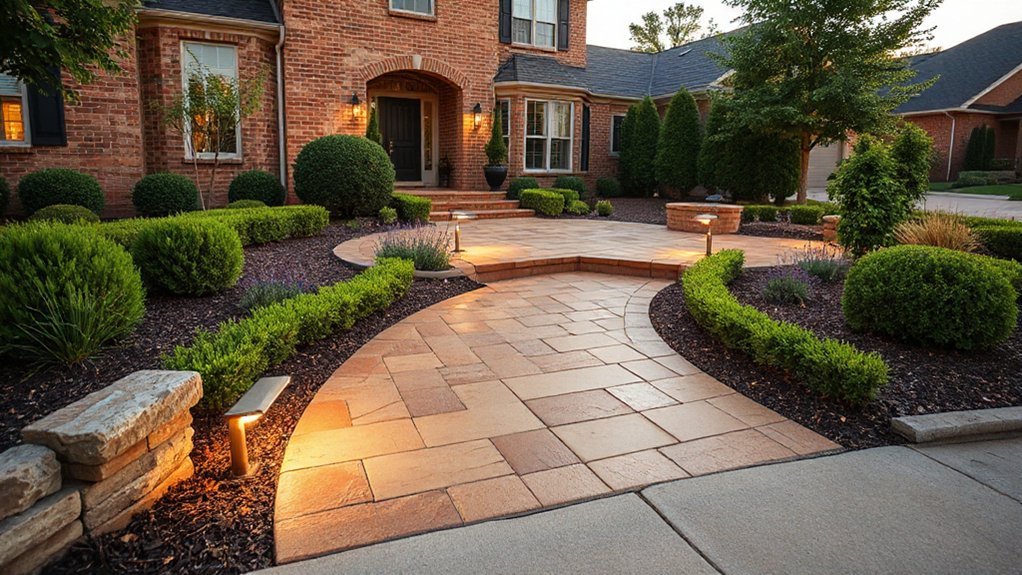
When your hardscape palette matches your home’s architectural language, the entire landscape reads as a cohesive system rather than a collection of add-ons. Start by inventorying existing cues: façade cladding, mortar color, roof tone, trim profiles, and metal finishes.
Then specify paving, wall stone, edging, and steps that echo those cues through compatible hue, joint pattern, and scale to maintain aesthetic harmony. Prioritize material durability by selecting frost-resistant masonry, UV-stable composites, and slip-rated surfaces appropriate to your climate and use intensity.
Align structural requirements with aesthetics: match wall units to required load ratings, choose permeable pavers where drainage demands it, and detail proper base, bedding, and control joints. You’ll reduce maintenance, prevent premature failure, and present an intentional, site-specific design.
Pick Plants That Soften Hardscape Edges
To soften the visual rigidity of paving, walls, and steps, you should specify cascading border plants that spill over edges and reduce harsh linear shifts.
You’ll get the cleanest results by selecting species with controlled, non-invasive habits and spacing them to maintain drainage and joint integrity.
Then you can layer foliage textures and bloom colors in a graduated sequence to create a cohesive buffer between hardscape planes and the surrounding planting beds.
Choose Cascading Border Plants
Although hardscape edges define clean lines, cascading border plants keep those shifts from reading as abrupt. Use Cascading borders to visually “feather” paving, retaining walls, and stair risers while protecting joints from soil splash and surface erosion.
Prioritize Plant selection by matching mature spread to the edge condition: choose tight, low mounds for narrow coping and broader trailers where you can allow overhang without blocking drainage.
Specify species with flexible stems, shallow but fibrous roots, and tolerance for heat radiated by masonry. Set plants 150–300 mm back from the hard edge, then train growth outward so foliage drapes rather than heaves.
Maintain a clear drainage gap and prune routinely to preserve access and prevent encroachment.
Layer Textures And Colors
Cascading border plants can handle the edge condition mechanically, but you’ll get a more integrated finish by layering textures and colors that visually moderate the mass and reflectivity of stone, concrete, and steel.
Start with a coarse-textured, upright matrix (ornamental grasses, broadleaf evergreens) set 300–600 mm back to frame the hard line. In front, add medium textures (lavenders, sages) to bridge scale, then finish with fine-textured spillers (thyme, sedum) to blur joints and caps.
Use Texture contrast deliberately: pair rigid pavers with airy foliage, or smooth concrete with serrated leaves.
Apply Color coordination by echoing aggregate tones with silvery or chartreuse foliage, then punctuate with restrained blooms that repeat nearby masonry hues.
Maintain clear sightlines.
Plan Drainage Before You Build Hardscape
Before you set pavers, pour concrete, or stack retaining walls, map how stormwater will move across the site and where it will discharge. Use a simple grading plan and confirm existing slopes with a level, then design positive drainage away from foundations and toward approved outlets.
Specify hardscape pitches (typically 1–2%) and verify elevations at door thresholds, drains, and low points. Integrate stormwater management elements early: channel drains, catch basins, downspout ties, and overflow routes sized for local rainfall intensity.
Protect subgrades with compacted, free-draining base and geotextile where soils are weak. For erosion control, stabilize disturbed areas, protect inlets, and keep sediment from entering drains during construction.
Inspect after rain and adjust grades before finalizing.
Blend Hardscape and Softscape With Transitions
Once you’ve established drainage and elevations, treat the junction between paving and planting as a deliberate shift zone rather than a hard edge. You’ll get a cohesive composition when you grade soil flush to finished surfaces, then soften lines with intermediate materials that manage runoff and reduce trip hazards along garden pathways.
Specify consistent module sizes and joint alignments so planting beds read as extensions of the hardscape.
- Use soldier-course pavers, cobble bands, or steel edging to define geometry while allowing roots and mulch to sit cleanly behind the restraint.
- Introduce gravel collars or decomposed granite aprons to progress from patios to beds and improve infiltration.
- Layer low, mounding perennials at edges and repeat select boulders or urns as landscape accents to anchor corners.
Add Lighting for Paths, Patios, and Plantings
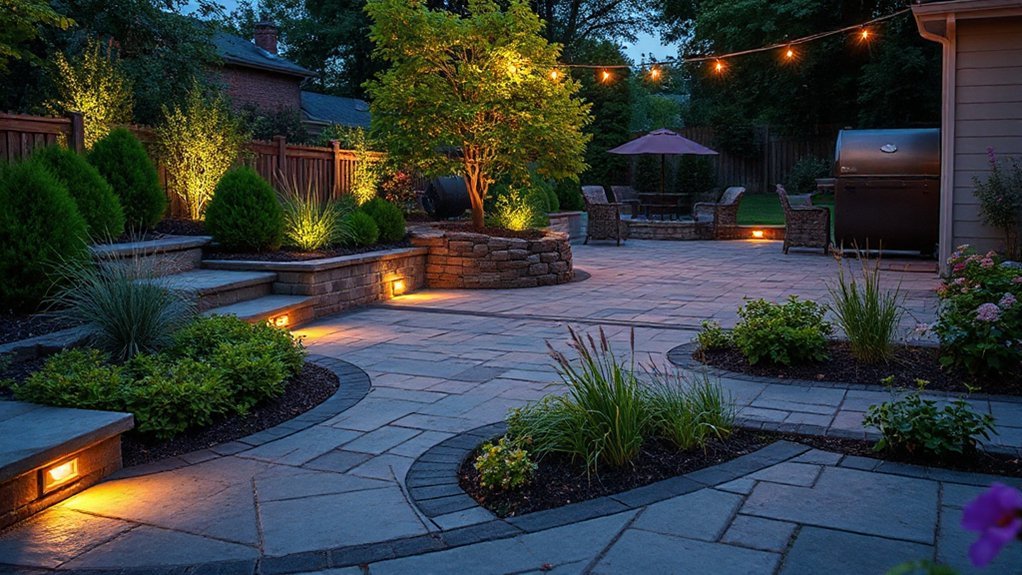
When you integrate lighting into your hardscape–softscape plan, you extend usability after dark and reinforce circulation and focal points without compromising grades or planting space. Specify low-voltage fixtures and route conduits beneath pavers or along edging to preserve root zones and simplify terminations.
Use pathway lighting at grade changes, intersections, and steps to control glare and meet safe foot-candle targets. On patios, set downlights or wall grazers to define seating perimeters and reduce trip hazards without flattening ambiance.
For garden illumination, aim narrow-beam accents at specimen trees and textured masonry, then shield sources to prevent spill into beds and windows. Separate circuits for paths, patios, and plantings so you can dim selectively and maintain visual hierarchy.
Verify transformer capacity, voltage drop, and IP ratings before installation and energizing.
Maintain Hardscape and Softscape All Year
Although a well-coordinated hardscape–softscape plan can look finished at installation, you’ll only preserve performance and aesthetics through year-round maintenance that addresses drainage, freeze–thaw movement, organic debris, and plant health.
Schedule seasonal maintenance to reset grades, keep joints functional, and protect root zones from compaction. Inspect runoff after storms; clear weep holes, channel drains, and swales so hydrostatic pressure doesn’t heave pavers or stain masonry.
In winter, avoid sodium chloride on concrete and adjacent beds; use calcium magnesium acetate and prompt snow removal to limit scaling.
- Re-sand polymeric joints, re-seal stone, and spot-level settled units.
- Prune for airflow, refresh mulch, and calibrate irrigation emitters.
- Apply integrated pest management: monitor thresholds, sanitize debris, and target treatments.
Frequently Asked Questions
How Much Does Combining Hardscape and Softscape Typically Cost per Square Foot?
You’ll typically pay $15–$60 per square foot, depending on cost estimation, site grading, and material selection. You can lower costs by limiting pavers, using native plantings, and optimizing irrigation and base preparation.
Do I Need a Permit to Build a Patio, Retaining Wall, or Walkway?
You might need a permit for a patio, retaining wall, or walkway, depending on local permitting requirements and zoning regulations. You should verify setbacks, wall height thresholds, drainage impacts, and HOA rules with your building department before construction.
How Long Does a Combined Hardscape and Softscape Project Usually Take?
You’ll typically finish in 2–6 weeks, but test the theory that sequencing drives duration. You’ll accelerate by staging excavation, base prep, planting, then integrating garden lighting and water features after inspections, curing, and irrigation commissioning.
What Are the Best Options for Pet-Friendly Hardscapes and Plants?
Choose durable hardscape materials like textured concrete, pavers, or decomposed granite for traction and easy sanitation. Specify Pet safe plants: rosemary, thyme, grasses, and marigolds; avoid sago palm, lilies, and azaleas.
Can I Combine Hardscaping and Soft Landscaping in a Small Rental Yard?
Yes, you can combine both in a small rental yard by using modular pavers, raised planters, and removable edging. Add low-voltage garden lighting and self-contained water features; you’ll enhance function, aesthetics, and portability.
Conclusion
As you integrate hardscaping and soft landscaping, picture stone pavers warming in late sun while layered foliage blurs their edges. You’ll get the best performance by confirming grades, drainage paths, and a balanced hardscape-to-softscape ratio before construction. Define outdoor zones with durable, compatible materials, then use plant massing to soften corners and guide circulation. Finish with shift details and calibrated lighting. Maintain joints, surfaces, mulch, and pruning so the design functions cleanly year-round.