Sash Windows: An All You Need To Know Ultimate Guide
Sash windows are one of the defining elements of British domestic architecture. From the Georgian terraces of Bath and Edinburgh to the Victorian suburbs of every major city, and from the Edwardian villas of the Home Counties to the grand stucco-fronted houses of Belgravia, the sliding sash window has shaped the appearance of British streetscapes for more than three centuries. Understanding sash windows — their history, their construction, their performance, their maintenance, and the options available when they need replacing — is useful knowledge for anyone living in or working on a period property.
A Brief History of Sash Windows
The double-hung sash window arrived in England in the late seventeenth century, almost certainly from the Netherlands, and became the standard window type for quality residential construction within a generation. By the early eighteenth century, the two-pane sash — upper and lower sashes counterbalanced by concealed weights — was effectively universal in new residential construction of any pretension.
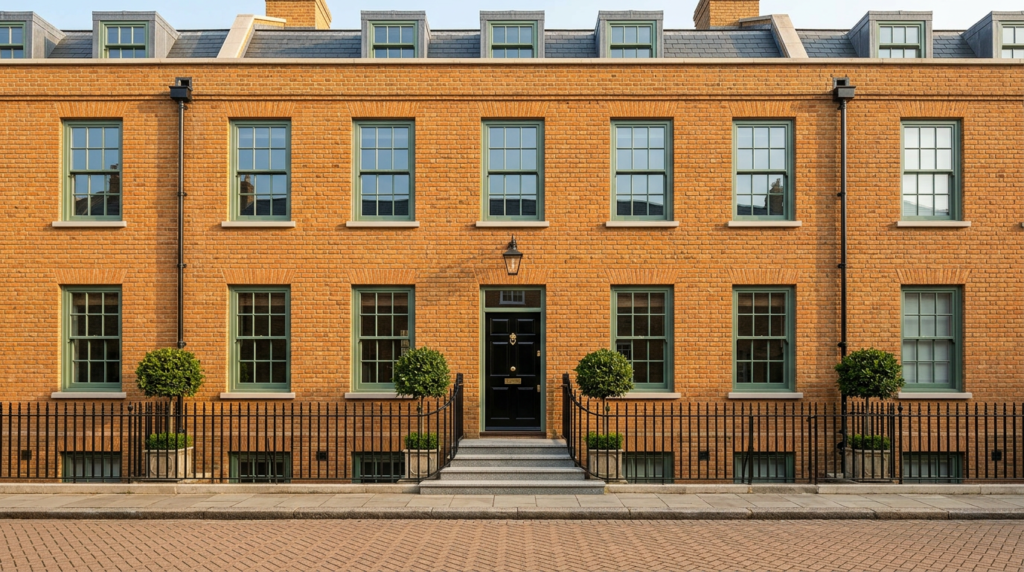
Georgian (1714–1830): The Georgian sash window established the proportional conventions that all subsequent sash windows referenced. Tall, slim proportions, multiple panes divided by thin glazing bars in each sash (typically six panes per sash in a standard window — six-over-six), and a delicate painted timber frame. The glazing bars of a quality Georgian sash were exceptionally fine — sometimes as slender as 22–25mm — achieved through the structural strength of old-growth timber that modern equivalents struggle to replicate.
Early Georgian windows sat flush with the external wall face, creating a flat front appearance. Following the London Building Act of 1709 (subsequently extended), windows were required to be set back 100mm from the wall face, which became the standard and created the characteristic reveal that frames the sash window in the external wall.
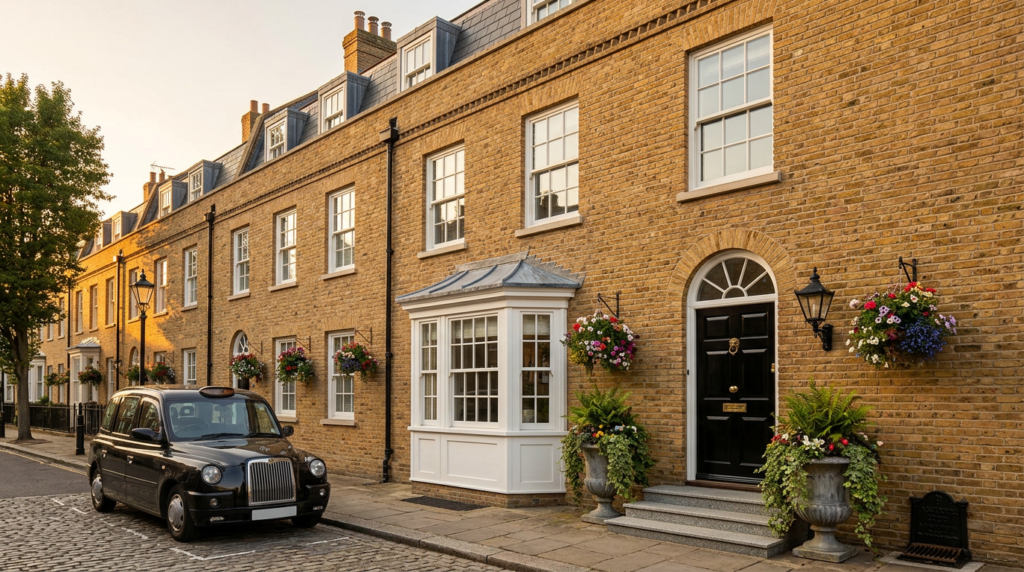
Victorian (1837–1901): The Victorian period standardised sash window production — pattern books and catalogue joinery brought consistent window designs to middle-class houses at scale. The fully-divided six-over-six sash of the Georgian period gradually gave way to larger pane configurations as plate glass technology improved — two-over-two, four-over-four, and eventually the two-pane sash with a single large pane in each sash. The Victorian sash also typically has a heavier section than Georgian equivalents — the influence of pattern-book design rather than individually crafted joinery.
Edwardian (1901–1914): The Edwardian sash is typically the most accessible to buyers in the period property market — a little less refined than the finest Georgian work, a little lighter and more graceful than standard Victorian, and produced in large numbers for the Edwardian suburban building boom. Upper sashes with margin lights (thin panes around the perimeter of an otherwise single large pane, often with coloured or decorative glass) are a particularly characteristic Edwardian detail.
How a Sash Window Works
The mechanical elegance of the double-hung sash window is one of the most ingenious solutions in domestic building technology. Both the upper and lower sash can slide vertically, counterbalanced by concealed weights that make the sashes feel nearly weightless in operation.
The box frame: The structural element of the sash window is the box frame — a hollow timber construction that houses the sash weights. The frame consists of the pulley stile (the vertical member containing the weight channel and the pulley wheel at the top), the inner lining (the face seen from inside), the outer lining (the face seen from outside), and the parting bead (a thin central strip that separates the two sash slides and keeps the sashes in their respective channels).
The sash weights: Each sash is connected by a sash cord over a pulley wheel to one or two cast iron or lead weights hidden inside the box frame. The weight of the counterbalance matches the weight of the sash — which is why the sash can be moved and will stay at any position along its travel. The cord runs over the pulley, down to the sash through a groove in the pulley stile, and attaches to the sash via a knot or sash nail.
The spiral balance: Modern timber and uPVC sash windows frequently replace the traditional weight-and-cord system with spiral balance springs — metal rods with an internal spring that provide the counterbalancing force without the hollow box frame required for weights. Spiral balances are simpler to install, easier to replace, and lighter in overall construction, but they provide less precise counterbalancing than a correctly weighted cord system and have a finite spring life.
The parting bead and staff bead: The parting bead (the thin timber strip between the two sash slides) and the staff bead (the timber strip on the inside face of the frame that holds the lower sash in its channel) are both important maintenance items. The parting bead can be removed to access the weight channel for cord replacement. The staff bead can be removed to take the lower sash out of the frame entirely for repair or repainting.
Sash Window Glazing: The Evolution of Glass
The original glazing in Georgian sash windows was hand-blown crown glass — a circular sheet of glass spun from a gather on a pontil rod, creating a slightly irregular, sometimes faintly rippled surface with a characteristic central boss (the bull’s eye, where the pontil attached). This glass has a quality of light transmission that modern flat glass cannot match — its slight imperfections scatter light in a way that makes surfaces appear more alive and more varied than modern glass.
Crown glass was gradually replaced by cylinder glass (blown into a cylindrical form and then cut and flattened) and eventually by plate glass — the flat, consistent, clear glass that became standard in Victorian and Edwardian windows as production technology improved.
For restoration of Georgian windows in historic buildings, the use of hand-made glass — still produced by specialist manufacturers — is the most sympathetic choice. For most period property restoration and replacement work, standard float glass is used, though slim double-glazed units with narrow warm-edge spacers allow the glazing to be upgraded to double-glazed performance within a relatively traditional-looking bar-and-pane arrangement.
The Performance of Sash Windows
Sash windows — particularly unrestored original timber sash windows — have a reputation for draughtiness, heat loss, and noise. This reputation is partly earned and partly overstated. Understanding the actual performance characteristics of sash windows is important for any property owner considering their options.
Draught and Air Infiltration
The traditional sash window slides in channels and relies on brush seals or pile weatherstripping to seal the gaps around the sliding sashes. This system is inherently less airtight than the compression seal of a closed casement window — the sliding sash will always have some degree of air movement at the sliding faces and at the meeting rail junction.
Unrestored sash windows, particularly those with perished brush seals, loose glazing putty, and gaps at the meeting rail, can generate significant draught that is uncomfortable in cold weather.
The good news is that this is largely remediable. A sash window that has been properly draught-proofed — with new pile weatherstripping, repaired putty, and a properly adjusted meeting rail — performs significantly better than an unrestored equivalent, achieving air infiltration rates approaching those of modern casement windows. Specialist draught-proofing systems (the Ventrolla system is among the most well-regarded) can be installed in original timber sash windows without altering their appearance.
Thermal Performance
A single-glazed original timber sash window has a U-value of approximately 5.0 W/m²K — among the highest (worst) of any building element. A double-glazed sash (in a new window, or using a slim sealed unit in a restored or new timber frame) achieves approximately 1.4–1.8 W/m²K.
The improvement from single to double glazing is substantial and is the most significant single thermal upgrade available to a period property with original windows. However, in the context of an overall building fabric assessment, windows are not always the most cost-effective element to upgrade first — insulation of the roof, floors, and walls typically has a greater impact per pound spent.
For listed buildings and conservation area properties, replacing original single-glazed sash windows with double-glazed replacements may not be consented. Secondary glazing — a separate inner panel fitted within the window reveal — provides meaningful thermal improvement (achieving U-values of approximately 1.4–1.8 W/m²K when combined with the original window) while being reversible and acceptable to most heritage bodies.
Acoustic Performance
The air gap in secondary glazing provides acoustic as well as thermal benefit — a secondary glazed window with a 100mm or greater air gap achieves significantly better sound reduction than a standard double-glazed sealed unit. For period properties on busy roads, secondary glazing is frequently the preferred solution for combining heritage preservation with acoustic improvement.
Maintaining Original Timber Sash Windows
Original timber sash windows, properly maintained, can last for centuries. The decline of original sash windows in the UK through the twentieth century was largely the result of deferred maintenance — windows that were allowed to deteriorate to the point where painting and minor repair were no longer sufficient and full replacement seemed the only option.
Periodic Painting
The most important single maintenance task for any timber sash window is regular exterior painting — every five to eight years, more frequently in exposed or coastal locations. Unpainted timber will absorb water, swell, and eventually decay. The critical areas are the glazing putty line (where water can track between putty and glass and into the timber beneath) and the sill (the most horizontal surface and the most vulnerable to water retention).
Quality oil-based primer and paint systems provide better long-term protection than water-based alternatives in most exterior applications. Before repainting, all loose or cracked putty should be raked out, primed, and repaired with linseed oil putty.
Cord Replacement
Sash cords typically last 20–50 years before they break. When a cord breaks, the sash on that side becomes heavy and resistant to movement, or the sash falls uncontrollably when opened. Cord replacement is straightforward for a reasonably confident DIYer:
- Remove the staff bead on the relevant side to release the lower sash
- Free the sash from its pocket in the pulley stile
- Remove the old cord from the sash groove
- Lift the pocket cover (a small removable section of the pulley stile) to access the weight chamber and retrieve the weight
- Thread new sash cord over the pulley, attach to the weight, and replace to the correct length in the sash groove
- Reinstall the sash and test movement
- Replace the staff bead
Quality woven sash cord (13–15mm diameter) lasts significantly longer than the polyester alternatives. Traditional braided cord of the correct specification is widely available.
Draught Proofing
Effective draught proofing of a timber sash window involves:
- Replacing or renewing brush pile weatherstripping in the sliding channels
- Fitting compression strips at the meeting rail junction
- Ensuring glazing putty is intact and fully bonded to glass and timber
- Checking and adjusting the staff bead and parting bead for correct clearance
Specialist companies (Ventrolla, The Sash Window Workshop, and local timber window specialists) can carry out full draught-proofing and overhaul in a day per window and dramatically improve air infiltration without altering the window’s appearance.
Timber Decay Repair
Localised timber decay — typically at sills, the bottom rail of the lower sash, and glazing bar joints where water has tracked past the putty — can be repaired rather than replaced using specialist consolidant and filler systems. Repair Care DRY Flex, Sika, and similar two-part epoxy systems consolidate softened timber, fill voids, and produce a structurally sound repair that can be primed and painted. These repairs extend window life significantly and are considerably cheaper than replacement.
Sash Window Replacement Options
When original sash windows have deteriorated beyond economic repair, or when windows have already been replaced with inferior alternatives and a restoration of period character is desired, several replacement options exist:
Like-for-Like Timber Replacement
The most sympathetic replacement and the standard required in listed buildings and conservation areas. New timber sash windows, manufactured to match the original profile, glazing bar arrangement, and dimensions, are produced by specialist timber window manufacturers. Quality options include:
- Accoya timber — thermally modified pine with dramatically improved stability and durability compared to standard softwood, requiring less frequent repainting and with excellent resistance to rot
- Hardwood (oak, iroko, meranti) — more durable than softwood but heavier and typically more expensive
- FSC-certified softwood — the traditional specification, requiring appropriate paint maintenance
Slim double-glazed units can be incorporated in new timber sash windows while maintaining the traditional glazing bar character. The sealed unit must be specified at the correct overall thickness to fit within the traditional bar-and-pane arrangement without creating bars that appear too heavy.
Cost: £800–£2,000+ per window installed for standard residential sizes; heritage box sash with traditional weights and slim double-glazing can exceed this.
uPVC Sash Windows
Lower-maintenance and lower-cost alternatives to timber, suitable for properties outside conservation areas and listed building designations. Modern uPVC sash windows have improved significantly from first-generation products in terms of profile quality, balance mechanism reliability, and visual character. Woodgrain effect foils in cream or grey produce more sympathetic results than standard white profiles.
The limitations remain: uPVC profiles are inherently bulkier than timber equivalents (requiring more material for structural rigidity), plain white uPVC reads differently from painted timber, and uPVC windows are not acceptable in conservation areas or for listed buildings. Service life is typically 25–35 years, compared to 50–100+ years for quality timber.
Cost: £500–£900 per window installed.
Aluminium Sash Windows
A niche but growing option. Aluminium allows slimmer profiles than uPVC while providing excellent durability and dimensional stability. Available in any powder-coated colour. More expensive than uPVC, less expensive than quality timber. Not typically acceptable in conservation areas.
Cost: £700–£1,300 per window installed.
Composite (Timber-Aluminium)
Timber interior with aluminium exterior — combining the internal character and paintability of timber with the low-maintenance, weather-resistant exterior of aluminium. A premium product popular in Scandinavian markets and increasingly available in the UK. May be acceptable in some conservation area applications where the exterior aluminium profile closely matches the original timber.
Cost: £1,000–£2,000+ per window.
Secondary Glazing
Not a sash window replacement but an alternative to it — a separate inner glazing panel fitted within the window reveal behind the existing primary window. Accepts listed building consent and conservation area approval in the vast majority of cases. Provides meaningful thermal improvement (U-value approximately 1.4–1.8 W/m²K combined with original window) and excellent acoustic performance with a large air gap. Does not require any alteration to the original window.
Cost: £250–£500 per window installed.
Planning and Heritage Considerations
Conservation Areas
In conservation areas, permitted development rights for window replacement are restricted or removed. Replacement windows should match the original in material, profile, glazing bar arrangement, and overall character. Most local planning authorities require timber sash windows in conservation areas; uPVC is almost universally refused.
Contact the local planning authority’s conservation officer before committing to any replacement specification in a conservation area.
Listed Buildings
Replacement of windows in a listed building requires listed building consent in England and Wales. This applies regardless of whether the windows are specifically listed in the designation. The standard requirement is that replacement windows match the original in material, profile, and character — which in practice means timber sash windows matching the original specification. Any departure from this standard requires specific justification and consent.
Part L of the Building Regulations
Replacement windows in England must meet minimum thermal performance requirements under Part L of the Building Regulations — a centre-pane U-value of 1.4 W/m²K for double-glazed units. Exemptions apply for listed buildings and buildings in conservation areas where compliance would unacceptably alter the character of the building.
The Value of Original Sash Windows
The financial case for retaining and restoring original sash windows, rather than replacing them with cheaper alternatives, is stronger than it is often recognised.
A period property with its original sash windows intact — properly maintained, draught-proofed, and in good condition — presents differently to buyers than an equivalent property where original windows have been replaced with uPVC equivalents. For buyers who specifically seek period properties for their authentic character, original windows are a positive signal; uPVC replacements are a visible compromise that many buyers will factor into their offer.
The cost of restoration versus replacement also frequently favours retention. Specialist draught-proofing and overhaul of an original sash window costs £200–£500 per window; secondary glazing adds another £250–£500. Total investment per window: £450–£1,000. Like-for-like timber replacement: £800–£2,000+. The choice to retain and restore the original is often cheaper than quality replacement and almost always better for the character of the property.
For any period property owner weighing up options, the starting presumption should be: restore what is there before replacing anything.