

Wanting the lowdown on what’s an underfloor heating thermostat? The thermostat is the interface between an underfloor heating system and the people who live with it. Get it right and the system delivers consistent, comfortable warmth that responds intelligently to how the house is actually used. Get it wrong and the system runs inefficiently, heats rooms unnecessarily, costs more than it should, or — most frustratingly — never quite achieves the temperature the occupants want. Given that the thermostat is typically one of the least expensive components in a UFH installation, the frequency with which it is under-specified is one of the most avoidable sources of UFH performance disappointment.
Key Takeaways
- UFH thermostats are not interchangeable with standard heating thermostats — underfloor heating responds slowly compared to radiators, and a thermostat designed for a fast-responding radiator system will cause the UFH system to cycle on and off inappropriately, reducing both comfort and efficiency.
- A floor sensor is essential for electric UFH and strongly recommended for wet UFH — the air sensor alone cannot prevent floor overheating, which damages sensitive floor coverings (particularly timber) and reduces element lifespan in electric systems.
- Programmable scheduling is not optional — UFH’s thermal mass means it must be turned on in advance of when warmth is needed. A non-programmable thermostat that simply responds to current room temperature is fundamentally mismatched to UFH’s operating characteristics.
- Wi-Fi connected smart thermostats unlock the full potential of UFH — remote access, learning algorithms, integration with smart home platforms, and time-of-use tariff optimisation all improve both comfort and running cost when the system is managed through a connected thermostat.
- Each zone needs its own thermostat — a single thermostat controlling the whole house produces a system that is permanently either over- or under-heating some rooms.
- The thermostat must be positioned correctly — on an internal wall, away from direct sunlight, heat sources, and draughts, at approximately 1.5m height. Poor placement is one of the most common causes of inaccurate temperature control.
- Wiring and compatibility matter — always confirm that a thermostat is compatible with the actuators on the manifold (for wet UFH) or the specific element type and power rating (for electric UFH) before purchase.
Why UFH Thermostats Are Different
Underfloor heating has a fundamentally different thermal response characteristic from a radiator system, and this affects everything about how the thermostat should work.
A radiator heats the air in a room relatively quickly — a cold radiator can bring a room to temperature in 20–40 minutes. An underfloor heating system heats the floor first, and the floor heats the room — a process that can take 1–3 hours from a cold start depending on the floor construction and the thermal mass involved. Tile over concrete screed is the slowest; electric mat under thin tile is the fastest.
This slow response means that a thermostat controlling UFH must anticipate demand rather than simply react to it. A thermostat that turns on the UFH when the room falls below the set temperature will cause the occupant to be cold for the 1–2 hours it takes the system to respond. A thermostat that turns on the UFH in advance of when warmth is needed — through a programmed schedule — delivers warmth at the right time.
It also means that the simple on/off cycling that works adequately for a fast-responding radiator system produces poor results in UFH. A UFH thermostat should either modulate the system gradually (proportional control) or use optimum start logic — learning algorithms that calculate exactly how far in advance of the target time the system needs to start, based on the current room temperature and the system’s historical response time.
Types of UFH Thermostat
Basic Programmable Thermostat
A basic programmable thermostat allows a schedule to be set — typically by time and day of the week — so the system turns on and off at defined times. Temperature setpoints can be programmed for each time period (comfort temperature during occupied periods, setback temperature when the house is unoccupied or at night).
This is the minimum specification for a UFH thermostat. A non-programmable thermostat — one that simply turns the system on when the room is cold and off when it is warm — is inadequate for UFH because it cannot anticipate demand and will produce a system that always lags behind actual requirements.
Basic programmable thermostats are available from £30–£80 and are appropriate for single-zone applications where smart home integration is not required and the occupants have predictable, regular routines.
Limitations: No remote access, no learning algorithms, no integration with other systems. Once programmed, the schedule is fixed unless manually adjusted — inconvenient for households with variable routines, holiday absences, or multiple users with different preferences.
Digital Programmable Thermostat with Floor Sensor
An upgrade on the basic programmable thermostat, this type includes a floor sensor — a temperature probe installed in the floor covering adjacent to the heating element or pipe — that monitors the actual floor surface temperature in addition to the air temperature.
The floor sensor serves two purposes:
Safety: It prevents the floor surface from exceeding the maximum safe temperature for the floor covering — typically 27°C for timber and engineered timber, 35°C for tile. Without a floor sensor, an electric UFH element or a wet UFH system running at high flow temperature can overheat a timber floor and cause it to cup, crack, or delaminate from the adhesive.
Efficiency: In electric UFH, controlling to a floor temperature setpoint rather than an air temperature setpoint can improve efficiency — the floor reaches the desired temperature and the element switches off, rather than the element continuing to run until the much slower-responding air reaches temperature.
Both sensors (air and floor) can be used simultaneously — the thermostat responds to whichever reaches its setpoint first, providing both comfort control and floor protection.
Cost range: £50–£150.
Wireless/RF Thermostat
A wireless thermostat communicates with a receiver unit (mounted near the manifold or the electric UFH junction box) via radio frequency, eliminating the need to run a wired connection from the thermostat to the system. In a retrofit installation where running a cable through a finished wall to the thermostat position would be disruptive, a wireless thermostat significantly simplifies installation.
Wireless thermostats are available in basic programmable and smart (Wi-Fi connected) configurations. The receiver unit is wired to the system; the thermostat itself requires batteries (typically AA or AAA, lasting 1–2 years).
Consideration: Wireless thermostats require a reliable RF signal path between the thermostat and receiver. In properties with thick stone or concrete walls, signal reliability should be checked before committing to wireless installation.
Cost range: £60–£200 depending on features.
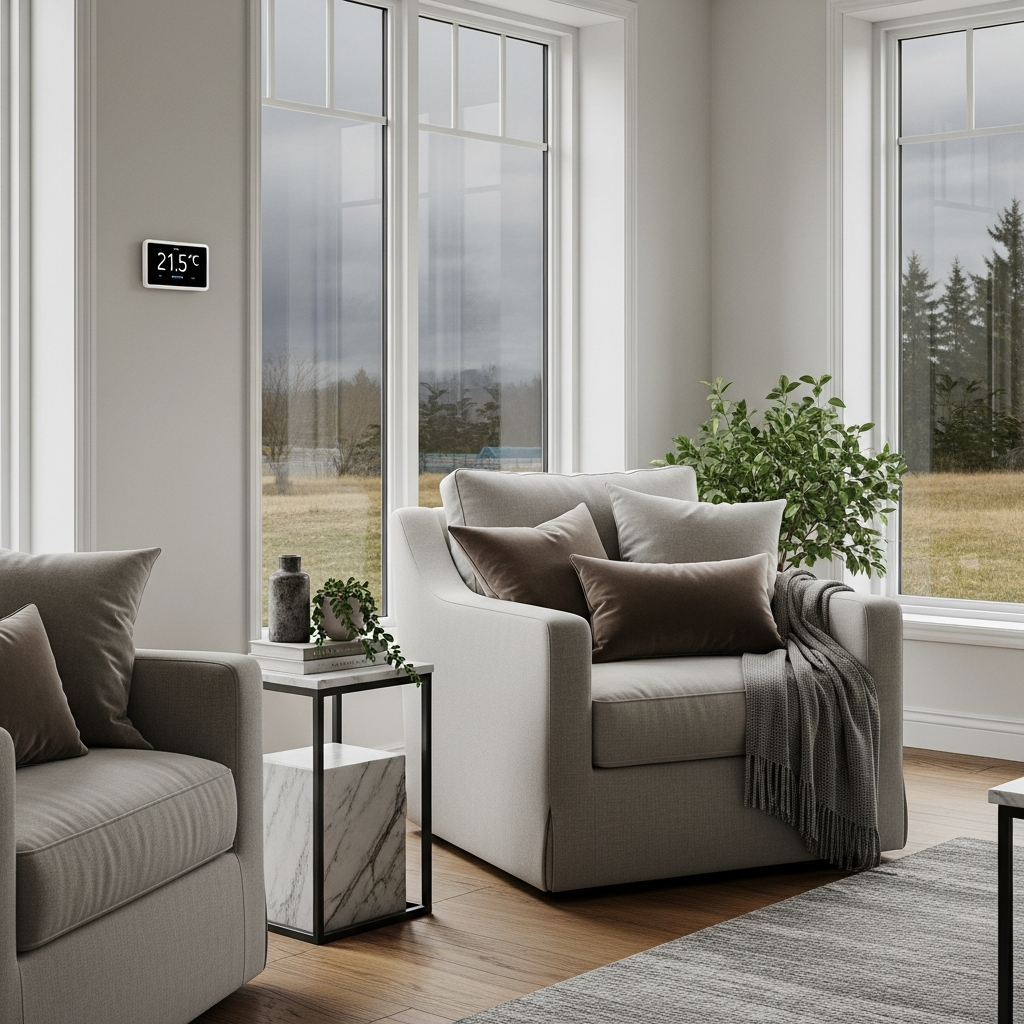
Smart Wi-Fi Connected Thermostat
Smart thermostats connect to the home Wi-Fi network and are controlled through a smartphone app. Beyond the scheduling and temperature control of a basic programmable thermostat, they offer:
Remote access: Adjust the heating from anywhere with a phone signal. Turn the heating on before returning from a longer-than-planned trip; turn it off if you left without doing so.
Learning algorithms: Some smart thermostats (notably Nest) learn the household’s patterns over time and automatically adjust schedules to deliver warmth when it is needed without manual programming. The optimum start algorithm — calculating how long before the target time the system needs to start — is particularly valuable for UFH’s slow thermal response.
Geofencing: The thermostat uses the smartphone’s location to detect when occupants are approaching home or leaving it, adjusting the system accordingly without manual input.
Energy reporting: Usage data by day, week, and month, visible through the app, helps occupants understand how much the system is running and identify opportunities to reduce consumption.
Integration with smart home platforms: Compatible thermostats integrate with Amazon Alexa, Google Assistant, Apple HomeKit, and platforms such as Home Assistant, allowing voice control, automation, and integration with other smart devices.
Time-of-use tariff optimisation: On a smart electricity tariff with variable prices (Octopus Agile, Intelligent Octopus), a smart thermostat can shift electric UFH operation to the cheapest periods and avoid running during expensive peak hours.
Cost range: £100–£300 for the thermostat; some systems require a separate hub or bridge.
Notable products: Heatmiser NeoStat, Warmup 4iE, Nest Learning Thermostat (with compatible relay), Drayton Wiser, Honeywell T6.
Multi-Zone Controller
In a home with multiple UFH zones — a common configuration in a whole-house installation — individual thermostats for each zone are managed through a multi-zone controller that coordinates all zones and communicates with the boiler or heat pump. The controller ensures that the heat source operates only when at least one zone is calling for heat, and shuts down the heat source when all zones are satisfied.
Multi-zone systems can be wired (all thermostats connected by cable to a central controller) or wireless (thermostats communicate via RF or Wi-Fi to a central hub). Premium multi-zone systems offer:
- Individual zone scheduling with different programmes for each room
- App control of all zones from a single interface
- Boiler/heat pump demand optimisation
- Integration with smart home platforms
- Energy reporting by zone
Multi-zone system cost range: £200–£800 for the controller and hub, plus individual thermostat costs per zone. Total system cost for a four-zone installation: £400–£1,200.
Notable products: Heatmiser NeoHub system, Warmup SmartGeo system, Honeywell Evohome, Drayton Wiser multi-zone.
Floor Sensor vs. Air Sensor: Understanding the Difference
The distinction between floor sensor and air sensor control is the most technically important aspect of UFH thermostat specification, and the one most frequently misunderstood by both homeowners and installers.
Air sensor control: The thermostat measures the temperature of the air in the room and switches the UFH on and off to maintain the set air temperature. This is the simplest and most familiar control mode — the same way a standard central heating thermostat works. The limitation for UFH is that the air temperature is the lagging indicator — it rises slowly after the floor has warmed, and falls slowly after the system has switched off.
Floor sensor control: The thermostat measures the temperature of the floor surface and switches the UFH on and off to maintain a set floor temperature. This responds more quickly to the system’s actual state, but it does not directly relate to room comfort — a floor at 25°C in a cold room does not feel warm to the occupant.
Dual sensor (combined) mode: The most effective control mode for most UFH applications. The thermostat is set to a target air temperature for comfort, but with a floor temperature maximum limit. The system heats until either the air reaches the target temperature (comfort satisfied) or the floor reaches its maximum limit (protection activated), whichever comes first. This delivers comfort while protecting the floor covering.
For electric UFH, dual mode is strongly recommended — the floor sensor protects the element and the floor covering from overheating in the event of thermostat failure or excessive heat demand.
For wet UFH, an air sensor alone is often considered adequate because the flow temperature is already limited by the mixing valve. A floor sensor adds protection for sensitive floor coverings (timber, in particular) and is recommended wherever timber or engineered timber flooring is used over UFH.
Installation and Positioning
The thermostat’s physical position in the room affects its accuracy and therefore the quality of temperature control.
Height: Thermostats should be positioned at approximately 1.5m height — at mid-point between floor and ceiling, in the breathing zone where room temperature is most relevant to comfort.
Wall type: Install on an internal wall wherever possible. An external wall thermostat will be influenced by the cold temperature of the wall and will cause the system to overheat the room to compensate. In poorly insulated rooms, even an internal wall thermostat can be affected by cold bridging.
Sun exposure: Direct sunlight on a thermostat will cause it to read the room as warmer than it is and underperform the heating system. Avoid positioning a thermostat on a south- or west-facing wall where afternoon sun will strike it.
Heat sources: Lamps, televisions, appliances, and other heat sources close to the thermostat will cause incorrect readings. Maintain at least 0.5–1m clearance from significant heat sources.
Draughts: A thermostat positioned near a door or window that is regularly opened will read excessively cold conditions and cause the system to overheat. Position away from frequent draught sources.
The floor sensor cable: The floor sensor probe (a temperature-sensing cable) is installed in the floor — typically in a conduit (a small-bore pipe or conduit sleeve) between two rows of electric heating cable, or adjacent to a UFH pipe in a wet system. The conduit is important: it allows the sensor to be withdrawn and replaced if it fails, without lifting the floor. A floor sensor installed without a conduit cannot be replaced without lifting the floor covering.
Wiring and Compatibility
Thermostat compatibility with the rest of the UFH system must be confirmed before purchase, not after.
For electric UFH: The thermostat must be compatible with the power rating of the heating element. Most domestic electric UFH thermostats are rated to switch up to 3kW or 16A directly. Larger systems (over 3kW per zone) require a separate relay or contactor to switch the main circuit, with the thermostat operating the relay control. Confirm the element’s wattage and the thermostat’s switching capacity.
For wet UFH with manifold actuators: The thermostat must be compatible with the actuator type — normally open (NO) or normally closed (NC) — and must provide the correct voltage output. Most UK residential UFH actuators operate on 230V and are normally closed (fail-safe to off). The thermostat should provide a 230V switched output to match. Some smart thermostats use 24V low-voltage systems that are not compatible with standard 230V UK actuators without an additional relay.
Neutral wire requirement: Many smart thermostats require a neutral wire at the thermostat position, in addition to the live (switched and permanent) and earth conductors. In some older wiring configurations, only a live and switched live are available at the thermostat position. A 2-wire compatible thermostat (one that does not require a neutral) must be specified in these cases, or a cable upgrade carried out.
Common Problems and How to Fix Them
Room never reaches temperature: Most commonly caused by thermostat positioned near a heat source (reads too high), or by the schedule not being set to start far enough in advance of when warmth is needed. Check thermostat position, and if scheduling is correct, extend the pre-heat period.
System runs continuously and overheats: Thermostat positioned near a cold draught or external wall (reads too cold), or a failed floor sensor in a floor-limit mode. Check positioning, and check the floor sensor reading on the thermostat display if available.
Uneven temperatures between rooms: Different heat demands in different zones, or manifold not balanced correctly — the thermostat cannot compensate for a manifold that is not delivering the right flow rates to each circuit. Check manifold balancing before adjusting thermostat settings.
Electric UFH causes timber floor to cup or crack: Floor temperature has exceeded the maximum safe limit for the timber product. Check whether a floor sensor is installed and correctly configured; if not, install one and set the floor temperature limit to 27°C or the timber supplier’s specified maximum.
Smart thermostat loses connection to app: Wi-Fi signal strength at the thermostat position. Thermostats are often located on internal walls that are some distance from the router. A Wi-Fi extender at a strategic point in the house resolves most connectivity issues.
Choosing the Right Thermostat: A Decision Framework
Bathroom or single small room, electric UFH: A digital programmable thermostat with integrated floor sensor. This is the minimum appropriate specification. Cost: £50–£100. Brands: Warmup, Heatmiser, Devi (Danfoss).
Kitchen or living room, electric or wet UFH, single zone: A smart Wi-Fi connected thermostat with floor sensor. The scheduling flexibility and remote access are particularly valuable in rooms with variable occupancy patterns. Cost: £100–£200. Brands: Heatmiser neoStat, Warmup 4iE, Nest with relay.
Multi-room wet UFH system, whole house: A multi-zone controller with individual smart thermostats per zone. The boiler demand management and whole-house visibility of a multi-zone system is essential for a whole-house UFH installation. Cost: £400–£1,200 for the system. Brands: Heatmiser NeoHub, Honeywell Evohome, Drayton Wiser.
Heat pump-connected wet UFH: A weather-compensated controller — one that adjusts UFH flow temperature in response to external temperature — provides the most significant efficiency improvement for heat pump systems. The thermostat should be compatible with the heat pump’s control interface. Check compatibility with the specific heat pump manufacturer before specifying.
The thermostat is not the most visible component of an underfloor heating system — it rarely appears in the aspirational design images that sell the technology. But it is the component through which the system is experienced every day, and its quality determines whether that daily experience is one of effortless warmth or perpetual frustration. Specifying it properly from the outset is one of the best investments in any UFH project.