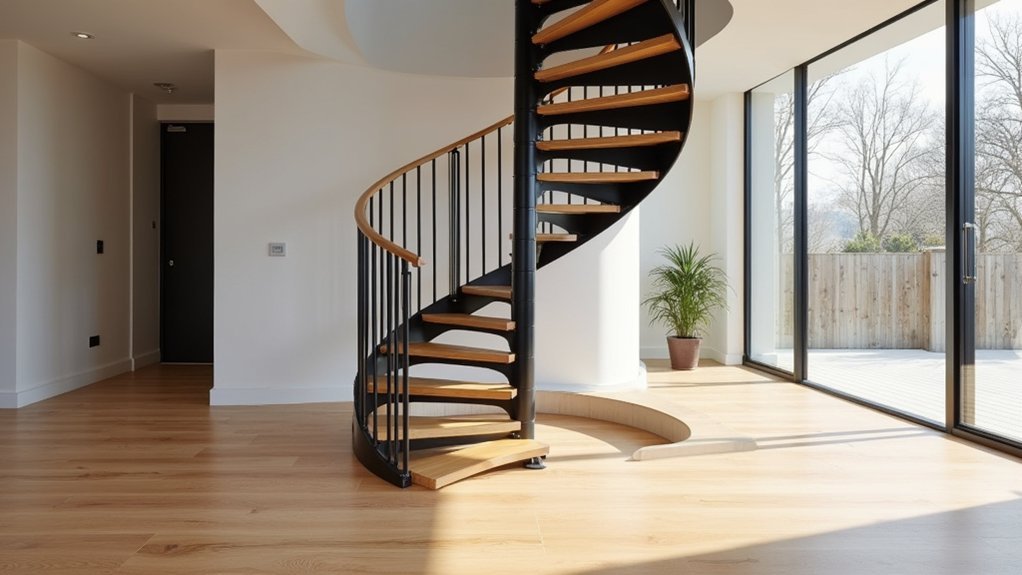
For a UK home with a spiral staircase, you’ll get the best results with stable, slip-tested flooring that can handle tight radii and heavy pivot traffic. Choose matte, textured LVT as the best all-rounder, or go for engineered wood with a factory anti-slip finish if you want real timber warmth. Use rubber for maximum grip in approach zones, and avoid high-gloss surfaces. Keep expansion gaps, template carefully, and you’ll see how to prevent common cut-and-fit errors.
Key Takeaways
- Choose slip-resistant, matte finishes; avoid high-gloss lacquer, polished stone, and smooth vinyl near spiral stair approaches.
- Prioritize durable, stable options like engineered wood, LVT, rubber, or R10–R11 porcelain tiles for high-traffic stair zones.
- Use products that handle tight curves and movement; thin, stable flooring reduces cracking and gapping around curved stringers.
- Control wear at entry/exit and nosing lines with textured surfaces, anti-slip nosings or tape, and easy-replace coverings like carpet tiles.
- Ensure accurate templating, consistent expansion gaps, sealed joints, and flat, dry subfloors to prevent squeaks, gaps, and moisture damage.
Best Flooring for Spiral Staircases (Quick Picks)
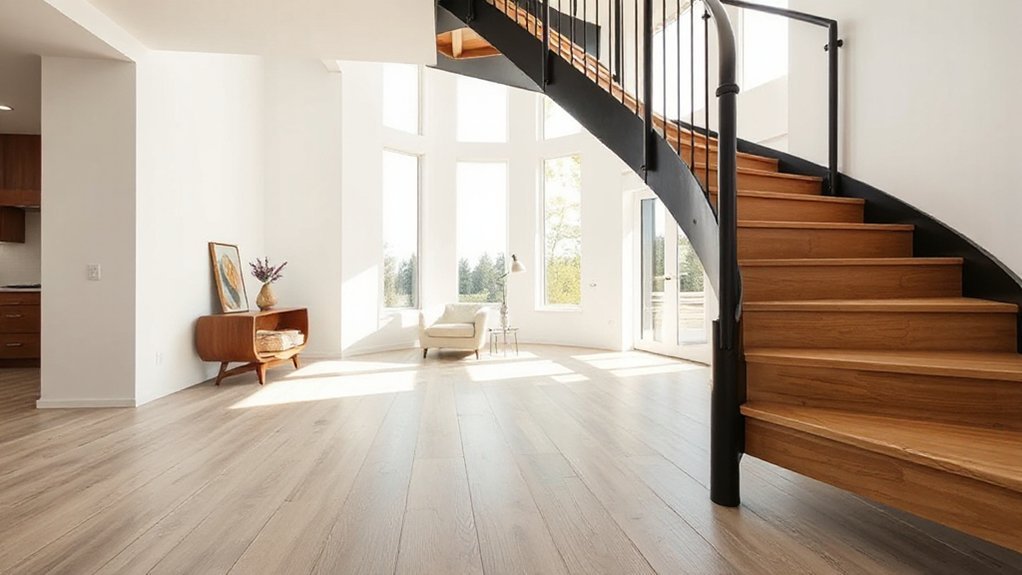
While spiral staircases save floor space, they place tougher demands on your flooring because tight turns and concentrated foot traffic amplify wear and highlight uneven shifts. For quick wins, you’ll usually do best with LVT (luxury vinyl tile) in a stone or oak visual: it’s stable, water-resistant, and supports clean Color coordination across landings and adjacent rooms. If you want a warmer feel, choose engineered timber with a tough lacquer; it handles seasonal movement better than solid boards and offers strong Material durability under daily use. For flats and rentals, commercial-grade loop-pile carpet tiles reduce slip risk and let you swap damaged sections without lifting the whole run. Keep finishes matte to disguise scuffs and maintain a consistent read in tighter light.
What Makes Flooring Spiral-Stair Friendly?
To make a spiral staircase work in a UK home, you need flooring that bends cleanly around a tight radius without cracking or lifting. You’ll also want a slip-resistant surface that keeps grip under socks or wet shoes, especially on narrow treads. Finally, you should specify clean edge progressions—neat nosings, trims, and accurate cuts—so you don’t end up with trip points or exposed edges.
Tight Radius Flexibility
Because a spiral staircase forces every tread to curve and taper, your flooring must bend to a tight radius without splitting, lifting, or telegraphing joints. You’ll get the cleanest wrap with thin, stable products: LVT dryback, rubber, linoleum, or engineered wood in narrow staves. Specify pliable nosings and matching stair profiles that accept heat-forming or kerfing, and keep the build-up minimal so the leading edge stays crisp. Prepare each tread with a smooth plywood overlay and feather-finish; then template the wedge shape to reduce on-site trimming errors. In UK refurb work, choose low-VOC adhesives and eco friendly materials to meet indoor air targets. Finish with Custom color schemes via welded seams, inlays, or factory-tinted wear layers.
Slip-Resistant Surface Grip
Even if you’ve nailed the curve and the nosings, a spiral stair still demands high surface grip where your foot lands on a narrow, turning tread. Prioritise Slip resistance you can evidence, not just “anti-slip” marketing. In the UK, ask for pendulum test values (PTV) to BS 7976, and aim for reliable wet performance if your stairs sit near an entrance or kitchen.
Choose flooring with a controlled Surface texture: fine embossing or lightly grained finishes raise friction without feeling abrasive under socks. Avoid high-gloss lacquer, polished stone, and smooth vinyl, which can drop friction fast with dust. If you’re specifying engineered timber, select factory-applied matt coatings with slip additives and confirm compatibility with your cleaning regime so you don’t strip the grip over time.
Clean Edge Transitions
High-grip finishes stop the slip, but you still need tidy, predictable edges where each wedge tread meets the nosing and the centre post. On a spiral, tiny misalignments catch toes, lift boards, and telegraph gaps as you climb. Choose flooring that allows accurate templating and repeatable cuts, then lock the perimeter with robust edge finishing: matching stair nosings, aluminium trims, or heat-welded coved skirting for safety and easy cleaning. Specify a progression design that manages thickness changes between tread, riser, and landing without a proud lip; aim for flush, continuous lines and consistent overhangs. Keep expansion gaps controlled with flexible sealant at the post, and use moisture-stable adhesives to prevent curl. You’ll get cleaner visuals, safer footing, and longer service life.
Where Spiral Stairs Wear Floors Out Fastest
Where do spiral staircases punish your flooring the most? You’ll see fastest wear at the entry quadrant where you pivot onto the first tread, and at the exit where you step off and turn. The tight radius concentrates footfall on a narrow arc, grinding grit into the finish and flattening texture. Expect scuffing along the inner stringer line and bruising at the nosing line where shoes clip while turning. If you’ve used decorative patterns, align them so the high-traffic arc doesn’t cut across delicate inlays; strong colour coordination can also disguise inevitable abrasion. Specify a tougher wear layer, add a matwell at both landings, and seal edges to stop moisture-driven swelling and staining. Check and renew finish yearly, too.
How Slip-Resistant Does the Flooring Need to Be?
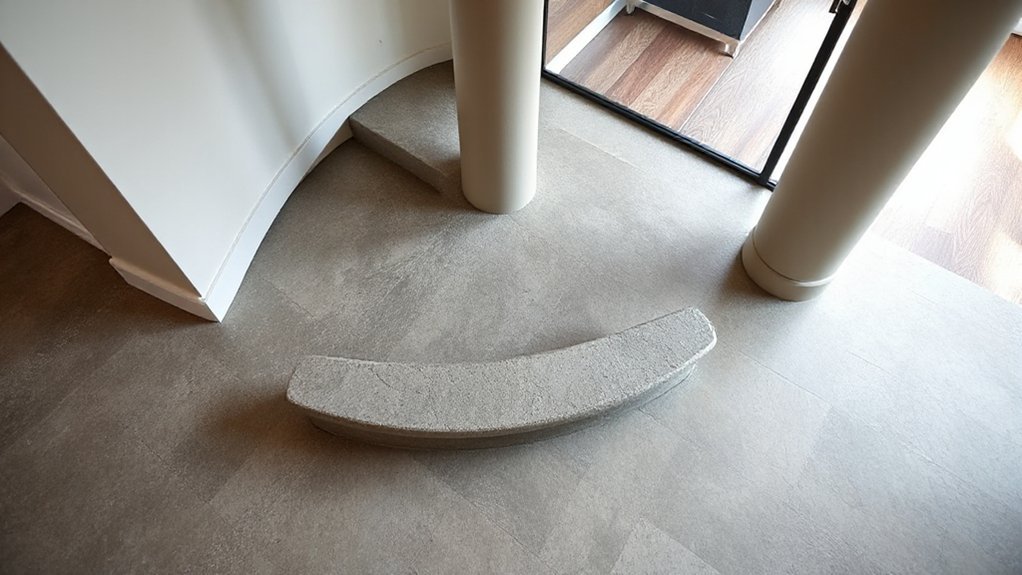
On a spiral staircase, you need higher tread traction because your foot lands at varying angles and the usable tread width narrows towards the centre pole. You’ll also have to factor in wet shoes and fine dust, which can drop slip resistance fast, so choose flooring with tested ratings suitable for UK conditions. Prioritise a textured, grippy surface finish that maintains contact under load without creating trip edges or making cleaning impractical.
Stair Tread Traction Needs
A spiral staircase concentrates foot traffic onto narrow, curved treads, so your flooring needs a reliably slip-resistant surface rather than just a “nice” finish. You should target a measurable spec: for UK homes, look for products tested to BS 7976 pendulum results and prioritise higher PTV values on stair applications. Choose textures that keep contact under turning loads and avoid high-gloss coatings.
- Specify slip resistance by test data, not marketing terms; ask for PTV results.
- Pair tread nosings or inserts with the same finish for colour matching and consistent grip.
- Check hardness and indentation resistance so edges don’t polish smooth over time.
- Apply maintenance tips: clean with neutral cleaner, skip waxes, and inspect wear points monthly.
Wet And Dusty Risks
How slip-resistant does your spiral-stair flooring need to be when rainwater, cleaning moisture, and fine dust routinely get carried in? You should specify performance, not guesswork, because curved treads and tight goings amplify any loss of friction. For UK homes, look for products with a declared slip rating suitable for internal wet contamination and test evidence (e.g., Pendulum Test Value) from the supplier, especially if the stair connects to an entrance, utility, or garden room. Build Moisture control into detailing: fit absorbent mats at thresholds, seal joints, and choose finishes that won’t soften or delaminate with damp mopping. Plan Dust mitigation too: use closed-riser layouts where possible, add stairwell extraction if near workshops, and set a cleaning regime that removes fine particulate before it acts like a dry lubricant.
Surface Texture And Grip
Because spiral treads narrow towards the centre and force your foot to load the edge, you can’t rely on “it feels grippy” as a benchmark—specify a surface texture and slip rating that stays consistent under real household contamination. In UK terms, ask for documented pendulum test results (BS 7976 / HSE) rather than vague claims. Prioritise Grip enhancement that doesn’t clog with dust, dog hair, or cleaning residues, and avoid high-gloss finishes that polish quickly on the nosing line.
- Target PTV ≥36 wet on the tread surface; ≥25 is only “moderate”.
- Choose embossed vinyl, textured rubber, or R10–R11 porcelain for reliable Surface texture.
- Add anti-slip nosings or tape on the outer arc where traffic concentrates.
- Maintain with neutral cleaner; greasy films destroy wet grip.
Luxury Vinyl Plank Near Spiral Stairs: Best All-Around
While spiral staircases demand a floor that can handle tight turns, heavy footfall, and tricky edging details, luxury vinyl plank (LVP) delivers the most reliable all-round performance. You’ll get stable click-lock joints that resist gapping as you scribe boards around the curved stringer, plus a rigid core that tolerates typical UK subfloor variation. Choose a 0.55mm wear layer for busy hallways and landings, and specify an R10 slip rating if the staircase sits near an entrance.
For colour coordination, match plank tone to stair treads and use a slim, colour-matched scotia or flexible edge trim to hide expansion gaps neatly. Maintenance tips: vacuum grit daily, damp-mop with pH-neutral cleaner, and fit barrier mats to cut tracked-in moisture.
Engineered Wood Near Spiral Stairs: Warm, Stable Option
If you want timber warmth by a spiral staircase without the movement issues of solid boards, you’ll find engineered wood’s cross‑ply build delivers strong dimensional stability in typical UK humidity swings. You can run it right up to the stair opening to create a clean, warm passage that complements metal or painted balustrades. You’ll need to plan stairside details—expansion gaps, edge trims, and secure fixing on curved cuts—so the perimeter stays tight, quiet, and compliant.
Dimensional Stability Benefits
- You can control Flooring expansion by leaving accurate perimeter gaps and using flexible trims at the stair well.
- You’ll get better tolerance to temperature gradients near radiators and upper-floor heat build-up.
- You can install over suitable underlay or UFH-rated systems to reduce stress at tight curves and landings.
- You’ll lower the risk of squeaks and edge lift because the core holds fixings and joints more consistently.
Check moisture content and subfloor flatness before fitting.
Warm Aesthetic Transitions
Because a spiral staircase naturally pulls the eye to the centre of the plan, engineered wood lets you create a warm, continuous progression that looks intentional rather than cut around. You can match tones from hallway to landing, using consistent board width and sheen so the stair becomes a feature, not a break in the scheme. For colour coordination, pick an oak grade and stain that complements your balustrade finish and nearby joinery; in UK light, mid-tone naturals reduce contrast and hide dust.
Engineered wood’s real-wood veneer gives warmth without the “plastic” look of vinyl, while factory lacquers deliver predictable reflectance. Add maintenance tips: use felt pads, a pH-neutral cleaner, and recoat before the veneer wears through.
Stairside Installation Considerations
Where do engineered boards succeed most around a spiral stair? You’ll find they handle tight radii and fluctuating UK humidity better than solid timber, while keeping a warm interior design finish. Plan for precise templating at the stringer and consistent expansion gaps, or you’ll invite squeaks and edge lift. For budget considerations, engineered wood also reduces wastage versus wide solid planks when you’re cutting wedges.
- Use a stable plywood subfloor, level to 3 mm over 2 m, to prevent chatter.
- Dry-lay and scribe each board to the curve; keep end-joints staggered.
- Choose a wear layer ≥3 mm and a tough lacquer for high-traffic treads.
- Fit stair nosings and matching trims, and seal cut edges against moisture.
Laminate Near Spiral Stairs: Budget-Friendly, Watch Seams
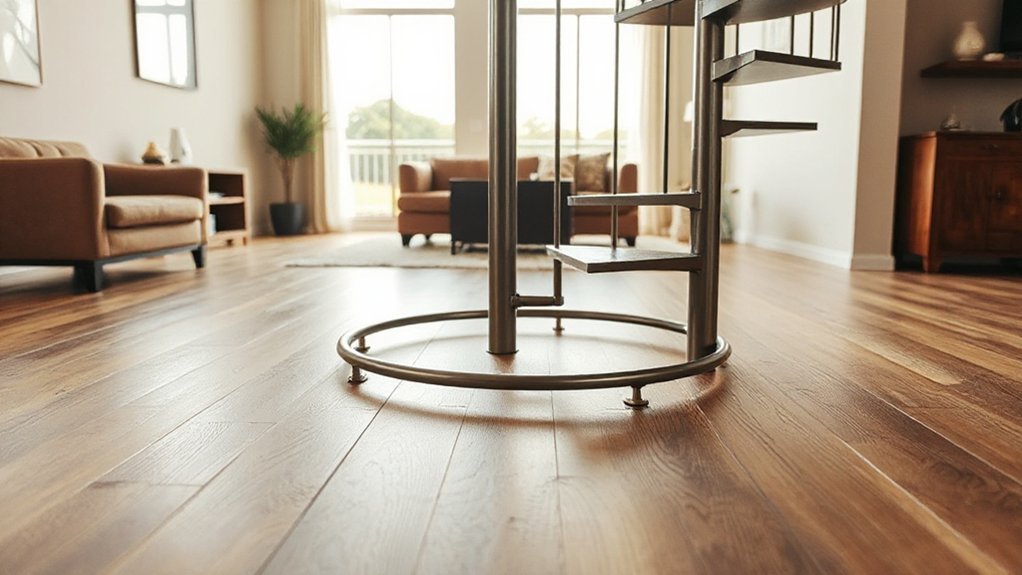
Laminate flooring gives you a cost-effective, hard-wearing surface around a spiral staircase, but you’ll need to manage seams carefully to stop edges lifting under concentrated footfall. Choose AC4/AC5 rated boards and a moisture-resistant core for UK hallways, and plan your layout so joints don’t land on the tightest turning line. Use decorative patterns and colour coordination to disguise inevitable cuts at the newel and to visually square up the landing. Maintain the manufacturer’s expansion gap, then cover it with a flexible scotia or quadrant to cope with seasonal movement. Bond edging pieces with D3 PVA and add a stair nosing profile where traffic pivots. Keep a continuous underlay, but tape all joins to prevent shear and squeaks.
Porcelain Tile at Spiral Stair Landings: Tough, Grippy Choices
Although spiral stair landings take concentrated, twisting foot traffic, porcelain tile gives you a hard, low-porosity surface that won’t dent, stain, or swell in typical UK hall/utility conditions. To keep it safe and practical, specify slip resistance and robust detailing that suits tight turning radii and wet shoes.
- Choose R10–R11 rated tiles (or PTV+36 wet) for grip on small landings.
- Use a matt, textured finish; it supports tile aesthetics while reducing glare and skid risk.
- Set tiles on a decoupling membrane over timber subfloors to limit cracking from movement.
- Detail edges with a metal trim or bullnose, and grout with flexible, mould-resistant polymer.
With Porcelain durability, you’ll get a long-wearing landing that stays easy to clean, even by the front door.
Cork Flooring Near Spiral Stairs: Quiet Underfoot, Softer Wear
Porcelain tile suits tight, wet-prone landings, but you might want a warmer, quieter surface on the approach to a spiral stair where footfall noise and comfort matter more than outright hardness. Cork flooring absorbs impact and limits bounce, so you cut click-clack sound in adjacent rooms and improve Acoustic insulation without extra underlay thickness.
Specify a high-density, sealed cork plank with a robust wear layer (AC3–AC4) for UK domestic traffic, and run it to a neat threshold strip at the first tread to protect the nosing zone. You’ll find it kinder underfoot for barefoot use and for kids, while still resisting dents better than softer foams. Choose products with low-VOC finishes and recycled bark content to keep Eco friendly materials in your spec.
Rubber Flooring Near Spiral Stairs: Maximum Traction
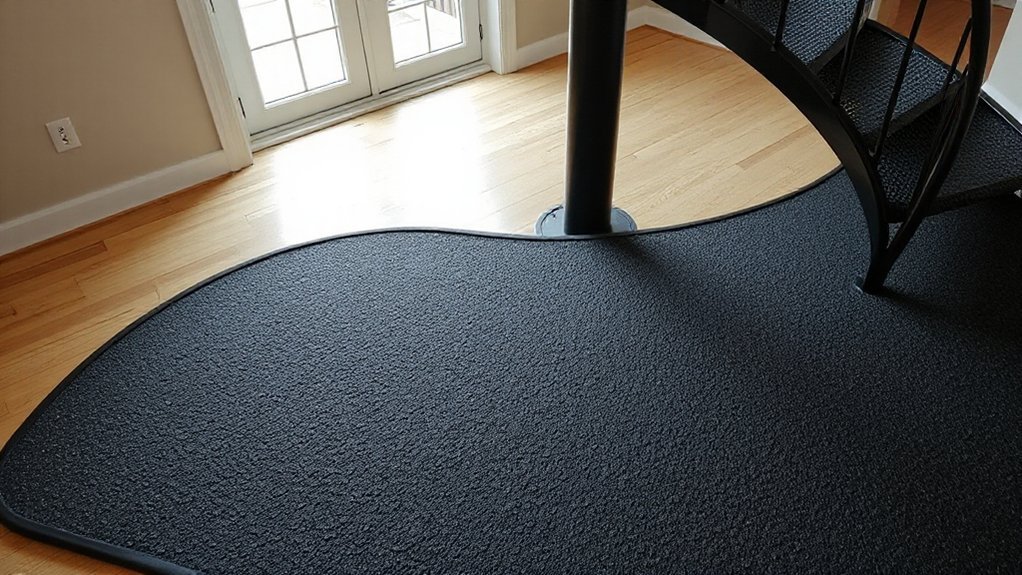
For sheer grip in the run-up to a spiral stair, rubber flooring gives you a high-friction surface that stays stable under quick turns and wet shoes. In UK homes, it’s a practical choice for halls and landings where rainwater and grit get tracked in, reducing slip risk without constant upkeep. You’ll also benefit from solid Material durability, as quality rubber resists indentation from shoes, hoovers, and mobility aids.
- Choose R10–R11 slip ratings for dependable traction in domestic entrances.
- Specify 3–6 mm with dense backing to limit curl and edge lift.
- Seal seams and run coved skirting to stop moisture ingress and simplify cleaning.
- Use Color coordination to define approach zones and improve visibility in low light.
Match Stair Treads, Nosing, and Floor Transitions
When you treat the spiral stair as a system rather than a standalone feature, you can match treads, nosing, and floor progressions so every step feels consistent underfoot and meets UK safety expectations. Choose tread finishes with equivalent slip resistance to adjacent flooring, and keep nosing profiles uniform to reduce trip risk and support Part K good practice.
Use a defined changeover strategy at the landing: pair threshold strips or reducer bars to the floor build-up so heights don’t change abruptly. If you’re mixing materials, specify compatible movement allowances and edge protection to prevent delamination. Decorative patterns should align to the stair’s travel line, not the room’s grid, so visual cues guide foot placement. With tight Color coordination between treads, nosings, and changeovers, you’ll improve contrast control without creating glare.
Install Around Spiral Stairs: Templates, Cuts, and Common Mistakes
Although spiral stairs look compact, they demand precise setting-out, because every plank or tile cut has to follow a tightening radius, fixed handrail posts, and small tolerances at the newel and landing edge. You’ll get cleaner results if you template first and cut once, especially where wedges meet the centre column and outer string.
- Make a stiff card or 3mm MDF template per tread zone, marking post centres, expansion gaps, and scribe lines.
- Dry-lay to confirm Decorative patterns and color coordination, then lock a datum line from the landing nosing.
- Cut with a fine-tooth blade; drill relief holes at tight radii to stop splitting and chipping.
- Avoid common errors: ignoring movement gaps, misreading the radius, overfilling with silicone, and letting joints land on the tread edge.
Frequently Asked Questions
Do Spiral Staircases Reduce Home Resale Value With Certain Flooring Choices?
Spiral staircases can reduce your resale value if your flooring durability is poor or your aesthetic compatibility clashes, but you can mitigate this by choosing hardwearing finishes, matching tones, and meeting UK Building Regulations and buyer expectations.
What Flooring Is Safest for Pets Using Spiral Stairs Daily?
Choose rubber, cork, or textured LVT with high Slip resistance (R10–R11) and padded underlay; you’ll maximise Pet safety on spiral treads. Avoid polished timber/stone. Use gritted nosings, secure fitting, and low-pile runners.
Can Radiant Floor Heating Be Installed Near Spiral Stair Landings?
Yes, you can install radiant heating near spiral stair landings; like Icarus, you’ll avoid overheating by spacing loops from fixings. Specify Stair landing insulation, decouple edging, and meet UK Part L, with thermostat zoning and testing.
How Do You Handle Flooring Height Differences Between Levels at Spiral Stairs?
You handle height differences by setting a flush threshold or tapered ramp, then trim with reducers. You maintain tread safety and slip resistance using nosings, consistent riser heights, and BS-compliant edge profiles throughout.
What Flooring Options Are Best for Humid Coastal Homes With Spiral Staircases?
Pick LVT, porcelain tile, or engineered wood; they’re your salt-air armour. Specify moisture resistant materials, sealed joints, and non slip surfaces on spiral treads. You’ll curb swelling, improve grip, and meet UK safety expectations.
Conclusion
Choose flooring that works with your spiral staircase, not against it. Coincidentally, the tightest curve is where traffic concentrates, and that’s where you need grip, resilience, and smooth progressions. You’ll get the best all‑round performance with LVP, softer acoustics with cork, and peak traction with rubber. Match treads, nosing, and thresholds so loads transfer cleanly and edges don’t lift. Template cuts carefully; a millimetre off shows.