You’ll choose a parquet pattern by matching room shape, traffic, and budget to fitting tolerance and waste. Use linear layouts to elongate narrow UK terraces, and block patterns in square rooms to avoid awkward cuts. Herringbone suits hallways and busy living areas, disguises minor subfloor variation, and needs 8–12% extra. Chevron gives a sharper V, costs more to fit, and needs 12–15%. Panels and borders can need 20%, plus SR1 prep and moisture control. Next, you’ll see which layouts suit each space.
Key Takeaways
- Choose parquet patterns to suit room shape: linear layouts elongate narrow terraces, while block patterns suit square rooms and reduce awkward cuts.
- Herringbone gives a woven look that disguises minor subfloor tolerances and works well in hallways, kitchens, and high-traffic living rooms.
- Chevron creates a continuous V with mitred ends, but needs tighter setting-out, higher wastage, and typically costs more to install.
- Block patterns (basketweave, brick bond, square) rely on accurate datum lines, consistent block sizes, and planned borders for a balanced finish.
- Plan for extra material: allow 8–12% for herringbone, 12–15% for chevron, and up to 20% for panels/borders.
How To Choose A Parquet Pattern (Room, Budget, Wear)
Although parquet is often chosen for its visual impact, you should start by matching the pattern to the room’s proportions, expected foot traffic, and your budget. In narrow UK terraces, use linear or strip-based parquet layouts to visually lengthen space; in square rooms, use block patterns to avoid awkward cuts. For high-wear hallways and kitchens, specify engineered parquet with a tougher lacquer and tighter joints, and avoid oversized blocks that telegraph movement. Budget-wise, simpler repeats reduce wastage and fitting time, cutting labour costs. Check subfloor flatness and moisture; complex patterns demand tighter tolerances and more adhesive. Consider Color options: lighter tones show grit, darker tones show scratches. Follow maintenance tips: use doormats, felt pads, and pH-neutral cleaners.
Herringbone Parquet Flooring (Look, Cost, Best Rooms)
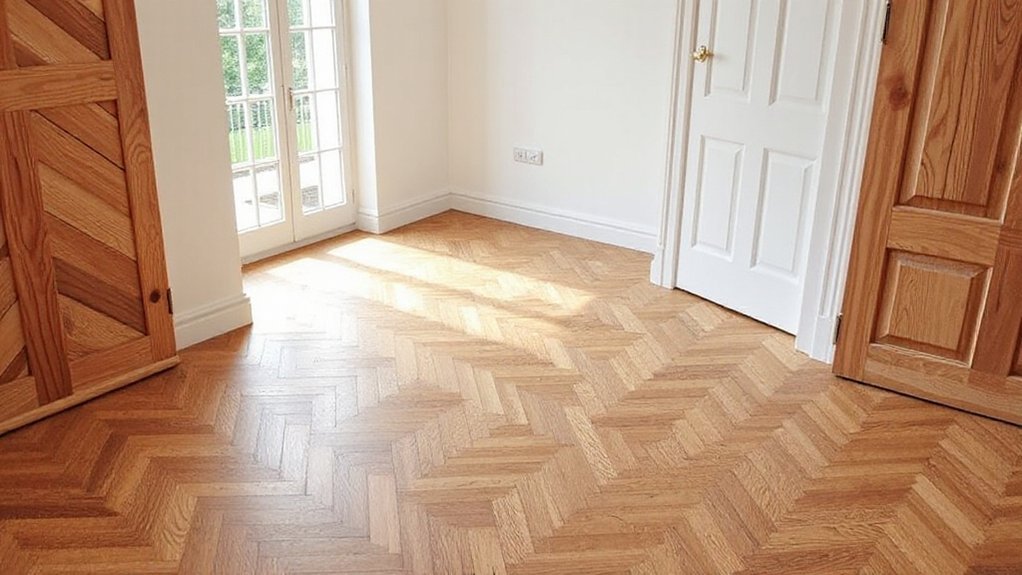
Once you’ve matched a parquet layout to your room shape, wear level, and budget, herringbone is often the pattern that balances impact with practicality. You get a broken-zigzag visual that lengthens narrow UK rooms and disguises minor subfloor tolerances better than straight boards. It also nods to parquet history, appearing in Victorian and Edwardian refurbishments as well as modern flats.
Cost depends on specification: expect higher labour than plank because installers must set accurate 90° repeats, manage borders, and cut wastage. In the UK, engineered oak herringbone typically delivers the best value over solid for stability with underfloor heating. Use it in hallways, kitchens, and living rooms where traffic is high. Parquet maintenance stays straightforward: felt pads, grit control, and periodic re-oiling or lacquer refresh.
Chevron Parquet Flooring Vs Herringbone (Key Differences)
When you compare chevron parquet flooring with herringbone, you’ll notice chevron forms a continuous V with mitred ends, while herringbone offsets rectangular blocks for a broken zigzag. You’ll also need to account for installation: chevron demands tighter setting-out and more precise cuts, so it typically takes longer to fit. In the UK, that extra labour and wastage usually pushes chevron’s supply-and-fit cost above herringbone.
Visual Pattern Differences
How do chevron and herringbone parquet look different once they’re on the floor? Chevron reads as a continuous V-shaped zigzag, with each block cut to a matching angle so joints align into crisp, uninterrupted lines. You’ll see strong directionality, so spaces feel longer or wider depending on the run of the pattern. Herringbone, by contrast, uses rectangular blocks laid at 90 degrees, creating a broken zigzag with a more segmented, woven effect and a busier visual rhythm.
Your colour options and material textures show differently too: chevron’s long, straight seams emphasise tonal variation and grain flow, while herringbone’s frequent junctions scatter light, making knots, brushing, and matt finishes appear more uniform across the field.
Installation Complexity And Cost
Although both patterns demand a flat, stable subfloor and accurate setting-out, chevron usually takes longer and costs more to install than herringbone because every block must be mitre-cut (typically 45° or 60°) so the points meet cleanly on a dead-straight centreline. You’ll also spend more on wastage and specialist labour, especially with solid wood that needs acclimatisation and tight moisture control to meet UK site conditions.
Herringbone installs faster because you use rectangular blocks with square ends, so you can keep cutting to a minimum and correct small deviations as you go. You’ll still need latex smoothing compound, a DPM where required, and a high-grab adhesive. Choose engineered boards for predictable Material durability and lower Environmental impact, as they use less hardwood and reduce replacement risk.
Block Parquet Patterns (Basketweave, Brick Bond, Squares)
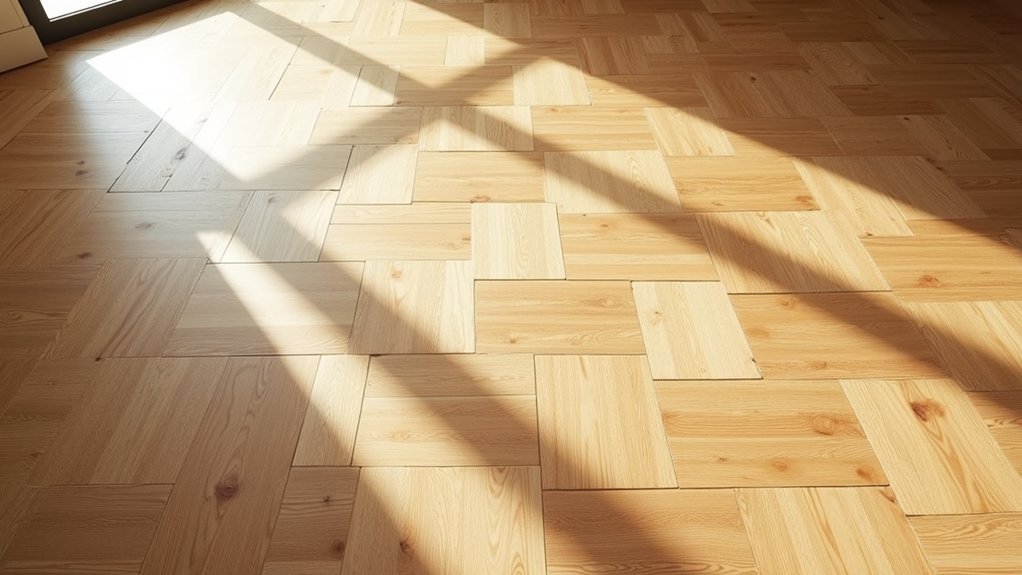
When you specify block parquet, you’re working with repeatable modules, so you need to set out your datum lines, borders, and block size before you fix anything down—especially for basketweave, where paired strips must stay square and consistent. With brick bond, you stagger joints to control visual direction and tolerance to subfloor variation, but you must manage end-joint alignment and expansion gaps to BS-compliant practice. With squares, you lock the room into a grid, so you’ll prioritise accurate centrelines and equal margins to avoid tapering cuts at the perimeter.
Basketweave Layout Essentials
If you’re specifying basketweave block parquet, start by locking down the module size and joint geometry, because the pattern’s visual rhythm depends on consistent block proportions and tight alignment. Set out a full grid from a true datum line, then dry-lay a few modules to confirm squareness and tolerance before adhesive goes down. In UK refurb work, check subfloor SR1/SR2 compliance and moisture (RH) so modules don’t creep or curl.
Choose block thickness and species with traffic class in mind to protect Flooring durability, and specify a compatible adhesive and primer for timber movement. Keep perimeter expansion gaps and plan borders to avoid slivers at thresholds. For Parquet maintenance, specify factory-finished blocks or a hardwax oil system, and ensure future sanding allowances remain.
Brick Bond Vs Squares
Because both patterns rely on the same rectangular blocks, the real decision between brick bond and squares comes down to how you want the joints to read across the room and how much tolerance you’ve got in the setting-out. Brick bond staggers end joints, so it disguises minor size variation and subfloor movement, making it a safer call in older UK terraces. Squares (often 2- or 4-block modules) create a grid that looks sharper but shows misalignment fast, so your chalk lines, datum, and expansion gaps must be spot on.
- Choose brick bond if you want flow through hallways and fewer visible errors.
- Choose squares if you want a formal, checkerboard rhythm in reception rooms.
- Plan Parquet cleaning access and future parquet repairs by keeping spare blocks matched.
Statement Parquet Patterns (Versailles, Chantilly, Panels)
Although classic herringbone and chevron suit many schemes, statement parquet patterns such as Versailles, Chantilly and framed panel layouts bring a more architectural, high-impact finish that you can’t replicate with plank flooring. Versailles reads as a gridded, coffer-like field and suits formal UK period rooms, while Chantilly uses diagonals and contrasting direction to heighten movement across wider bays. Framed panels (often with a border and feature centre) let you align the geometry with fireplaces, door thresholds and room proportions for a deliberate, “designed-in” look. If you care about Parquet pattern history, these layouts reference French court traditions and later Victorian adaptations seen in British townhouses. For environmental impact considerations, favour FSC-certified timber, engineered cores, and low-VOC finishes to reduce embodied carbon and indoor emissions.
Fitting Costs, Waste % And Subfloor Prep (UK Guide)
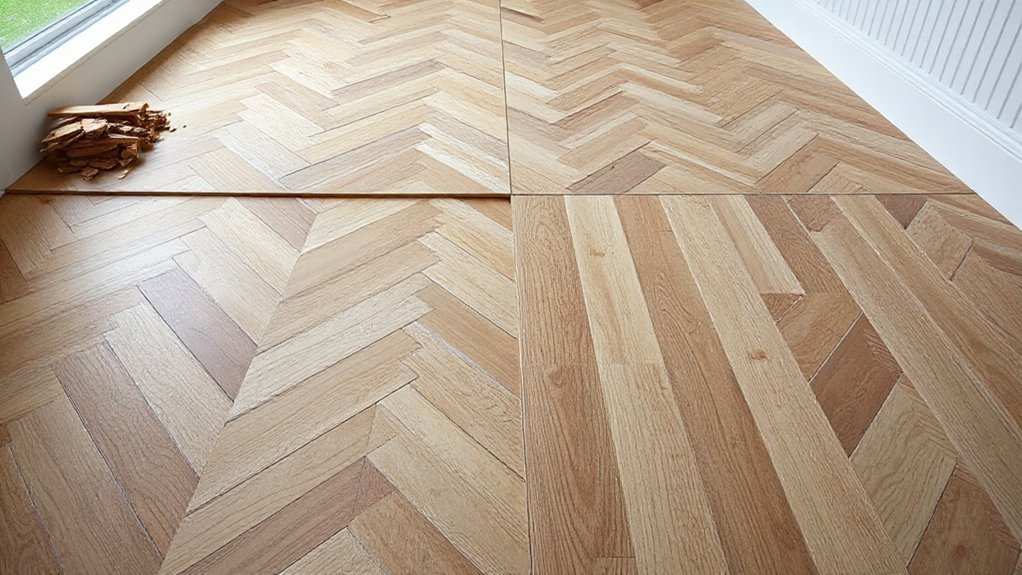
Before you commit to a parquet pattern, cost it like a flooring contractor would: allow for higher labour rates than plank installs, plan a realistic waste percentage, and budget for subfloor prep to British tolerances. Intricate herringbone, chevron, and panelled layouts slow setting-out and cutting, so day rates rise and adhesives increase.
- Fitting costs: Expect more time on chalk lines, mitres, borders, and expansion details; ask for a written scope, including sanding/finishing where applicable.
- Waste %: Allow 8–12% for herringbone, 12–15% for chevron, and up to 20% for panels and borders; tighter tolerances protect Material durability.
- Subfloor prep: Insist on SR1 where possible, moisture testing, DPM/primer, and smoothing compound; good prep reduces environmental impact by preventing failures and rework.
Frequently Asked Questions
Can Parquet Flooring Be Installed Over Underfloor Heating in UK Homes?
Yes, you can install parquet over underfloor heating in UK homes if you confirm Underfloor heating compatibility. You’ll follow parquet installation tips: use engineered boards, acclimatise, glue-down, control moisture, and limit surface temperatures to 27°C.
How Do I Clean and Maintain Parquet Without Damaging the Finish?
Keep it shipshape: vacuum soft-brush weekly, grit damages lacquer. Use a barely damp microfibre mop with pH-neutral wood cleaner; never steam. Add felt pads, wipe spills fast, and recoat promptly—Cleaning techniques and Maintenance tips that protect UK finishes.
Is Engineered Parquet Better Than Solid Wood for Moisture-Prone Areas?
Yes—engineered parquet performs better in moisture-prone UK areas because its cross-ply core resists cupping and swelling, delivering Engineered durability. You’ll still prefer solid in stable rooms for Solid wood authenticity and refinishability.
Can Parquet Be Sanded and Refinished, and How Many Times?
Yes—you can sand and refinish parquet; solid wood typically allows 3–6 full sandings, engineered parquet 1–3, depending on wear-layer thickness. Parquet durability hinges on careful sanding depth; refinishing frequency depends on traffic and finish.
Does Parquet Flooring Increase Home Value and Appeal to UK Buyers?
Yes, parquet can boost UK home value and buyer appeal; like a well-set mosaic, it signals quality. Choose Parquet design options and historical parquet styles, and you’ll enhance perceived durability, heritage, and resale confidence.
Conclusion
You’ve now got the tools to pick a parquet pattern that suits your room, budget, and expected wear. Choose herringbone for classic movement, chevron for crisp symmetry, and block designs for straightforward installation and lower waste. If you want maximum impact, specify Versailles or panelled layouts, but plan for higher fitting costs and tighter tolerances. Get your subfloor flat, dry, and stable, then allow for UK wastage and trims—done right, it’ll last forever.