
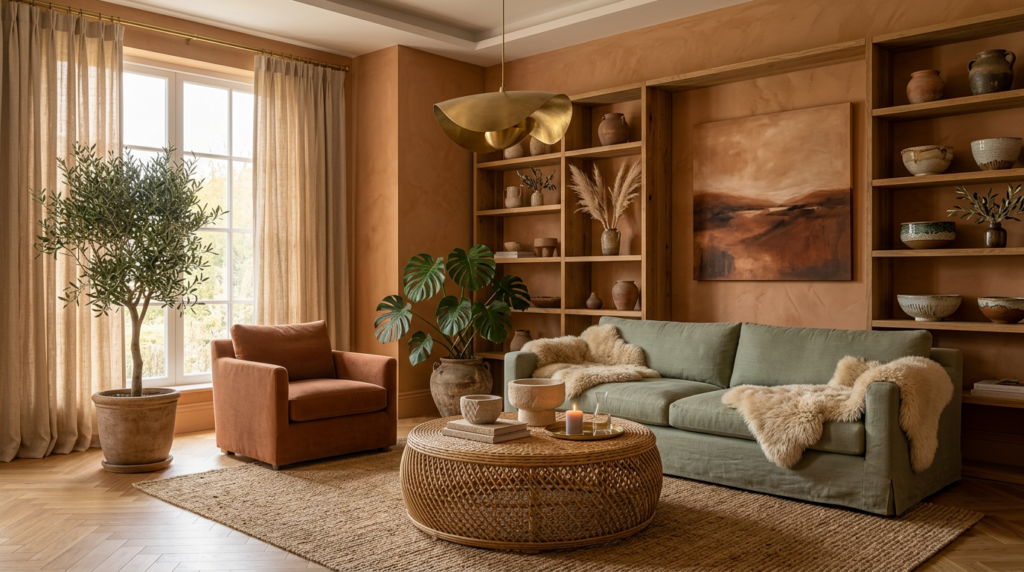
You can use earthy tones in interior design to make a space feel grounded, but you’ll get the best result when you commit to a clear direction. Start by choosing warm undertones for cozy energy or cool undertones for a calmer look, then pick one anchor piece—like a rug or sofa—to set the palette. From there, every wood finish, textile, and accent has a job. The real challenge is keeping it rich, not muddy—and that’s where most rooms go off track.
Choose an Earthy Palette (Warm vs Cool Undertones)
Before you buy a single swatch, decide whether your earthy palette will lean warm or cool, because that undertone sets the mood of the entire room.
Warm undertones (clay, terracotta, camel, olive, golden oak) make spaces feel sunlit, cozy, and inviting, especially in north-facing rooms or homes with cool daylight.
Cool undertones (stone, taupe, slate, eucalyptus, walnut, smoked clay) read calmer, crisper, and more modern, and they balance bright southern light or busy patterns.
Test paint and fabric in morning and evening light; undertones shift fast against flooring and trim.
Keep your neutrals in the same temperature family, then add one or two accent hues within that range for depth without muddiness or clashing.
Start With One Anchor Piece or Surface
Once you’ve picked a warm or cool undertone, choose one anchor piece or surface to lock that direction in and guide every other choice. Make it substantial and constant: a sofa, area rug, hardwood floor, stone countertop, or a large piece of art.
Your anchor should carry the exact earthy family you want—clay, rust, camel, olive, slate, or taupe—so it reads clearly even in different light.
Then build outward with smaller, easier-to-swap elements that echo or contrast within the same undertone. Pull two to three supporting shades from the anchor and repeat them across textiles, curtains, bedding, and accessories.
Use varied textures—linen, wool, leather, rattan, ceramics—to keep the palette rich without adding more colors. Keep metals and woods consistent with the anchor’s warmth or coolness.
Paint With Earthy Tones (and Pick the Right Finish)
Because paint covers more visual real estate than almost anything else, an earthy wall color can set the room’s temperature in seconds. Choose clay, mushroom, sage, olive, or muted terracotta to soften harsh light and make furnishings feel grounded.
If you want a calm backdrop, keep undertones consistent: warm beige with rust accents, or cool greige with dusty greens.
Then pick the finish like you’d pick fabric. Use flat or matte on low-traffic walls for a velvety, depthy look that hides minor flaws.
Go eggshell for living rooms and bedrooms when you need a little wipeability.
Choose satin for kitchens, baths, and trim where splashes happen, but keep sheen limited so earthy colors stay natural.
Always sample at different times.
Mix Wood, Stone, and Clay Without Renovating
Even if you can’t change floors or countertops, you can still layer wood, stone, and clay to give a room that grounded, earthy mix. Start with what you already have: wood furniture, a stone fireplace, or ceramic tile.
Then balance it with small, hard-surface swaps that don’t require construction.
Bring in wood through a new side table, open shelving, or a warm-toned frame. Add stone with a marble or slate board on a console, a stone tray on a coffee table, or a granite cutting slab that stays on display.
Introduce clay with terracotta planters, a matte ceramic lamp base, or a handcrafted bowl. Keep undertones consistent—warm woods with beige stone, cooler woods with gray stone—and vary finishes for depth.
Layer Earthy Tones With Textiles and Décor
While hard materials set the foundation, textiles and décor give earthy tones their most livable depth. Start with a rug that carries warm sand, rust, or olive, then echo those hues in smaller hits so the room feels intentional.
Swap in linen or cotton curtains, a chunky knit throw, and woven baskets to add touchable texture that reads “earth” without changing a wall.
Build layers through contrast: pair smooth leather with nubby bouclé, matte ceramic with glazed vases, and raw wood frames with brushed brass accents.
Choose cushions in tonal variations—clay, terracotta, camel, and taupe—so you create rhythm across the sofa.
Finish with art and objects: landscape prints, stoneware, dried botanicals, and hand-thrown bowls that tie everything together.
Keep Earthy Tones From Looking Muddy or Dark
Earthy palettes can start to look muddy or overly dark if too many mid-tone browns and olives cluster together without contrast. Break them up with clear value shifts: pair deep clay or espresso with warm ivory, sand, or pale greige.
Bring in reflective surfaces—aged brass, light oak, glass, or a satin paint finish—to bounce light and keep the room open.
Control undertones so colors don’t fight; stick to either warm, red-based browns or cooler, green-leaning olives, then repeat that choice in small accents.
Use pattern to add separation: a striped rug, veined stone, or woven basketry creates definition without adding new hues.
Finally, lighten the vertical plane—walls, curtains, and large art—so your darker pieces feel intentional.
Conclusion
You can make earthy tones feel intentional by choosing warm or cool undertones and sticking to them. Start with one anchor piece, then echo its hue through paint, textiles, and décor. Bring in wood, stone, and clay for natural depth, even in small doses. Layer mid-tones with lighter shades and a few reflective finishes so the room won’t look muddy. When you balance contrast and texture, you’ll create a grounded space that still feels fresh.