
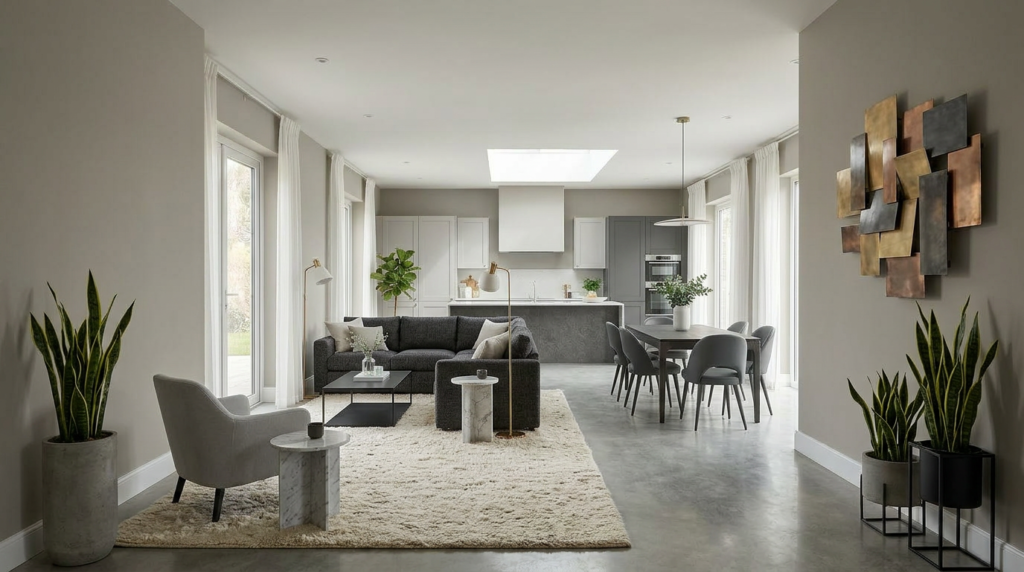
When you choose a modern grey scheme, you’re really setting the temperature of the whole space. You can keep it cool and crisp with bright whites and matte black, or warm it up with greige, wood tones, and earthy accents. You’ll get the most impact when you layer three greys and mix textures so nothing feels flat. The key is knowing which grey works with your light—and which one fights it.
Pick Your Grey Base: Warm, Cool, or Greige
Before you pick accent colours or finishes, choose the right grey base because it sets the undertone for the entire space. Start by deciding what mood you want: warm grey reads inviting, cool grey feels crisp, and greige balances both with a soft, modern neutrality.
Warm greys carry subtle beige, taupe, or brown notes, so they pair easily with oak, brass, and creamy whites.
Cool greys lean blue, green, or violet, so they suit black metal, chrome, and bright whites.
Greige works when you want flexibility; it won’t fight wood grains or stone veining, and it keeps textiles looking natural.
Sample three candidates on large boards, then compare them to your flooring, countertops, and key fabrics before committing.
Choose Grey by Room Light and Bulb Warmth
How your grey looks shifts dramatically with the light in the room and the warmth of your bulbs, so match the paint to both instead of judging it in isolation.
In north-facing rooms, cool daylight can make many greys read bluer and flatter, so test slightly warmer or deeper options to keep them grounded.
South- and west-facing spaces flood paint with warm sun; a grey that seemed neutral on a swatch can turn beige by afternoon, so sample truer, cooler notes there.
At night, bulbs take over. With warm LEDs (2700–3000K), greys often look cozier but can skew brown.
With neutral-to-cool LEDs (3500–5000K), they sharpen and may feel icy.
Paint large boards, view them morning-to-night, and decide under the bulbs you’ll actually use.
Pair Grey With White (Bright vs Soft)
Because white sets the “temperature” of everything around it, the white you pair with grey can make the same paint look crisp and modern or soft and relaxed. If you choose a bright, clean white with a cool undertone, your greys read sharper, edges look defined, and the whole space feels more graphic.
Use it on trim, ceilings, or cabinetry when you want contrast and a gallery-like finish.
If you prefer a softer white—slightly creamy or muted—your greys turn calmer and more enveloping. Pair it with mid-tone greys on walls to reduce stark transitions and make shadows look smoother.
Before committing, paint large swatches side by side and view them morning, afternoon, and at night. Keep finishes consistent for truer comparisons.
Warm Grey Palettes With Wood Tones
While cool greys can feel sleek, warm greys come alive next to wood tones, giving your space a grounded, inviting look. Choose greys with taupe, mushroom, or greige undertones, and they’ll echo oak, walnut, or ash instead of fighting them.
If your floors skew honey, pick a warm mid-grey for walls to calm the sweetness. With darker walnut, go for a lighter warm grey so the room doesn’t feel heavy.
Use matte finishes to keep the pairing natural, and let wood grain stay visible for character.
Balance metal accents carefully: brushed brass warms the palette, while black hardware adds crisp contrast.
Keep textiles in oatmeal, camel, or clay to reinforce warmth without losing the modern edge.
Add Depth With 3-Layer Grey Styling
To keep an all-grey room from feeling flat, build it in three deliberate layers: a base grey, a supporting grey, and a sharp accent.
Start with your base on the largest planes—walls, main sofa, or broad flooring—so the room reads calm and continuous. Choose a supporting grey one to two steps lighter or darker, then place it on secondary pieces like drapery, rugs, or cabinetry to create contrast without noise.
Finish with a sharp accent grey in small, high-impact doses: matte blackened steel, charcoal trim, or slate hardware. Vary texture as you stack the layers—plush wool, smooth paint, brushed metal, and stone—to amplify depth while staying monochrome. Keep sheen shifts intentional for balance.
Use Colour Accents That Suit Grey Interiors
Three-layer grey styling gives your room dimension; now use colour accents to give it personality and direction. Start by choosing one lead accent colour, then repeat it in two or three small doses so the scheme feels intentional.
With cool greys, reach for inky navy, emerald, or crisp white for a clean, tailored look.
With warm greys, lean into ochre, terracotta, blush, or soft sage to keep the space welcoming.
If you want energy, add a controlled shot of mustard, teal, or coral, but keep it to 10–15% of what you see.
Use black accents to sharpen lines, or brass to add warmth.
Test swatches in your lighting before you commit.
Mix Textures So Grey Doesn’t Look Flat
A grey palette comes alive when you layer textures that catch light and shadow in different ways. Start with a soft foundation: a nubby wool rug, a plush sofa, or a brushed cotton throw.
Then add contrast with sleek elements like lacquered side tables, polished stone, or glossy ceramics so the room gains depth without changing colour.
Bring in tactile vertical surfaces to stop walls from feeling blank. You can use linen curtains, ribbed panelling, textured wallpaper, or a limewash finish to create movement as daylight shifts.
Mix warm and cool greys across materials—concrete, oak, boucle, and glass—so the palette feels intentional, not monotonous. Keep patterns subtle: herringbone, micro-checks, or tone-on-tone stripes work best.
Use Matte Black Accents With Modern Grey
Layered textures give grey its depth, and matte black accents sharpen that depth into a modern, intentional look. Use black to outline forms: slim picture frames, curtain rods, table legs, or a floor lamp with a crisp silhouette. Keep the black matte, not glossy, so it reads as graphic and calm instead of flashy.
Balance matters. Repeat black in small doses across the space so it feels curated, not heavy—think three to five touchpoints. Pair it with warm greys, greige, or stone to avoid a cold, sterile vibe.
If you’re using cool grey, add softer materials nearby, like wool, linen, or oak, so the contrast stays inviting. Choose clean lines and let negative space do the work.
Modern Grey Colour Schemes by Room (Quick Picks)
In every room, grey behaves a little differently, so it helps to pick a scheme that matches the light, the function, and the mood you want.
In living rooms, pair warm greige walls with crisp white trim and oak tones for an easy, contemporary base.
In kitchens, choose a cool mid-grey for cabinets, then add white stone and brushed steel to keep it sharp.
In bedrooms, go soft: misty grey paint, layered linen, and muted blush or sage accents for calm.
In bathrooms, lean spa-like with pale grey tile, matte black hardware, and bright white grout lines.
In offices, use charcoal on one wall, light grey elsewhere, and walnut details for focus.
In hallways, pick a light reflective grey and bold art.
Common Modern Grey Colour Mistakes to Avoid
Although grey feels like a foolproof neutral, it can turn cold, muddy, or flat fast if you ignore undertones, lighting, and contrast. Don’t choose paint from a tiny swatch; test large samples on multiple walls and check them morning, afternoon, and night.
Avoid pairing a cool grey with warm wood or brass unless you add a bridging neutral (greige, taupe) to stop clashing. Don’t match everything to one grey; mix values and textures so the room has depth—think charcoal accents, soft mid-greys, and crisp whites.
Skip heavy grey-on-grey in low light; you’ll get a cave effect, so brighten with layered lighting and reflective finishes. Finally, don’t forget black: a thin hit of it sharpens modern lines.
Conclusion
You can make modern grey colour schemes feel crisp or cozy when you choose the right base, lighting match, and white pairing. Keep your look intentional by layering three greys, mixing textures, and grounding the space with wood or matte black accents. Add one confident accent colour for personality, then repeat it lightly for balance. As you plan room by room, avoid flat, single-tone grey and mismatched bulbs that dull everything.