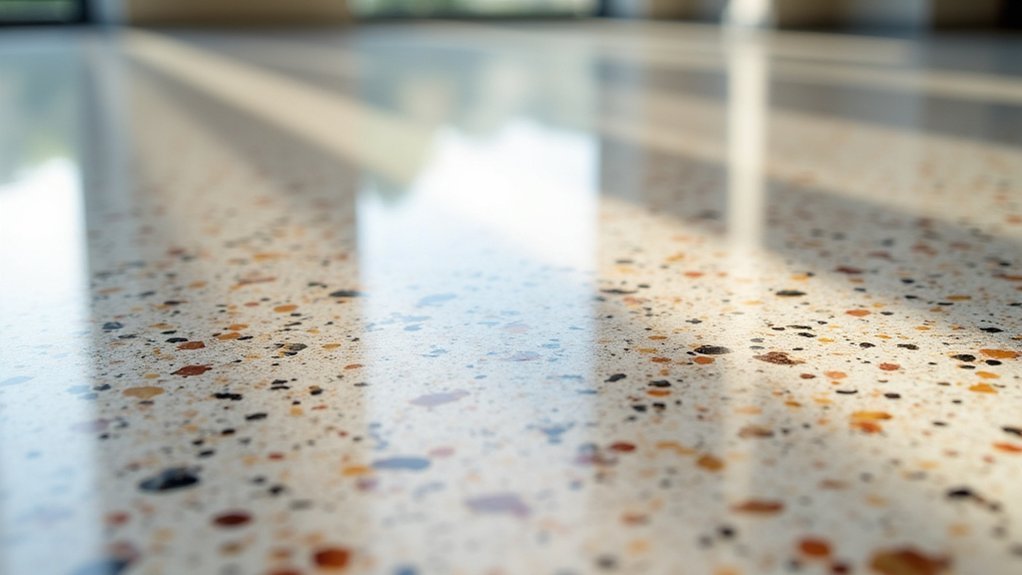
Terrazzo flooring is a composite surface you get by binding graded chips of marble, granite, quartz or glass (often reclaimed or locally sourced) in a cementitious or epoxy resin matrix, then grinding, polishing or honing, and sealing it. Cement terrazzo is typically 20–40mm thick with a traditional matte finish and better moisture tolerance; epoxy terrazzo is 6–12mm, fast-curing, colour-precise and glossier. Keep going and you’ll see how aggregates, joints and sealers change performance.
Key Takeaways
- Terrazzo flooring is made of decorative aggregate chips (marble, granite, quartz, glass, or reclaimed materials) embedded in a binder.
- The binder is either cementitious (traditional, thicker) or epoxy resin (modern, thinner), which holds the aggregates together.
- Aggregates are graded by size (fine to large), affecting pattern boldness, visual texture, and overall appearance.
- Pigments can be added to the binder to control base color and create consistent, customizable designs.
- Divider strips (brass, zinc, aluminum, or PVC) are used to form patterns and help manage movement and cracking.
What Is Terrazzo Flooring Made Of?
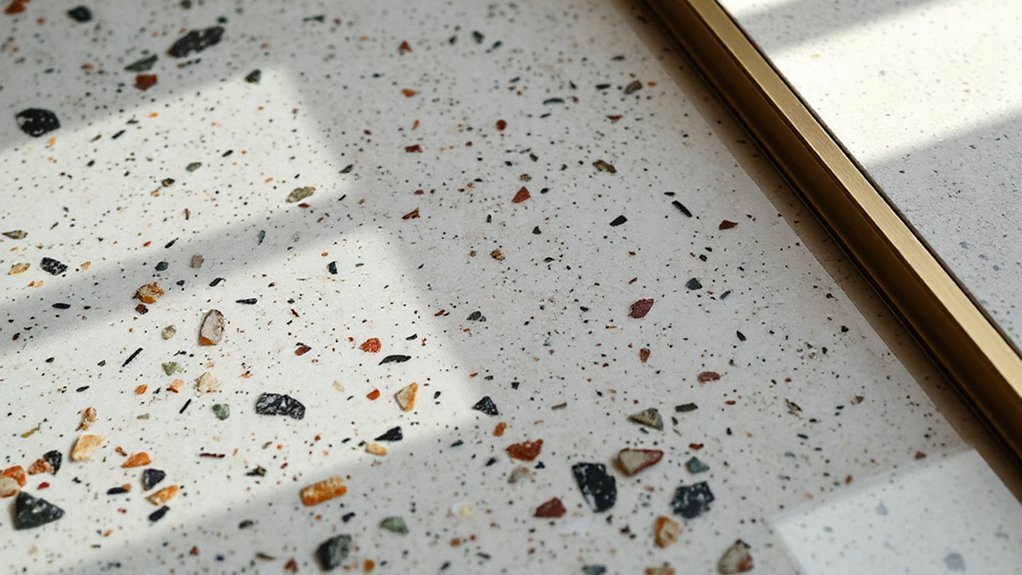
Although terrazzo reads as a single, seamless surface, it’s actually a composite: marble, granite, quartz or glass chips bound in a cementitious or epoxy resin matrix, then ground and polished to expose the aggregate. You choose the aggregate blend for performance and aesthetics: harder granites suit busy UK foyers, while glass brings light-play to retail and hospitality. Pigments tint the matrix so you can align with RAL or bespoke palettes, and metal divider strips (brass, aluminium, or stainless steel) control cracking, set joint geometry, and sharpen patterns. Underneath, you’ll specify a stable substrate and appropriate primers, then finish with sealers that manage staining and slip. Terrazzo artistry comes from grading, colour mix, and strip layout, shaped by its historical evolution from Venetian fragments.
Cement vs Epoxy Terrazzo: Which Binder Is It?
Because the binder sets the system’s strength, thickness, curing time and final look, you’ll usually choose between traditional cementitious terrazzo and modern epoxy resin terrazzo. Cement suits heritage refurbishments and aligns with terrazzo’s Historical origins, but it needs thicker builds, longer drying and careful moisture management—relevant in UK basements and ground floors. Epoxy goes thinner, cures fast and delivers sharper colour control for contemporary commercial fit-outs, yet it’s less forgiving on damp substrates and may raise Environmental impact concerns due to petrochemical resins.
- Cement: 20–40mm builds, robust for heavy-duty public domains
- Epoxy: 6–12mm builds, ideal for tight thresholds and retrofits
- Cement: softer, more porous, traditional matte patina
- Epoxy: dense, glossy, high-definition aggregates and brass strips
- Your choice hinges on programme, substrate moisture, and design intent
What’s in Terrazzo Binder (and What It Changes)
When you specify terrazzo, you’re not just choosing aggregates—you’re choosing the binder system that locks them in. Cement binders bring a mineral matrix with traditional depth and breathability, while epoxy binders use polymer resins for tighter tolerances, stronger adhesion, and sharper colour control. That chemistry shifts performance in UK settings, affecting thickness, crack and stain resistance, curing time, and long-term maintenance.
Cement Vs Epoxy Binders
Whether you’re specifying terrazzo for a commercial fit-out or a high-end residential scheme, the binder you choose—cementitious or epoxy—sets the floor’s performance envelope as much as the aggregate does. In the UK, cement binders reference historical applications: Venetian-style mixes, thicker beds, and a familiar, mineral character that suits heritage refurbishments. Epoxy reads as contemporary: a resin matrix that holds fine chips crisply, enabling sharper graphics and tighter tolerances—handy on fast-track programmes. If you’re targeting Eco friendly options, cement can align with lower-resin strategies, while epoxy can support high recycled content and thinner builds, reducing material volume. You’ll typically weigh:
- traditional sand/cement screed build-ups
- resin-bound thin-set systems
- pigment compatibility and colour depth
- joint layout and divider detailing
- substrate moisture conditions in British slabs
Binder Effects On Performance
How does the binder actually change terrazzo’s behaviour under UK site conditions? It controls cure speed, moisture tolerance, and crack risk. Cementitious binders suit breathable slabs but can shrink, so you’ll specify movement joints and allow longer programme time in damp British builds. Epoxy binders cure fast and polish hard, yet they hate rising damp; you’ll need a DPM and tight RH checks, especially on ground floors and basements. Binder choice also shifts slip resistance: harder epoxies take a higher gloss, while cement accepts a softer honed finish that reads more ‘matt stone’. For Terrazzo durability, the binder governs abrasion, chemical resistance, and micro‑porosity, which affects staining from tea, wine, and de-icers. If you’re prioritising Eco friendly materials, you’ll weigh low‑VOC resins and low‑cement mixes.
Terrazzo Aggregates: Marble, Granite, Quartz, Glass
Once you’ve set the binder, you’ll specify the aggregate blend that defines the terrazzo’s look and performance on UK projects. You can use marble chips to introduce classic veining and a softer, heritage-led aesthetic, while granite and quartz aggregates boost hardness and wear resistance for heavier footfall. Add glass aggregate when you want sharper colour effects and light play, from subtle sparkle to high-contrast patterns.
Marble Chips And Veining
Because marble remains the benchmark aggregate for terrazzo in the UK, its chips and natural veining largely determine the floor’s character, from crisp, contemporary fields to richly marbled movement. You specify chip grading, colour mix, and exposure level to control Terrazzo patterns, then let Marble veining add depth once the surface is ground and polished. In UK commercial fit-outs, you’ll often balance clean geometry with organic streaking, so the floor reads tailored yet lively under cool daylight.
- Fine chips for a calm, near-solid field
- Medium chips for classic, speckled legibility
- Bold, large chips for graphic, gallery impact
- High-contrast veined marble for dramatic flow lines
- Tone-on-tone veining for subtle movement in reception areas
Granite And Quartz Strength
While marble sets the visual benchmark, granite and quartz give terrazzo its hard‑wearing backbone in UK high‑traffic schemes. You’ll feel the difference in concourses, schools, NHS corridors, and retail fit‑outs where abrasion, grit ingress, and trolley loads punish softer aggregates. Granite’s interlocking crystals and quartz’s high Mohs hardness help the matrix resist scratching and edge spalling, so the polish holds longer between refurb cycles. Specify tighter grading for a denser surface, and pair it with a suitable binder to control shrinkage and micro‑cracking. For Terrazzo sustainability, you can prioritise locally sourced crushed granite or reclaimed quartz‑rich stone to cut embodied carbon. Terrazzo maintenance stays straightforward: neutral cleaners, periodic re‑sealing, and planned burnishing rather than aggressive stripping.
Glass Aggregate Color Effects
How do you shift terrazzo’s mood without changing the base system? You specify glass aggregate. In UK projects, recycled glass chips deliver crisp hue control and light play that stone can’t match. With Terrazzo artistry, you can steer saturation, translucency, and contrast while keeping performance targets intact. For Color customization, you’ll tune chip size, mix ratio, and polish level to manage sparkle versus calm.
- Sea-glass greens for coastal lobbies and leisure centres
- Cobalt flecks that read cooler under 4000K LEDs
- Amber and ruby chips that warm grey binders
- Clear glass that boosts reflectance in darker corridors
- Black-backed glass that sharpens veining and grid patterns
You’ll also check alkali resistance and slip requirements, as glass can polish to a higher sheen.
How Aggregate Size Changes Terrazzo Flooring’s Look
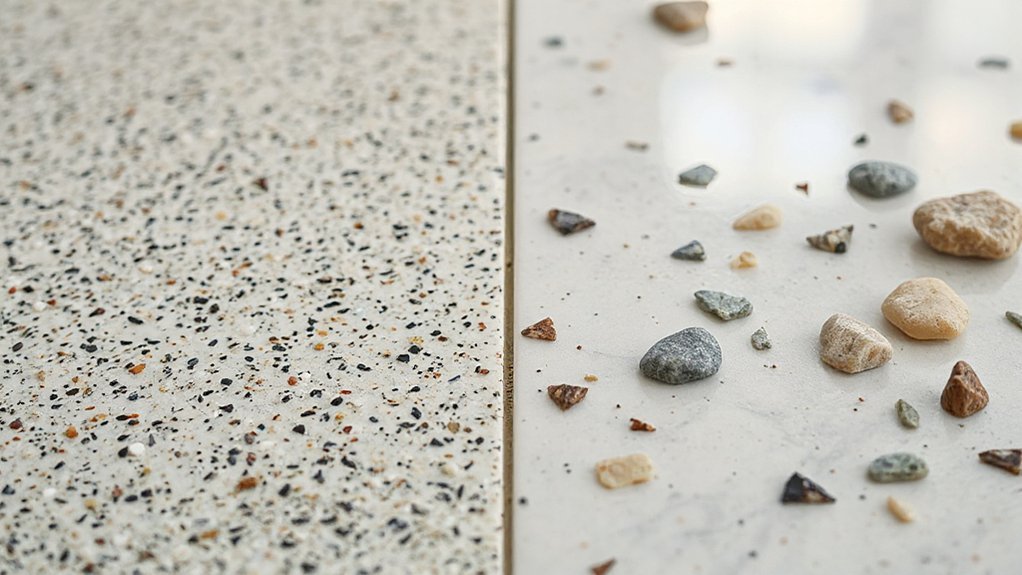
Even if you keep the binder and colour palette constant, aggregate size will radically shift terrazzo’s visual “read” across a space. Specify large chips and you’ll get bold, legible geometry from standing height—great for wayfinding in UK public buildings and a nod to terrazzo’s Historical significance in civic interiors. Choose medium sizes for balanced grain that suits open-plan offices and retail. Go fine and you’ll achieve a calmer, almost honed-concrete field that makes tight rooms feel larger and lighting more even. You also change perceived slip risk: bigger fragments can telegraph texture, although slip resistance still depends on the final finish system. Size affects the Environmental impact too; coarser grading can accept more reclaimed offcuts with less crushing and lower embodied energy overall.
Terrazzo Pigments: How Color Is Added and Controlled
Because terrazzo colour comes from multiple inputs, you’ll only get a predictable, repeatable finish if you control pigments as tightly as you do aggregate grading. In cementitious or resin systems, you dose iron oxides, carbon black, or organic tints by weight, then verify dispersion to prevent marbling and metamerism under UK daylight LEDs. You’ll also spec UV resistance and alkali compatibility, because pigment stability determines whether Terrazzo color holds through curing, polishing, and years of cleaning.
- Calibrated scales and batch tickets for every mix
- Pre-wet or slurry pigments to eliminate clumping
- Trial panels cured to site temperature and humidity
- Lightfastness checks against BS/ISO references
- Polishing sequence matched to avoid colour bloom
Divider Strips in Terrazzo: Brass, Zinc, Aluminum, PVC
While the aggregate and binder set the visual field, divider strips define the geometry, manage movement, and give you crisp shifts between colours, pours, and finishes. You’ll see them laid to control panel sizes, reduce cracking risk, and form borders, grids, logos, and radii with tight tolerances on UK site. Brass gives a warm, premium line and suits heritage schemes with Historical influences, though it can patinate. Zinc reads cooler and is traditionally paired with cementitious mixes; it’s also easy to bend for curves. Aluminium offers a clean, modern edge, but you’ll specify it carefully where alkalinity or moisture could drive staining. PVC strips suit budget or fast-track installs and provide Eco friendly options when using recycled content and low-VOC components.
Terrazzo Finish Options: Polished, Honed, Matte
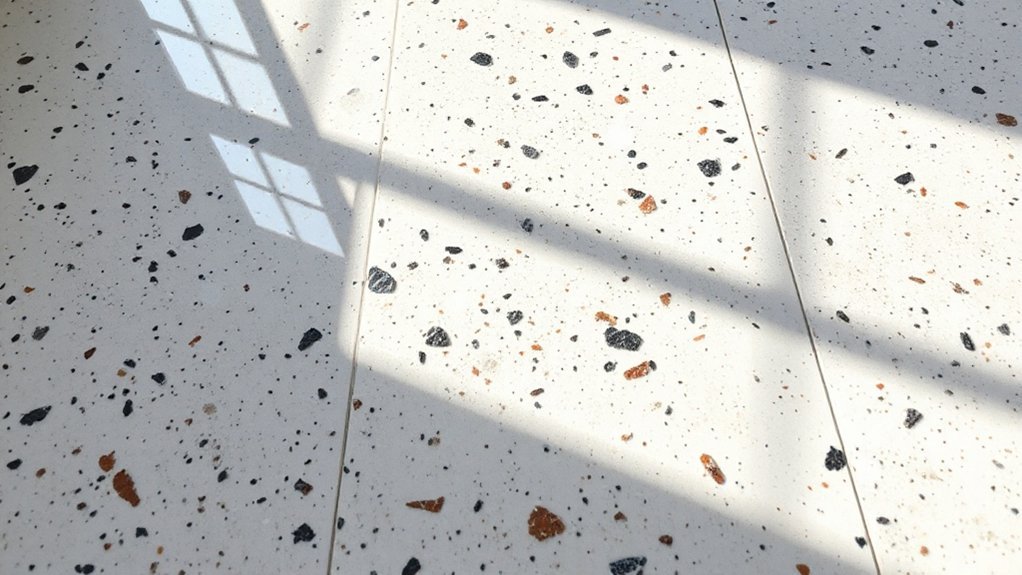
You’ll shape terrazzo’s final look with your finish choice, starting with polished for a high-sheen surface that boosts colour clarity and light reflectance in UK interiors. Choose honed when you want a flatter, tactile texture with reduced glare while keeping the aggregate crisp. Specify matte for a soft, contemporary read that masks minor scuffs and suits understated schemes.
Polished Terrazzo Sheen
If you want terrazzo to read crisp and architectural under UK lighting, a polished sheen delivers the highest reflectance and colour depth. You’ll amplify aggregate contrast, tighten perceived joints, and make reception areas feel brighter without adding luminaires. Specify a dense, mechanically polished surface to support Terrazzo durability in high-traffic stations, schools, and retail. Because the finish relies on grinding and polishing—not topical films—you reduce recoat cycles, which can lower Environmental impact across the maintenance plan.
- Daylight from north-facing glazing bounces cleanly across the floor
- Black-and-white chips pop like a sharp CAD lineweight
- Brass trims and stainless details mirror subtly at skirting level
- Wayfinding graphics read clearer against a brighter field
- Spill wipe-downs feel faster in cafés and foyers
Honed Surface Texture
Where polished terrazzo reads high-gloss and crisp, a honed surface gives you a flatter, more tactile finish that controls glare under UK LEDs and overcast daylight. You achieve it by stopping the grinding sequence earlier, typically around 200–400 grit, so the aggregate still shows clearly but without mirror reflectance.
Specify a honed surface when you want dependable slip resistance in entrance lobbies, retail aisles, or school corridors, especially where wet footwear is common. It’s a textured finish that hides micro-scratches and light scuffing better than a full polish, reducing perceived maintenance between cleans. Pair it with a penetrating sealer and a neutral cleaner to keep pores from loading with grime. Detail thresholds and mat wells so grit doesn’t abrade the binder over time.
Matte Finish Appeal
Although honed terrazzo already dials back sheen, a true matte finish pushes the aesthetic further, giving the floor a soft, light-absorbing read that suits contemporary UK interiors under diffuse skylight and cool-white LED grids. You’ll specify matte when you want lower reflectance, calmer pattern legibility, and fewer glare hotspots in open-plan kitchens, schools, and offices. It still showcases Terrazzo artistry, but with a more mineral, tactile presence that nods to the material’s historical significance without feeling ornate. Expect slightly higher porosity versus polished, so you’ll rely on penetrating sealers, tighter maintenance cycles, and slip-testing to BS 7976 where required.
- Subtle aggregate contrasts, no mirror flash
- Softer joins at skirting and thresholds
- Reduced visual noise under spotlights
- Better tolerance of micro-scratches and scuffs
- Quiet, gallery-like depth in pale mixes
Terrazzo Sealers: Penetrating vs Topical Protection
Because terrazzo’s cementitious matrix and aggregate can behave very differently around moisture and staining, the sealer you choose matters as much as the mix design. In UK projects, you’ll typically specify either a penetrating impregnator or a topical film.
Penetrating sealers soak into capillaries, reducing water uptake and oil staining while keeping the surface looking natural—ideal when matte aesthetics align with terrazzo design trends. They won’t add much sheen, but they help you avoid dark patches around entrances and café seating.
Topical sealers sit on top, giving stronger chemical resistance and easier day-to-day wipe-downs. However, they can show scuffs, may alter slip performance, and they’ll need periodic re-coats as part of Terrazzo maintenance. Choose based on footfall, cleaning regime, and exposure.
How Terrazzo Flooring Is Installed and Polished
Once you’ve locked in the mix and sealer strategy, you install terrazzo as a tightly controlled sequence of substrate prep, placing, curing, and diamond grinding. You’ll test moisture and laitance, then prime and set dividing strips to manage shrinkage and crisp geometry. Next, you pump or hand-lay the binder, compact it, and protect edges while it cures to spec for Terrazzo durability. After curing, you run progressive diamond passes, grouting pinholes between cuts, then densify and polish to the sheen your scheme demands. Finally, you reseal, burnish, and commission the floor with UK maintenance guidance, tracking Environmental impact through low-VOC products and slurry capture.
- Flat, sound slab with controlled RH
- Zinc/brass strips aligned to the grid
- Even placement and tight compaction
- Stepwise grinding: coarse to ultra-fine
- Final polish, seal, and edge detailing
How to Choose Terrazzo Materials for Your Space
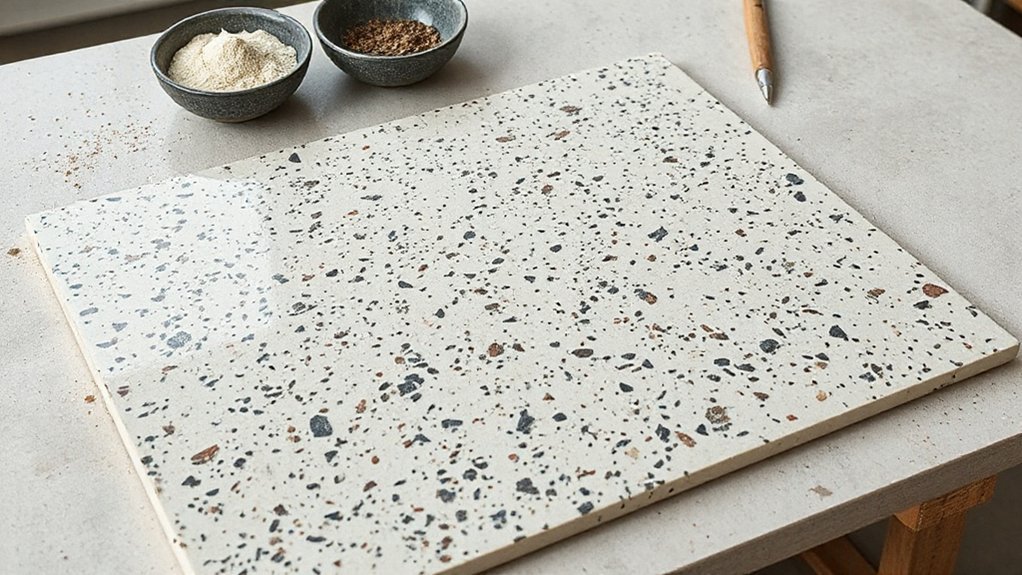
With installation and polishing mapped out, you can now specify the terrazzo ingredients that will actually perform under your project’s footfall, cleaning regime, and aesthetic brief. Start with binder choice: cementitious suits heritage looks and breathability, while epoxy gives tighter tolerances, richer colour, and faster curing—better for UK fit-out programmes. Match aggregate size to slip risk and visual scale; smaller chips read calmer in compact flats, larger fragments suit lobbies. Select marble, granite, or recycled glass to hit hardness, reflectance, and cost targets, and ask suppliers for EPDs to compare Eco friendly options. Specify pigment stability under UV in atriums. For maintenance tips, choose a denser mix, request stain-resistant sealer, and design discreet expansion joints for longevity.
Frequently Asked Questions
How Long Does Terrazzo Flooring Typically Last With Proper Maintenance?
With proper maintenance, you can expect terrazzo to last 75–100+ years. Specify competent terrazzo installation, reseal on schedule, and control grit. You’ll preserve its design finish while enjoying environmental benefits through long lifecycle performance.
Is Terrazzo Flooring Slippery When Wet, and How Can It Be Improved?
Yes, it can feel slippery when wet—like a rainy London pavement underfoot. You’ll boost slip resistance by specifying matte sealers, micro-etching, anti-slip aggregates, and other surface treatments, plus effective drainage and entrance matting.
Can Terrazzo Be Repaired if It Cracks, Chips, or Stains Over Time?
Yes, you can repair terrazzo cracks, chips, and stains over time. You’ll use Repair techniques like epoxy fill, colour-matched resin, grinding, and re-polishing. With planned Terrazzo maintenance, you’ll restore performance and appearance across UK projects.
How Does Terrazzo Compare in Cost to Tile, Concrete, or Natural Stone?
You’ll usually pay more for terrazzo than ceramic tile or basic concrete, but similar to premium natural stone in the UK. You’re buying eco friendly materials, long service life, low maintenance, and design versatility.
Is Terrazzo a Good Choice for Radiant Floor Heating Systems?
Yes—you’ll find terrazzo suits radiant heating well; like a London Underground platform, it shifts warmth fast thanks to thermal conductivity. Mind installation considerations: screed thickness, expansion joints, curing time. You’ll get sleek, even heat.
Conclusion
You’ve seen terrazzo isn’t one recipe—it’s a toolkit. You choose a cement or epoxy binder as the backbone, then set marble, granite, quartz, or glass aggregates like constellations in a night sky. Particle size steers the pattern; polishing, honing, or matte finishing tunes the sheen. Sealers act as your raincoat—penetrating for subtle defence, topical for extra armour. Specify well, install precisely, and you’ll get a hard-wearing UK floor that looks bespoke.